
- Catalogs
- Argus Controls
- AUTOMATED FERTIGATION

AUTOMATED FERTIGATION

AUTOMATED FERTIGATION
Fertigation is a method of delivering nutrients and water to crops to enhance yield and quality. Automated systems aid in efficient water and nutrient use, reducing disease and environmental impact.
Fertigation Methods
Dilute Tank Control: Fertilizers are premixed and stored until use, offering simplicity and accuracy. However, it requires large storage tanks and is less flexible for large operations.
In-Line Injection: More popular due to flexibility, it injects concentrated solutions into the water stream during irrigation. It allows for rapid adjustments in nutrient concentration but may face blending issues at low flow rates.
Automated Fertigation Systems
These systems can integrate nutrient dosing with irrigation scheduling, offering centralized control and monitoring. They adapt to facility designs and include features like tank level monitoring, EC and pH tracking, and nutrient dosing equipment.
Considerations for System Selection
Choose a dilute tank system for single feed solutions with stable composition. Opt for in-line injection when multiple nutrient formulations or variable feeding strengths are needed.
Key Features of Argus Systems
Argus systems support multiple recipes, precise dosing, and integration with environmental controls. They offer advanced capabilities for nutrient management and are easy to install and operate.
Conclusion
Automated fertigation systems enhance crop management by integrating nutrient and irrigation controls, offering flexibility and precision in nutrient delivery.
Catalog excerpts

AUTOMATED FERTIGATION Choosing the right system Fertigation is the process of delivering plants nutrients and water to produce a quality crop with higher yields. Employing an automated fertigation system can help growers make informed decisions that can significantly impact water and nutrient usage as well as contribute to reducing disease. An automated fertigation system can be integrated with the facility’s environmental control system The methodology behind the technology is pretty straightforward. Sensors measure the moisture in the soil, if it gets too dry, the crop is automatically irrigated. Timely irrigation decisions translate into better nutrient management results. Most notable, the reduction of fertilizer leaching can lead to direct fertilizer savings as well as minimize the environmental footprint of runoff from herbicide, fungicide, and systematic pesticide applications. Also, for growers using controlled release fertilizers, there is great potential to monitor EC and determine how temperature and other environmental factors impact release rate (Burnett et al., 2014). As environmental regulations continue to get more strict, and consumer concern over the use of agrochemicals increase, adopting this type of technology allows growers to evolve their standard practices and benefit from the improved crop outcomes. Despite these positive features, dilute tanks are not as popular as in-line injection systems, particularly for larger operations. Large, costly storage tanks are required and each combination of fertilizer formulation and concentration requires its own tank. It is generally only practical to adjust the fertilizer strength and formulation when refilling a tank from empty. A re-pressurizing irrigation pump is also required to deliver the dilute solution to the irrigation system. There are two common ways to supply fertilizers through an irrigation system for plant production: dilute tank control and in-line injection. IRRIGATION PUMP OVERFLOW LEVEL NUTRIENT NUTRIENT ACID OVERFLOW ALARM SOL. VALVE FLOW METER & EC PROBE OPTIONAL FILTER (COARSE) RETURN CAPACITY FILL DILUTE TANK CONTROL: Batch Method Using the dilute tank control method, fertilizers are premixed at the final feed strength concentration for the crop and stored in a tank or reservoir until used. This method is the simplest, safest and potentially most accurate way to achieve the final dilution strength. Dilute tank batches can be prepared by hand or the process can be fully automated. Since the mixing process is completely separate from distribution, the dilute solution can be removed from the tank at practically any flow rate without ever affecting the concentration accuracy. Additionally, the volume of ready-made feed solution acts as a safety reserve in case of problems with chemical or water supply. RETURN RESERVE CAPACITY LOW ALARM Dilute Tank Control dosing system IN-LINE INJECTION: Continuous Methods In-line injection equipment can range from simple mechanical injectors driven by water flow to fully automated nutrient control systems. Pressurized in-line systems preserve the ...cont’d on next p
Open the catalog to page 1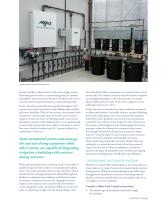
Single-element nutrient dosing system pressure and flow characteristics of the water supply system, eliminating the need for a re-pressurizing pump. In contrast, atmospheric injection systems blend the fertilizer and water in a non-pressurized tank and require a re-pressurizing pump. In-line injection is generally more popular than dilute tank systems since it does not require large holding tanks and they offer more flexibility. With in-line systems, concentrated stock solutions are continuously injected into the water stream as irrigation events are underway. Mixing usually occurs in the downstream...
Open the catalog to page 2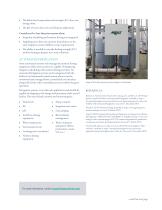
• The dilute feed composition and strength (EC) does not change often. • The pH of water does not need frequent adjustment. Consider an In-Line Injection system when: • Irrigation scheduling and nutrient dosing are integrated. • Supplying more than one nutrient formulation on the same irrigation system (different crop requirements). • The ability is needed to vary the feeding strength (EC) without having to prepare new stock solutions. AUTOMATED FERTIGATION Some automated systems only manage the nutrient dosing equipment while other systems are capable of integrating irrigation scheduling with...
Open the catalog to page 3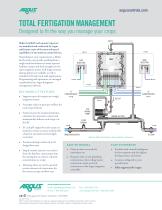
TOTAL FERTIGATION MANAGEMENT Designed to fit the way you manage your crops INLET Multi-Feed RM (rack mount) injectors are manufactured exclusively by Argus and feature some of the most advanced capabilities of any nutrient control device. Depending on your requirements, a MultiFeed system can provide anything from a single-tank formulation to many separate fertilizer recipes and feed strengths on the same irrigation system. Full single-element dosing options are available as well as standard A/B style stock tank applications. Programming and operations are managed seamlessly by the Argus fertigation...
Open the catalog to page 4All Argus Controls catalogs and technical brochures
 TITAN 900
4 Pages
 Multi-feed RM
3 Pages
