
- Catalogs
- Berg Hortimotive
- Empas spraying booms


- Products
- Catalogs
- News & Trends
- Exhibitions
Empas spraying booms

Empas spraying booms
Empas spraying booms utilize two types of nozzles: position nozzles with diaphragm valves and façade nozzles with self-closing filters. Both types serve the same purpose of opening and closing at 0.7 bar to prevent leakage.
Filters located behind the nozzles require cleaning approximately every 10 hours, depending on contamination levels. This involves rinsing them under tap water. The pressure filter should be cleaned after each use.
Nozzles should be checked before each spray application to ensure the spray pattern remains correct. If the pattern is poor, it can be corrected by cleaning the nozzles with water and a toothbrush.
During normal spray applications, the tramline is followed without spraying initially, and spraying occurs on the return path. Nozzles are positioned to spray alternately, with tips rotated 15 degrees to lift leaves from the bottom first, preventing interference with the spray pattern.
For spraying masts longer than 18 nozzles, an air bleed valve is used to release trapped air. For shorter booms, the uppermost tip can be opened to bleed air.
Catalog excerpts
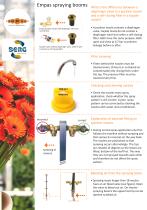
Empas spraying booms Empas position nozzle with diaphragm valve and normal filter. Façade nozzle without diaphragm valve, which is why it contains a self-closing filter. What is the difference between a diaphragm valve in a position nozzle and a self-closing filter in a façade nozzle? • A position nozzle contains a diaphragm valve. Façade masts do not contain a diaphragm valve but rather a self-closing filter. Both have the same purpose: Both open and close at 0.7 bar to prevent leakage before or after. Filter cleaning • Filters behind the nozzles must be cleaned every 10 hours or so (based on contamination) by rinsing them under the tap. The pressure filter must be cleaned every time. Checking and cleaning nozzles • Check the nozzles every spray application; check whether the spray pattern is still correct. A poor spray pattern can be corrected by cleaning the nozzles with water and a toothbrush. Explanation of bayonet fitting on position nozzles • During normal spray application one first follows the tramline without spraying and then sprays (in reverse) on the way back. The nozzles are positioned so that spraying occurs alternatingly. The tips are rotated 15 degrees so the leaves are lifted, bottom of the leaf first. This way they are not sprayed towards each other and therefore do not affect the spray pattern. Bleeding air from the spraying boom • Spraying masts longer than 18 nozzles have an air bleed valve (see figure). Open the valve to bleed out air. On shorter spraying booms the uppermost tip can be opened to
Open the catalog to page 1All Berg Hortimotive catalogs and technical brochures
 MetoSWT spray trolley
2 Pages
 Pipe rail trolley BRW150
2 Pages
 Betrac electric tow tractor
2 Pages
 Benomic S-Line
2 Pages
 AGV Automatic Guided Vehicle
2 Pages


- Agriculture software
- Harvest trolley
- Transport cart
- Self-propelled harvest trolley
- Data management software
- Adjustable-height harvest trolley
- Greenhouse transport cart
- Greenhouse harvest trolley
- Electric harvest trolley
- Metal transport cart
- Platform transport cart
- Planning software
- Crop car harvest trolley
- Plant software
- Motorized transport cart
- Electric transport cart
- Spray robot
- Small farm spray robot
- Greenhouse software
- Horticulture spray robot