
- Catalogs
- BEWITAL agri GmbH & Co. KG
- CALF REARING


- Products
- Catalogs
- News & Trends
- Exhibitions
CALF REARING
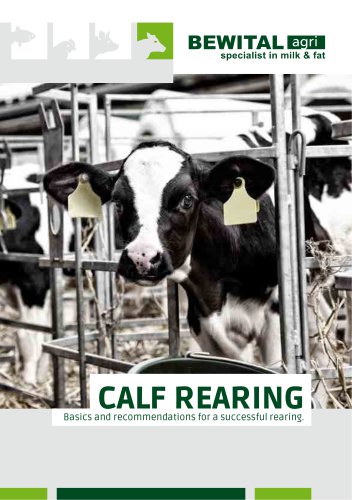
CALF REARING
Successful dairy farming hinges on high milk yields and the longevity of dairy cows, starting with the health and development of calves. Key to this is proper calf rearing, which involves colostrum supply and optimal feeding to ensure weight gain, organ development, and immunity.
Main Factors Influencing Calves
External factors such as pathogens, temperature, and moisture significantly impact calves. Immediate colostrum supply is crucial for immunity, as delays reduce IgG concentration, increasing disease susceptibility. Whole milk lacks sufficient iron, necessitating supplementation. Cold temperatures require increased energy intake through milk replacers. Early nutrition impacts lifelong performance, emphasizing the need for adequate energy and protein. High weight gains are essential for future milk yields, with a recommended feeding period of ten weeks.
Animal Health Begins in the Gut
Early gut health is vital, supported by systems like the BEWITAL-Vitality-System.
BEWI-MILK® Assortment
This includes special calf milk replacers with or without skimmed milk powder to support growth and health.
Challenges and Problems
Healthy calves are crucial for continuous growth, as illness during rearing affects future productivity.
BEWI-SAN Solutions
These focus on crucial early life stages, ensuring safe rearing and addressing issues like diarrhoea and growth stabilization.
Annex
Guidelines on optimal rearing intensity and milk feeding schedules are provided.
BEWITAL-Vitality-System (BVS 2.0)
This system includes sweeteners, organic acids, special fat formulations, probiotics, and prebiotics to enhance feed acceptance, regulate intestinal pH, and promote healthy intestinal flora, supporting nutrient absorption and digestion.
Calf Feeding Concepts
Feeding strategies using BEWI-SAN and BEWI-MILK® products promote intestinal health from birth, optimizing growth and supporting the immune system with specific formulations for different rearing phases.
Milk Replacer Products
Products like BEWI-MILK® Protect, AM 9, and AM 5 are tailored for different growth stages and nutritional needs, optimized for high protein content and digestibility.
Challenges in Calf Rearing
Challenges include seasonal temperature variations affecting calf health and growth, emphasizing the importance of maintaining high nutrition levels and managing health issues.
BEWI-SAN Solutions
These products address common calf rearing problems, such as diarrhoea and nutritional deficiencies, aiming to stabilize digestion, support immune function, and enhance the nutritional value of whole milk.
Conclusion
Recommendations include supplementing whole milk to meet calves' nutritional needs and prevent health issues related to electrolyte imbalances and high temperatures.
Electrolyte and Fluid Management for Calves
Calves require additional electrolyte drinks, especially during stress or diarrhoea. BEWI-SAN Bewilyt provides electrolytes, vitamins, and energy to support immune systems and fluid balance. It is recommended at 50 g/L of water at 30°C, freely available during stress phases, and as an interim drink during diarrhoea.
Diarrhoea Management
Diarrhoea leads to significant fluid and electrolyte loss. Immediate intervention with BEWI-SAN Diätmix is crucial, providing electrolytes, vitamins, and energy. For mild cases, 50 g per litre of drink is advised, while severe cases require 75-90 g per litre.
Growth Stabilization
Stress can hinder growth. BEWI-SAN Pulmo supports immune function and growth during stress, mixed at 10 g per animal per day into milk feed.
Early Feeding Encouragement
BEWI-SAN Start Flakes transition calves from milk to solid feed, promoting rumen development and health with digestible fibres and appetising substances.
Milk Feeding Concentration
Proper milk replacer concentration is crucial for digestion and growth, with recommended concentrations ranging from 125 g to 160 g per litre of water.
Rearing Intensity and Growth Targets
Calves should achieve specific weight gains for optimal growth and timely calving, with guidelines provided for daily weight gain and feeding plans.
Catalog excerpts
CALF REARING Basics and recommendations for a successful rearing.
Open the catalog to page 1
Introduction Economically successful dairy farms attach great importance to high milk yields and a long productive life for dairy cows. To achieve this, the health and development of the calf during the feeding phase is very important. The rearing of the future dairy cow starts with the colostrum supply of the newborn calf and continues with optimal feeding in the drinking phase. Well-fed calves not only show high daily weight gains during the first weeks of life, but also optimal organ development, a healthy gut microbiome and good immunity. Optimum rearing lays the foundation for the performance...
Open the catalog to page 2
1.6 High weight gains as a calf are the basis for high milk yields as a cow .. 16 2. Animal health begins in the gut 5. bewi-SAN - solutions for successful calf rearing
Open the catalog to page 3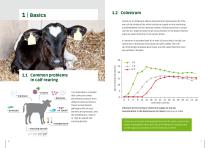
Fischer et al. 2018 were able to demonstrate impressively the influence of the timing of the initial colostrum supply on the imprinting and development of the immune system. Prompt provision of colostrum led to a rapid increase in IgG concentration in the blood, thereby inducing rapid immunity in the calves‘ blood. If colostrum is provided later (6 or even 12 hours later), the IgG concentration in the blood rises slowly and with a delay. The critical immunological phase lasts longer and the calves become more susceptible to disease. 1.1 C ommon problems in calf rearing It is important to consider...
Open the catalog to page 4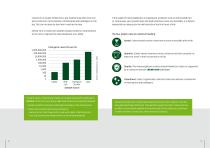
Colostrum is usually milked into a jug. Studies show that even very If the supply of immunoglobulins is inadequate, problems such as immunodeficien- good colostrum can be heavily contaminated with pathogens in the cy, total losses, poor growth rates and high treatment costs are inevitable. It is almost jug. This can increase by the time it reaches the teat. impossible to make up for the deficiencies of the first hours of life! Almost 70 % of colostrum samples showed coliform contamination The four golden rules of colostrum feeding: by the time it reached the teat (Boelhauve et al. 2018). Speed:...
Open the catalog to page 5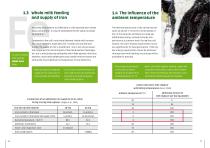
In case of whole milk feeding: 1.3 Whole milk feeding and supply of iron According to Bostedt et al. (1990) 18.8 % of all naturally born calves show a lack of iron. In case of extended birth this value increases up to 42.2 %. Compared to the calf's nutritional demand, whole milk contains less trace elements, especially iron. If calves are only fed whole milk, the supply of iron is insufficient. Iron is not only an essential component for the formation of the blood element haemoglobin, but is also producing antibodies which fight against infections. Anaemia, lower daily weight gains and a weak...
Open the catalog to page 6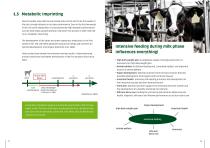
1.5 M etabolic imprinting Recent studies show that the nutritional status of the calf in the first weeks of life has a strong influence on its later performance. Even in the first few weeks of life, the calf‘s metabolism is characterised by high metabolic performance such as feed intake, growth and later milk yield. This process is often referred to as ‚metabolic imprinting‘. The development of the udder and other organs also takes place in the first weeks of life. The calf needs adequate amounts of energy and nutrients for optimal development of all organs (Hammon et al. 2020). Many studies...
Open the catalog to page 7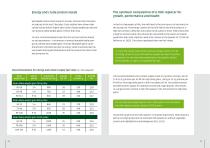
Worldwide interest and research in early calf nutrition has been increasing in the last 2 decades. Early studies have shown that calves fed ad libitum ingest about 20% of body weight per day and can achieve daily weight gains of more than 1 kg. Current recommendations take this into account and are based on two parameters - the amount of energy (metabolisable energy) to achieve body weight gain ("energy-allowable gains”) and -the amount of protein (protein to energy ratio) to achieve lean tissue growth and organ development and to prevent the calves from becoming too fat. In the first few weeks...
Open the catalog to page 8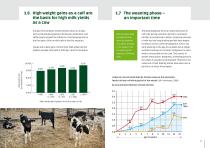
Not all calves take up solid feed as early as possible. It is often necessary to support this by reducing the amount of offered milk. A longer-term analysis of 2252 female calves on a dairy farm in Mecklenburg-Western Pomerania (Volkmann et al. 2019) clearly showed the influence of calf development in the first year of life on milk yield in the first lactation. Calves with a daily gain of more than 1000 g/day had the highest average milk yield of 9700 kg in the first lactation. The weaning phase forms an important point in calf's life during transition period to ruminants and has to be planned...
Open the catalog to page 9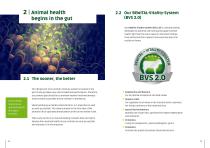
2.2 Our BEWITAL-Vitality-System (BVS 2.0) Our BEWITAL-Vitality-System (BVS 2.0) is constantly being developed to optimise calf rearing and support animal health right from the start, based on the latest findings from animal nutrition research and extensive practical 2.1 The sooner, the better 70 to 80 percent of an animal’s immune system is located in the gut? So the gut plays a key role in health and performance. Therefore, our primary goal should be to promote healthy intestinal developOnly a healthy intestine can optimally absorb and digest nutrients. ment as early as possible and to maintain...
Open the catalog to page 10
2.3 O ur calf concept to promote intestinal health Intestinal health is a crucial factor for well-being and performance. The intestines of newborn calves are still developing and are therefore more susceptible to disorders. It is important to support the intestinal health of the calf as best as possible from the beginning. Adapted feeding is of great importance in this context. ANIMAL HEALTH BEGINS IN THE GUT With our BEWI-SAN products you can positively influence the intestinal microbiome and the intestinal barrier from the first day of life. For this purpose, we recommend a high-quality calf...
Open the catalog to page 11
We are offering our milk replacer assortment BEWI-MILK® to supply calves optimally in the first weeks of life and to reach their full growth potential. It is based on latest scientific knowledge and actual feeding instructions. Following aspects feature our range: • Adjusted to different practical requirements we offer suitable products for every feeding situation. • Problem free feed intake (important for young calves). 3.1 Special calf milk replacer with skimmed milk powder BEWI-MILK® Protect Maximum safety and growth Intensive rearing in the first weeks of life is only possible with a healthy...
Open the catalog to page 12All BEWITAL agri GmbH & Co. KG catalogs and technical brochures
 Aquaculture
7 Pages
 DAIRY COW FEEDING
27 Pages
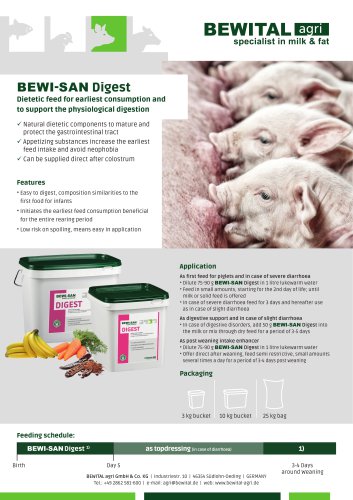 BEWI-SAN Digest
1 Page
 PIGLET REARING
27 Pages
- Supplementary feed
- Animal supplementary feed
- Dry nutritional supplement
- Mineral supplementary feed
- Cattle supplementary feed
- Vitamin supplementary feed
- Digestion supplementary feed
- Feed supplement for the immune system
- Poultry supplementary feed
- Deficiency corrector feed supplement
- Protein supplementary feed
- Feed additive
- Pig supplementary feed
- Powder feed supplement
- Reproduction supplementary feed
- Amino acid feed supplement
- Dry feed additive
- Metabolism supplementary feed
- Fat feed supplement
- Poultry feed additive