
- Catalogs
- BEWITAL agri GmbH & Co. KG
- DAIRY COW FEEDING


- Products
- Catalogs
- News & Trends
- Exhibitions
DAIRY COW FEEDING
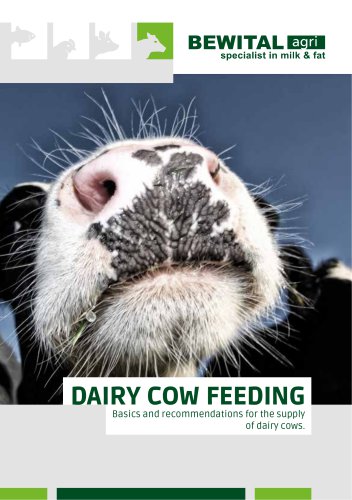
DAIRY COW FEEDING
Dairy farmers strive for cows that are healthy, long-lived, and productive. Balancing health, performance, and efficient feeding is challenging, especially with increased milk yields requiring higher energy supply during early lactation to prevent health and fertility issues. Lifetime efficiency, measured as kg milk per day of life, is crucial for economic success.
1. Basics
1.1 Development of Milk Yield
Milk yield has increased significantly due to breeding, creating challenges in meeting energy and ration requirements.
1.2 Rumen Health
High energy density in rations is necessary, but excessive concentrates can lead to rumen acidosis.
1.3 Gut Health
A healthy gut is vital for health and performance, preventing endotoxins from affecting metabolism.
1.5 Principles of Energy Supply
High-density rations are essential for high-performance cows, with fats being crucial due to their energy density.
1.6 Energy Metabolism and Health
Early lactation is critical; energy deficits can lead to body mass loss and metabolic issues affecting fertility and immunity.
2. Vegetable Oils and Their Processing
2.1 Refining
Refining removes unwanted substances from oils, producing triglycerides and free fatty acids.
2.2 Stability of Fats in the Rumen
Rumen-stable fats are essential for high milk yield and fertility, as they do not disrupt rumen microbes.
2.3 Biohydrogenation
Unsaturated fatty acids are converted to saturated ones in the rumen, ensuring cows absorb mainly saturated fats.
2.4 Saponification
Saponification produces rumen-stable fats but is less reliable under acidic conditions.
2.5 Fractionation and Hydrogenation
These processes increase saturated fatty acids, enhancing rumen stability and palatability.
3. Solutions for Dairy Cow's Different Metabolic Situations
Addressing glucose and energy deficits during critical periods is essential for maintaining cow health and productivity.
4. Production Processes and Product Lines of Fat Powders
Details on the production of rumen-stable fat powders and product lines are provided.
5. Annex
Includes dairy cow ration requirements during early lactation and fatty acid compositions of vegetable oils.
- CLA optimizes energy balance, increases milk yield, and improves fertility.
- Rumen-stable fat enhances energy concentration without affecting rumen function.
- Energy content is 24.5 MJ NEL/kg.
- Application: Add 200 g BEWI-FATRIX® CLA per cow daily from 14 days before to 30 days after birth, or 100 g daily from 14 days before to 80 days after birth.
- Supports high energy supply and metabolic efficiency with rapeseed lecithin, vitamins E and C, and willow bark.
- Application: Use 100 g per cow daily in the first third of lactation or when increased requirements are present.
- Reduces risks of milk fever and urinary stone formation with ammonium chloride.
- Application: Use max. 20 g per kg dry matter feed after DCAB calculation.
- Comparison of Ca-soaps, fractionated fats, and hydrogenated fats shows differences in fat content, digestibility, and rumen stability.
- Total mixed ration (TMR) requirements include specific energy, starch, sugar, and fiber content.
- Different oils have varying fatty acid compositions affecting melting points and metabolic functions.
- Unsaturated fatty acids support metabolism but are sensitive to storage conditions.
Catalog excerpts
BEWITAL EE3D specialist in milk & fat Basics and recommendations for the supply
Open the catalog to page 1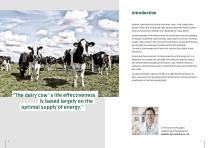
Introduction Healthy, long-lived and productive dairy cows - that‘s what dairy farmers want. But finding the right balance between health, performance and efficient feeding is a challenge for many farms. Increasing daily milk yields across the entire dairy herd are leading to sharply rising feed requirements, particularly in terms of energy supply. Particularly in the first third of lactation, energy deficiencies quickly lead to subsequent health and fertility problems. Currently, the average dairy farm only reaches just under three lactations. To improve the economics of milk production in the...
Open the catalog to page 2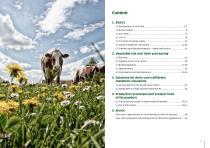
2. Vegetable oils and their processing 3. Solutions for dairy cow's different metabolic situations 4. Production processes and product lines of fat powders
Open the catalog to page 3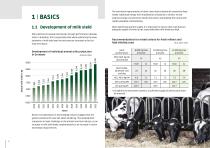
The nutritional requirements of dairy cows must primarily be covered by feed intake. Additional energy from mobilisation of body fat is limited. Increa- 1.1 Development of milk yield When optimising protein supply, it is important to ensure that cows have an adequate supply of amino acids, especially when milk yields are high. sing the energy concentration should not lead to overloading the rumen with rapidly available carbohydrates. Milk yield has increased enormously through performance development in breeding. This is especially clear when examining the developments of milk yield over the...
Open the catalog to page 4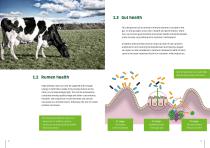
1.3 Gut health 70 to 80 percent of an animal‘s immune system is located in the gut. So the gut plays a key role in health and performance. Therefore, our primary goal should be to promote healthy intestinal development as early as possible and to maintain it afterwards. A healthy intestinal flora and an intact gut barrier also prevent endotoxins from entering the bloodstream and having a negative impact on the metabolism. Optimum metabolic health of dairy cows is the most important factor for economic milk production. Only a healthy gut can optimally absorb and process nutrients. 1.2 Rumen health...
Open the catalog to page 5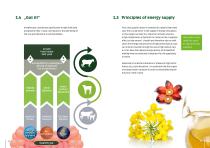
1.5 Principles of energy supply A healthy gut contributes significantly to high milk yield First class quality ration is essential for today’s high-yield and good fertility. It also contributes to the well-being of cow. The crucial factor is the supply of energy. Disruption the cow and therefore to animal welfare. in this supply can lead to a reduction of body reserves. Growth Feed intake Milk yield A high mobilization of body fat for instance has a negative High quality vege- effect on the animal´s health and therefore also on milk table fats serve yield. The energy requirements of high performance...
Open the catalog to page 6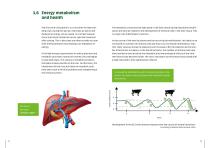
1.6 E nergy metabolism and health The first third of lactation is a critical time for high-yiel- The metabolic processes that take place in the fatty tissue during dissolution/mobili- ding cows. During this period, milk yield, as well as the sation are directly related to the development of immune cells in the fatty tissue. This demand on energy, are at a peak. In contrast however is a sign of an inflammatory reaction. the actual ration intake has not yet reached maximum after calving. This is why cows are often not able to cover In the course of the next lactations and the recurring fat mobilisation,...
Open the catalog to page 7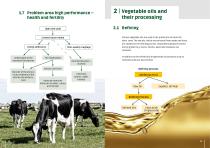
1.7 P roblem area high performance – health and fertility 2|V egetable oils and their processing High milk yield Various vegetable oils are used in the production of ration for Limited ration intake dairy cows. The raw oils, which are extracted from seeds and fruits, are cleaned in the refining process. Unwanted substances stored Energy deficiency Poor quality roughage during growth (e.g. toxins, dioxins, pesticide residues), are removed. Undersupply of the reproductive anatomy In addition to the refined oils (triglyceride), by-products such as Fat mobilisation Ruminal disorders – acidosis free...
Open the catalog to page 8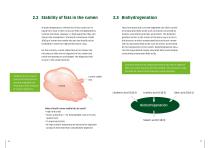
2.2 Stability of fats in the rumen At body temperature, refined oils in the rumen are in Fats from grass and corn and vegetable oils often consist liquid form. Due to their structure they are digestible by of unsaturated fatty acids such as linolenic acid (C18:3), ruminal microbes. However, in high quantities they can linoleic acid (C18:2) and oleic acid (C18:1). The biohydro- disrupt the metabolism. Therefore a maximum of 600- genation of fats in the rumen of the dairy cow is a micro- 1000 g of rumen non-stable oils per day should not be bial process in which unsaturated fatty acids are conver-...
Open the catalog to page 9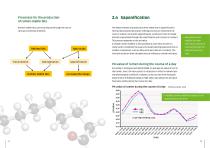
Processes for the production of rumen-stable fats Rumen-stable fats can be produced through the use of The oldest method of producing rumen-stable fats is saponification. various processing methods. Fatty acids produced during the refining process are mixed with calcium or sodium. During the saponification, protection from microbial attacks is generated through the esterification with calcium or sodium. Refined Oils Fatty Acids • Adequate rumen This process depends on the pH-value. A reliable rumen-stability is only possible at a pH-value of over 6.5. yield cows cannot be Under acidic conditions...
Open the catalog to page 10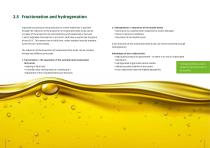
Hydrogenated fats are processed in the production of fat powders. Improved processing in the production of rumen-stable fats is possible through the reduction of the proportion of unsaturated fatty acids and an increase of the proportion of saturated fatty acids (especially C 16:0 and C 18:0). Vegetable oils based on C 16:0 and C 18:0 have a typical mel-ting point of over 50 °C. This means that in solid form, under standard outside temperatures they are rumen-stable. The reduction of the proportion of unsaturated fatty acids can be reached through two different processes: • Heating of liquid...
Open the catalog to page 11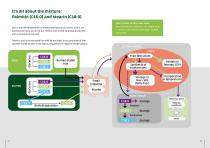
It‘s all about the mixture: Palmitin (C16:0) and stearin (C18:0) Many studies on dairy cows show: The combination of palmitic and stearic acid Due to the biohydrogenation of unsaturated fatty acids, stearic acid is the in rumen-stable fat has advantages for high predominant fatty acid in the gut. Stearic acid is used for energy production milk yields. and is not stored in the liver. Palmitic acid is incorporated into milk fat and leads to accumulation of liver fat when intake via feed is too high during periods of negative energy balance. BLOOD PLASMA LIVER Free fatty acids Rumen-stable fats...
Open the catalog to page 12All BEWITAL agri GmbH & Co. KG catalogs and technical brochures
 Aquaculture
7 Pages
 BEWI-SAN Digest
1 Page
 PIGLET REARING
27 Pages
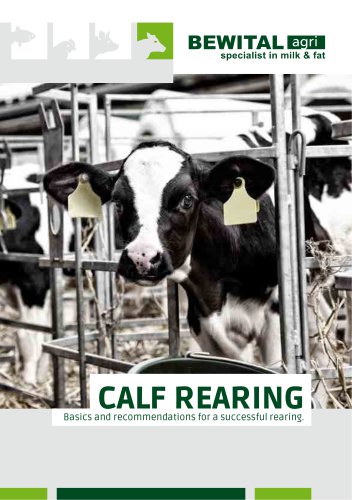 CALF REARING
27 Pages
- Supplementary feed
- Animal supplementary feed
- Dry nutritional supplement
- Mineral supplementary feed
- Cattle supplementary feed
- Vitamin supplementary feed
- Digestion supplementary feed
- Feed supplement for the immune system
- Poultry supplementary feed
- Deficiency corrector feed supplement
- Protein supplementary feed
- Feed additive
- Pig supplementary feed
- Powder feed supplement
- Reproduction supplementary feed
- Amino acid feed supplement
- Dry feed additive
- Metabolism supplementary feed
- Fat feed supplement
- Poultry feed additive