
- Catalogs
- Bucher Vaslin
- Bucher Inertys

Bucher Inertys

Bucher Inertys
Bucher Inertys, initially used for white and rosé wines, has expanded its application to red wines. This patented process involves pressing under inert gas with gas recycling, aiming to enhance the aromatic potential of fresh grapes and improve the value of press juices from fermented pomace.
Fermented Pomace Pressing
Press juices from racked, pressed pomace constitute 13-17% of total wine production. These juices are richer in phenolics compared to free-run juices, potentially enhancing the wine's phenolic profile. However, their vegetal and bitter characteristics can limit their use.
Benefits of Inerting
During pressing, contact with air leads to oxygen dissolution, with wines containing 2.0 to 7.5 mg/l of oxygen post-crumbling. The Bucher Inertys process significantly reduces dissolved oxygen, altering the organoleptic properties of the wines.
Pressing Under Neutral Gas
The process uses neutral gas (e.g., CO2, nitrogen) with gas recycling in a flexible reserve. This setup ensures efficient gas transfer without limiting flow rate.
Impact on Wine Characteristics
Experts from ISVV rated wines for vegetal and fresh fruit intensity. Inerting press juices, especially from P2 and P3, enhances fruitiness and reduces vegetal notes. Inerted press juices are integrated into high-quality wines, improving their aromatic profile.
Multi-purpose Use
The Bucher Inertys press is adaptable for aromatic white, rosé, and now red wines. It offers traditional and neutral gas pressing options, with fully automated presses available in various capacities.
Conclusion
The Bucher Inertys process provides significant benefits in enhancing wine quality by reducing oxidation and improving aromatic profiles, making it a valuable tool for winemakers.
Catalog excerpts
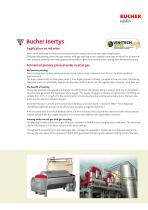
Bucher Inertys Application on red wine When so far dedicated to white and rosé wines, Bucher Inertys has found new ways of application. This patented pressing under inert gas process with gas recycling is now adapted to any type of wines first to reveal all their aromatic potential with fresh grapes and secondly to give value to press juices coming from fermented pomace. Fermented pomace pressed under neutral gas Red pomace pressing Wines coming from racked, pressed pomace named « press juices » represent from 13 to 17 % of the totality of produced wine. The main characteristic of those press juices is their higher phenolic richness compared to free-run juices; considering that press juices can potentially improve the phenolic profile of wines, yet the vegetal, bitter characters limit their use. The benefit of inerting During the pressing and especially during the crumbling phase, the pomace being in contact with the air contained in the press tank generates the dissolution of the oxygen. The supply of oxygen is massive and wines after crumbling can contain from 2.0 to 7.5 mg/l of it. The concentration is inversely proportional to the extracted volume, the last press juices are the richest in dissolved oxygen. Mr. Emile Peynaud – Lecturer at the University in Bordeaux and wine expert – noticed in 1984: « The mechanical crumbling enables the pomace to dry off but also provokes a negative oxidation ». A recent survey with the ISVV of Bordeaux (Vine and Wine Sciences Institute) confirms that the Bucher Inertys process reduces substantially the oxygen dissolved in the wines and modifies their organoleptic character. Pressing under neutral gas with gas recycling The pressing is made under neutral gas with gas recycling in a flexible reserve hanging next to the press. The volume of the flexible reserve is of an equal volume as the press capacity. Throughout the pressing cycle, the neutral gas (CO2, nitrogen for example) is transferred from the press tank to the reserve. The very nature of the reserve (in flexible PVC) guarantees the gas transfer without limiting instant flow
Open the catalog to page 1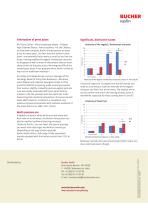
Valorisation of press juices Significant, distinctive tastes Free-run juices Intensity of the vegetal / herbaceous character (Source: A. Pons 2014) A board of experts of 15 people from the ISVV tasted and rated on a continuous scale the intensity of the vegetal character and fresh fruit of the wines. The analysis of the results confirm how much the inerting of press juices is worthwhile, especially for those coming from P2 and P3. Intensity of fresh fruit Average rating Multi-purpose use Adapted to aromatic white wines and rosé wines and from now on to red wines, the Bucher Inertys press can...
Open the catalog to page 2All Bucher Vaslin catalogs and technical brochures
 Bucher JLB 12 / 20
6 Pages
 Bucher JLB 5
2 Pages
 Delta Rflow XM
2 Pages
 Delta Vistalys HD
2 Pages
 Delta TRV 20 / 35
2 Pages
 Delta TBE 600 / 800 / 1000
2 Pages
 Delta PMV 1 / 2 / 4
2 Pages
 Delta DP
2 Pages
 Delta ELVTR 300 / 400
2 Pages
 Delta TRE 300
2 Pages
 Bucher XPro 5 / 8 / 15
2 Pages
 Bucher XPlus IT
6 Pages
 XPert IT
6 Pages


- Cart
- Agricultural trailer
- Dump cart
- Single-axle wagon
- Belt conveyor
- Mounted trailer
- Mobile conveyor
- Feed conveyor
- Trailer with mechanic braking
- Optical sorter
- Automatic sorting table
- Treatment system
- Harvesting trailer
- Water treatment system
- Fruit sorting machine
- Fruit conveyor
- Manual sorter
- Vibrating mesh sorter
- Sorting conveyor
- Mobile sorter