
- Catalogs
- Conduzioni Aziende FORTE
- ALFALFA PELLETS

ALFALFA PELLETS
1 / 1 PageView full catalog
ALFALFA PELLETS
Product catalog summary
Alfalfa Varieties and Nutritional Specifications
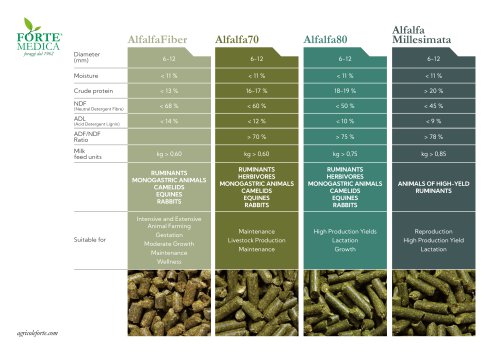
The document presents data on different alfalfa types: Millesimata, Alfalfa 80, Alfalfa 70, and Alfalfa Fiber, focusing on their nutritional content and suitability for various animal categories.
Nutritional Parameters
- Crude Protein Content: Ranges from >78% in Millesimata to >70% in Alfalfa Fiber.
- Neutral Detergent Fibre (NDF): Varies between >20% in Millesimata to 16-17% in Alfalfa Fiber.
- Moisture Content: Less than 11% across all types.
- ADF/NDF Ratio: Increases from <45% in Millesimata to <68% in Alfalfa Fiber.
- Acid Detergent Lignin (ADL): Ranges from <9% to <14% depending on the variety.
- Diameter (mm): Minimum values indicated: >0.85 mm for Millesimata, decreasing to >0.60 mm for Alfalfa Fiber.
Animal Suitability and Usage
The alfalfa types are categorized based on their suitability for different animal groups and production goals:
- High-Yield Ruminants: Millesimata and Alfalfa 80 are recommended for reproduction, high production yield, and lactation phases.
- Ruminants and Herbivores: Alfalfa 70 supports growth, maintenance, and livestock production.
- Monogastric Animals, Camelids, Equines, and Rabbits: Alfalfa Fiber is suitable for maintenance, wellness, and moderate growth.
Production and Farming Context
The alfalfa varieties are intended for use in both intensive and extensive animal farming systems, supporting various physiological stages such as gestation, lactation, growth, and maintenance.
Summary of Key Recommendations
- Choose alfalfa type based on animal species and production stage to optimize nutritional benefits.
- Monitor crude protein and fiber content to meet specific dietary requirements.
- Maintain moisture content below 11% to ensure feed quality.
- Consider fiber characteristics (NDF, ADF, ADL) for digestibility and animal health.
Source: agricoleforte.com
See more
Catalog excerpts
FORTE* MEDICA foraggi dal 1962
Open the catalog to page 1All Conduzioni Aziende FORTE catalogs and technical brochures
 Alfalfa wafer
1 Page
 ALFALFA BALES
1 Page
Related Searches
- Supplementary feed
- Animal supplementary feed
- Dry nutritional supplement
- Cattle supplementary feed
- Digestion supplementary feed
- Feed supplement for the immune system
- Protein supplementary feed
- Pig supplementary feed
- Sheep supplementary feed
- Goat supplementary feed
- Equine supplementary feed
- Granular feed supplement
- Fodder
- Animal feed fodder
- Cattle fodder
- Alfalfa fodder
- Equine fodder
*Prices are pre-tax. They exclude delivery charges and customs duties and do not include additional charges for installation or activation options. Prices are indicative only and may vary by country, with changes to the cost of raw materials and exchange rates.