
- Catalogs
- CPS Agri Limited – CROP PROTECTION SOLUTIONS.
- CPS INSTRUCTIONS FOR USING BALE NET

- Company
- Products
- Catalogs
- News & Trends
- Exhibitions
CPS INSTRUCTIONS FOR USING BALE NET
CPS INSTRUCTIONS FOR USING BALE NET
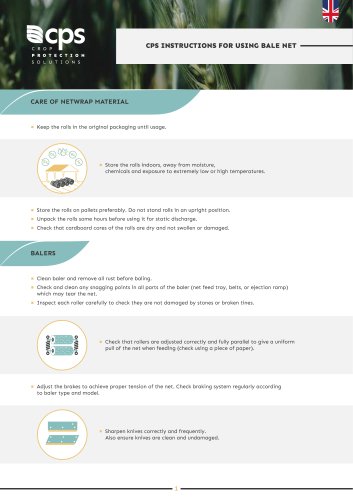
- Keep rolls in original packaging until use and store on pallets, not upright.
- Unpack rolls hours before use for static discharge and ensure cardboard cores are dry and undamaged.
- Store rolls indoors, away from moisture, chemicals, and extreme temperatures.
- Clean baler and remove rust before use; check for snagging points that may tear the net.
- Inspect rollers for damage and adjust brakes for proper net tension.
- Ensure rollers are parallel for uniform net pull and sharpen knives regularly.
- Feed crop evenly and ensure net is tight and cut clearly to avoid loose threads.
- Check tailgate, belts, and chamber rollers for damage and maintain machine as per instructions.
- Drive straight for uniform bale shape and eject bales immediately to avoid damage.
- Use specially designed nets for over-edge bales to prevent bursting.
Tables provide specific layer recommendations based on bale diameter and chamber width for different materials like silage, hay, straw, and corn stalks.
- Do not stack bales directly on the ground; use indoor covers for long-term storage.
- Store bales on well-drained locations with circular surfaces facing North-South for sunlight exposure.
- Ensure adequate airflow to prevent humidity and temperature increase.
- Add extra net layers for heavy-duty bales, long-term outdoor storage, or stony fields.
- Extreme conditions may require further increase in wraps.
Netwrap strength can be affected by sunlight and rain, especially in environments with high levels of iron, chlorine, or sulphur.
Catalog excerpts
CPS INSTRUCTIONS FOR USING BALE NET CARE OF NETWRAP MATERIAL Keep the rolls in the original packaging until usage. Store the rolls indoors, away from moisture, chemicals and exposure to extremely low or high temperatures. Store the rolls on pallets preferably. Do not stand rolls in an upright position. Unpack the rolls some hours before using it for static discharge. Check that cardboard cores of the rolls are dry and not swollen or damaged. Clean baler and remove all rust before baling. Check and clean any snagging points in all parts of the baler (net feed tray, belts, or ejection ramp) which may tear the net. Inspect each roller carefully to check they are not damaged by stones or broken tines. Check that rollers are adjusted correctly and fully parallel to give a uniform pull of the net when feeding (check using a piece of paper). Adjust the brakes to achieve proper tension of the net. Check braking system regularly according to baler type and model. Sharpen knives correctly and frequently. Also ensure knives are clea
Open the catalog to page 1
Check that the tailgate, belts and chamber rollers are not damaged. Comply with the machine maintenance instructions and check all relevant parts. MINIMUM RECOMMENDED LAYERS: ■ Feed crop evenly, from side to side. ■ Make sure net is tight on roll. The net should always be on the outside of the bale. When the netwrap starts feeding, use the brakes and stop moving, otherwise the bale continues being formed and part of the net will end up inside the crop. Drive in a straight line - do not zigzag. Bale shape should be uniform and flat across its surface. ■ Make sure the net is cut clearly, to avoid...
Open the catalog to page 2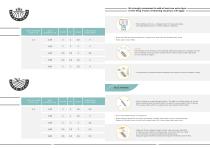
We strongly recommend to add at least one extra layer of Net Wrap if each of following situations will apply: - When baling a short cut - chopped straw, for heavy-duty bales, very high density bales or in severe weather conditions. When the bales are stored outside for a long term or when they are handled many times. When used in stony fields. NOTE: The strength of the netwrap can be adversely affected by exposure to sunlight and rain when combined with crop, soils or external environments which contain high levels or iron, chlorine or sulphur. A combination of several extreme conditions may...
Open the catalog to page 3All CPS Agri Limited – CROP PROTECTION SOLUTIONS. catalogs and technical brochures
 Catalog
19 Pages
 CPS product brochure
10 Pages
 CPS brochure
6 Pages