


AGRICULTURAL TYRES

AGRICULTURAL TYRES
The document provides technical data on Firestone agricultural tyres, emphasizing the brand's commitment to supporting farmers with reliable products and services. Firestone's history of innovation in agriculture is highlighted, along with their dedication to quality and customer service.
- Firestone offers a wide range of tyres tailored to different agricultural needs, ensuring optimal performance both in the field and on the road.
- The company maintains a strong logistics network across Europe, enabling quick delivery of products.
- Firestone provides a 5-year warranty on their tyres and offers technical support through a dedicated team and a mobile app for tyre specifications and pressure recommendations.
The document includes detailed specifications for various tyre models, categorized by type and application, such as radial and bias agricultural tyres, combine-harvester tyres, and industrial tyres. Each tyre's specifications include size, construction, speed-load index, and whether they are tubeless or tube type.
- Tyre loads and pressures are calculated according to European Tyre and Rim Technical Organisation guidelines.
- Users are advised not to exceed vehicle manufacturer recommendations or legal maximums for axle load or speed.
- Tyre pressure adjustments should only be made when tyres are cold.
The manual serves as a comprehensive guide to selecting and maintaining Firestone tyres, ensuring maximum safety and value. For further assistance, customers are encouraged to contact Firestone's Technical Service Division.
- R4000 and R8000: These models are suitable for low and high torque applications, with specific load and pressure values for different speeds.
- MAXI TRACTION HARVEST: Designed for combines and harvesters, offering excellent traction, self-cleaning, and long tire life due to its Dual Angle Lug design.
- PERFORMER Series: Includes PERFORMER 85, 90, and 95, designed for row crop equipment with high load capacity and outstanding on-road performance.
- Never reinflate a tyre that has been operated in a run-flat or underinflated condition (80% or less of recommended pressure) without demounting and inspecting all tyres and rim parts.
- Always use specialized tools for mounting and demounting tyres.
- Completely deflate tyres before loosening any nuts or clamps on a multipiece rim assembly.
- Do not use bent, pitted, cracked, or worn rim parts.
- Inspect inside of tyres for damage and repair if necessary.
- Use new tubes in new tyres and ensure compatibility with tyre size.
- Use only approved tyre mounting lubricants.
- Inflate tyres to manufacturer’s recommended pressure using a safety cage and extension hose.
Mounting Guidelines for Agricultural Tyres:
- Lubricate beads and rim before mounting.
- Use tyre iron or mounting machine to pry beads over rim flange.
- Inflate tyre to seat beads, not exceeding 35 psi.
- Ensure tyre is centered on rim before inflation.
Dismounting Guidelines:
- Deflate tyre completely before dismounting.
- Use a bead breaker to push bead off the wheel.
- Pry beads off the wheel in small increments.
Hydro-inflation Procedure for Fluid Ballast:
- Inflate tyre to 35 psi and position valve at the top.
- Fill tyre with fluid using a hydro-inflation pump, maintaining pressure between 5 and 20 psi.
- Maintain fluid level at 75% to cover the valve and submerge the rim.
- Set final operating pressure with tyre mounted on the tractor.
Key Data from Tables:
- The tables provide detailed specifications for tyre volumes and fluid fill levels for various tyre sizes, including the amount of water and calcium chloride required for hydro-inflation.
General Information:
- The document includes contact information for Bridgestone/Firestone offices across various countries.
- It emphasizes the importance of using trained personnel and proper equipment for tyre mounting and dismounting.
Catalog excerpts
You never farm alone TECHNICAL DATA FIRESTONE AGRICULTURAL TYRES 2022
Open the catalog to page 1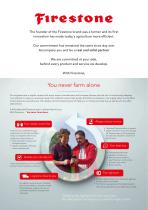
The founder of the Firestone brand was a farmer and its first innovation has made today's agriculture more efficient. Our commitment has remained the same since day one: Accompany you and be a real and solid partner We are committed at your side, behind every product and service we develop. With Firestone, You never farm alone Our engineers are in regular contact with major tractor manufacturers and European farmers with the aim of continuously adapting our products to meet your evolving needs. Our craftsmen ensure high quality standards in production. Our supply chain is committed to fast deliveries...
Open the catalog to page 2
This manual has been prepared to help you obtain the maximum safety and value from Firestone tyres. While not completely comprehensive, it provides useful definitions, advice on proper selection and care, and lists the detailed specifications of a wide range of patterns and sizes. We hope that you will get the very most out of our high quality products. Further information or advice on FS tyres can be obtained from the Technical Service Division of Firestone. Loads & pressures shown in the data tables are calculated in accordance to the European Tyre and Rim Technical Organisation guidelines...
Open the catalog to page 3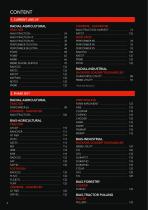
CONTENT 1. CURRENT LINE-UP COMBINE - HARVESTER * Restricted distribution FREE ROLLING BIAS-TRACTOR PULLING PULLER
Open the catalog to page 4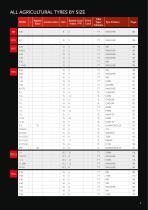
ALL AGRICULTURAL TYRES BY SIZE Width Aspect Construction Ratio Extra Load Tube Type/ Tyre Pattern Tubeless
Open the catalog to page 5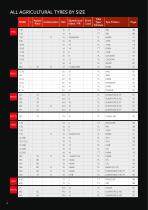
ALL AGRICULTURAL TYRES BY SIZE Width Extra Load Tube Type/ Tyre Pattern Tubeless Aspect Construction Ratio DURAFORCE UTILITY DURAFORCE UTILITY
Open the catalog to page 6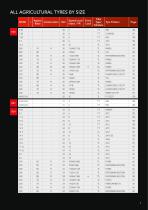
ALL AGRICULTURAL TYRES BY SIZE Width Aspect Construction Ratio Extra Load Tube Type/ Tyre Pattern Tubeless DURAFORCE UTILITY DURAFORCE UTILITY DURAFORCE UTILITY
Open the catalog to page 7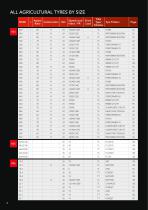
ALL AGRICULTURAL TYRES BY SIZE Width Aspect Construction Ratio Extra Load Tube Type/ Tyre Pattern Tubeless DURAFORCE UTILITY DURAFORCE UTILITY DURAFORCE UTILITY
Open the catalog to page 8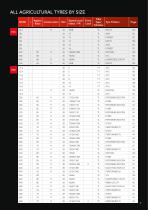
ALL AGRICULTURAL TYRES BY SIZE Width Aspect Construction Ratio Extra Load Tube Type/ Tyre Pattern Tubeless DURAFORCE UTILITY DURAFORCE UTILITY
Open the catalog to page 9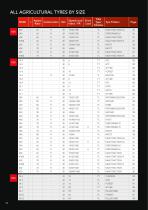
ALL AGRICULTURAL TYRES BY SIZE Width Aspect Construction Ratio Extra Load Tube Type/ Tyre Pattern Tubeless MAXI TRACTION MAXI TRACTION MAXI TRACTION MAXI TRACTION MAXI TRACTION MAXI TRACTION
Open the catalog to page 10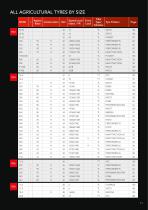
ALL AGRICULTURAL TYRES BY SIZE Width Aspect Construction Ratio Tube Type/ Tyre Pattern Tubeless MAXI TRACTION MAXI TRACTION MAXI TRACTION Extra Load MAXI TRACTION
Open the catalog to page 11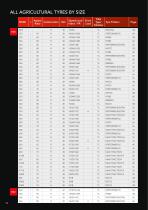
ALL AGRICULTURAL TYRES BY SIZE Width Aspect Construction Ratio Extra Load Tube Type/ Tyre Pattern Tubeless MAXI TRACTION MAXI TRACTION MAXI TRACTION
Open the catalog to page 12
ALL AGRICULTURAL TYRES BY SIZE Width Aspect Construction Ratio Extra Load Tube Type/ Tyre Pattern Tubeless MAXI TRACTION MAXI TRACTION
Open the catalog to page 13
GENERAL INFO SIZE MARKINGS Front Tyre Marking Radial (Standard) Tyre Marking load index at 50 km/h speed symbol for 40 km/h dash denotes crossply construction section width in inches rim diameter in inches “R” denotes radial construction section width in inches Implement Tyre Marking Radial (Metric) Tyre Marking (special rim diameter used in Europe) 520/70R38 dash denotes crossply construction “R” denotes radial construction aspect ratio section width in inches aspect ratio section width in mm Flotation Tyre Marking 66 x 43.00-25 10 PR ply rating nominal diameter of the rim in inches dash denotes...
Open the catalog to page 14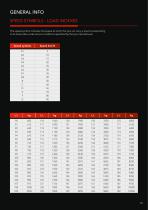
The speed symbol indicates the speed at which the tyre can carry a load corresponding to its load index under service conditions specified by the tyre manufacturer.
Open the catalog to page 15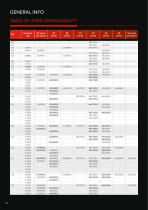
GENERAL INFO TABLE OF INTER-CHANGEABILITY SRI Standard size
Open the catalog to page 16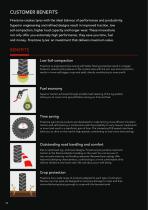
CUSTOMER BENEFITS Firestone creates tyres with the ideal balance of performance and productivity. Superior engineering and refined designs result in improved traction, low soil-compaction, higher load capacity and longer wear. These innovations not only offer you extremely high performance, they save you time, fuel and money. Firestone tyres: an investment that delivers maximum value. BENEFITS Low Soil-compaction Firestone re-engineered tyre-casing with better flexing-properties result in a bigger footprint, reducing the pressure in the contact-area with the soil. Low soil-compaction results...
Open the catalog to page 18
& TYRE DEVELOPMENT FEATURES Long life Optimised compounds and a unique tyre-construction in function of the task to be performed make Firestone tyres extremely durable so they last longer. Flatter and wider threads in combination with an optimised lug design lead to even pressure distribution on the road, resulting in a uniform wear and extended tyre-life. Firestone products keep on performing, even when half-worn out. FEATURES High load capacity Strong and well engineered tyre-casings make it possible to deal with the heaviest loads without compromising your operation-speed. A selected range...
Open the catalog to page 19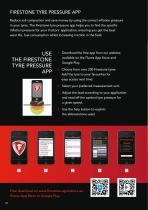
FIRESTONE TYRE PRESSURE APP Reduce soil compaction and save money by using the correct inflation pressure in your tyres, The Firestone tyre pressure app helps you to find the specific inflation pressure for your tractors’ application, ensuring you get the best wear life, fuel consumption whilst increasing traction in the field. USE THE FIRESTONE TYRE PRESSURE APP 1. Download the free app from our website; available on the iTunes App Store and Google Play. 2. Choose from over 200 Firestone tyres. Add the tyre to your favourites for easy access next time. 3. Select your preferred measurement unit....
Open the catalog to page 20
You never farm alone 1. CURRENT PRODUCT LINE-UP
Open the catalog to page 21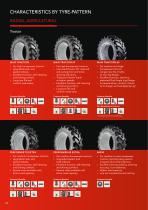
CHARACTERISTICS BY TYRE-PATTERN RADIAL AGRICULTURAL Tractor MAXI TRACTION » For high horsepower tractors. » Upgraded load- and speed indexes. » Excellent traction, self-cleaning and driving comfort. » Long tyre life and uniform tread wear. » For high horsepower tractors. » Improved Flexion (IF): reduced soil-compaction and more working efficiency. » Transport heavier loads at higher speeds. » Excellent traction, self-cleaning and driving comfort. » Long tyre life and uniform tread wear. » For medium and large horsepower tractors. » Longer tyre life, thanks to new lug design. » Excellent traction,...
Open the catalog to page 22All Firestone catalogs and technical brochures
 RADIAL AGRICULTURAL 2017
6 Pages
 Industrial
6 Pages
 Tractor
8 Pages
 Sprayer
6 Pages
 Combine
6 Pages
 Maxi Traction 65
2 Pages