- Catalogs
- FT WIND SENSORS
- FT723 & FT743-FF


- Products
- Catalogs
- News & Trends
- Exhibitions
FT723 & FT743-FF
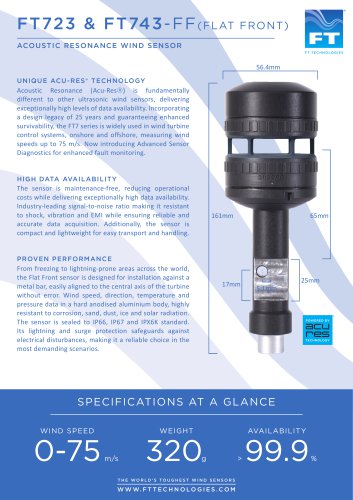
FT723 & FT743-FF
- Wind Speed: FT723 measures 0-50 m/s, FT743 measures 0-75 m/s with a resolution of 0.1 m/s and varying accuracy depending on speed range.
- Wind Direction: Full 360° range with 1° resolution and accuracy of 2° RMS within ±10° datum.
- Pressure Measurement: Range of 260 - 1260 hPa with 0.0001 hPa resolution and 0.5% RMEA accuracy.
- Temperature Range: Operating and storage from -40° to +85°C.
- Ingress Protection: Rated IP66, IP67, and IPX6K.
- Utilizes Acoustic Resonance technology for automatic compensation of temperature, pressure, and humidity variations.
- Compact and lightweight design with a hard-anodised aluminium body resistant to corrosion, sand, dust, ice, and solar radiation.
- Equipped with lightning and surge protection for reliability in extreme conditions.
- Supply voltage between 12V to 30V DC, with a nominal 24V DC.
- Heater power consumption is configurable, limited by default to 99W.
- RS485 interface with ASCII data format, supporting both polled and continuous output modes.
- Maximum data update rate of 10 measurements per second.
Catalog excerpts
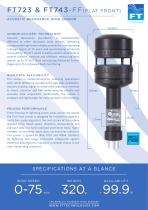
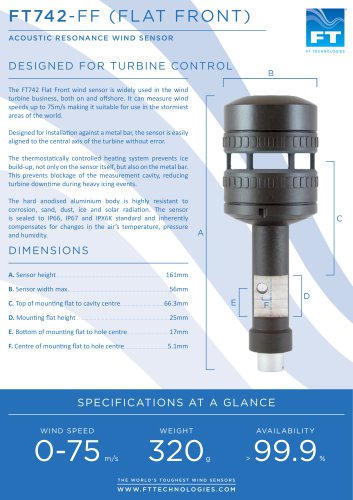
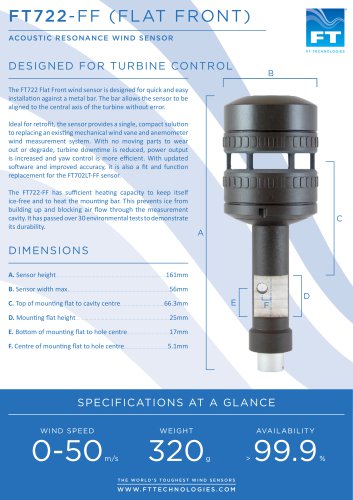
ACO UST I C R E S O N A N C E W IN D S ENSOR 56.4mm U NI Q U E AC U -RES® T ECHNOLOGY Acoustic Resonance (Acu-Res®) is fundamentally different to other ultrasonic wind sensors, delivering exceptionally high levels of data availability. Incorporating a design legacy of 25 years and guaranteeing enhanced survivability, the FT7 series is widely used in wind turbine control systems, onshore and offshore, measuring wind speeds up to 75 m/s. Now introducing Advanced Sensor Diagnostics for enhanced fault monitoring. H I GH DATA AVAILABILIT Y The sensor is maintenance-free, reducing operational costs while delivering exceptionally high data availability. Industry-leading signal-to-noise ratio making it resistant to shock, vibration and EMI while ensuring reliable and accurate data acquisition. Additionally, the sensor is compact and lightweight for easy transport and handling. From freezing to lightning-prone areas across the world, the Flat Front sensor is designed for installation against a metal bar, easily aligned to the central axis of the turbine without error. Wind speed, direction, temperature and pressure data in a hard anodised aluminium body, highly resistant to corrosion, sand, dust, ice and solar radiation. The sensor is sealed to IP66, IP67 and IPX6K standard. Its lightning and surge protection safeguards against electrical disturbances, making it a reliable choice in the most demanding scenarios. THE WORLD’S TOUGHEST WIND SENSORS
Open the catalog to page 1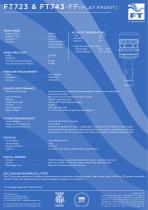
WIND SPEED ACOUSTIC TEMPERATURE WIND DIRECTION Accuracy (within ±10° datum). .. Accuracy (outside ±10° datum). Under the following conditions: PRESSURE MEASUREMENT SENSOR PERFORMANCE Temperature range. Acoustic Resonance (automatically compensates for variations in temperature, pressure & humidity) .Metres per second, kilometres per hour or knots .0° to 55°C. The heater set point can be configured. POWER REQUIREMENTS .Limited to 4A (default), 6A (max) - configurable in software in 0.1A increments. Heater power consumption will depend on the energy required to keep the sensor's temperature at...
Open the catalog to page 2All FT WIND SENSORS catalogs and technical brochures
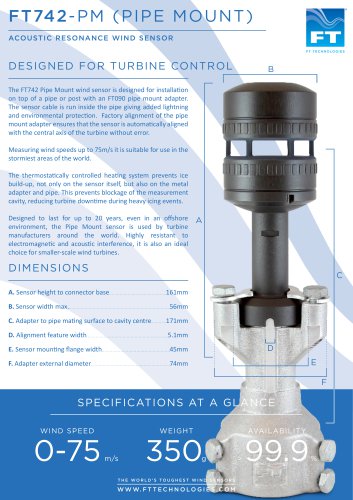 FT742-PM
2 Pages
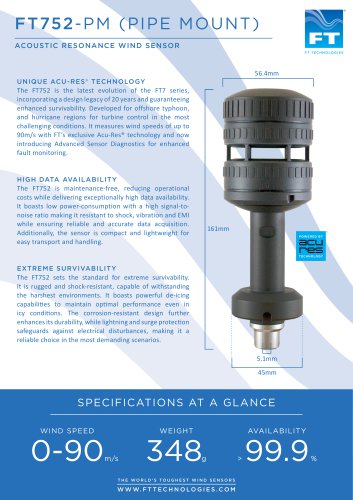 FT752-PM
2 Pages
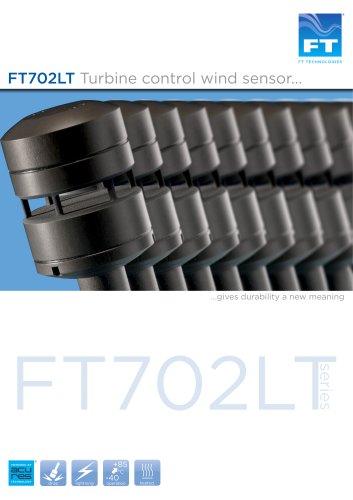 FT702LT
6 Pages
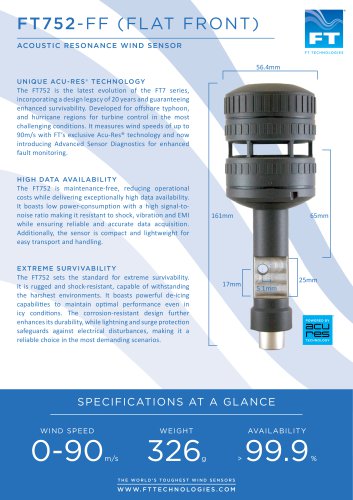 FT752-FF
2 Pages
 FT742-FF
2 Pages
 FT722-FF
2 Pages
 FT752-DM50
2 Pages
 FT722-DM50
2 Pages
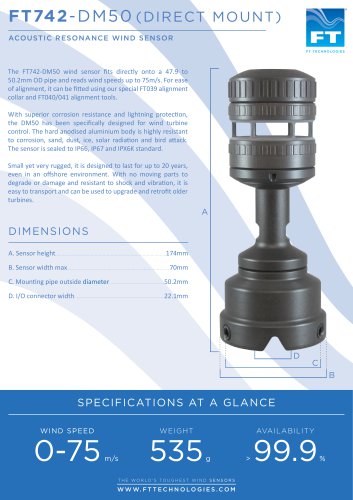 FT742-DM50
2 Pages
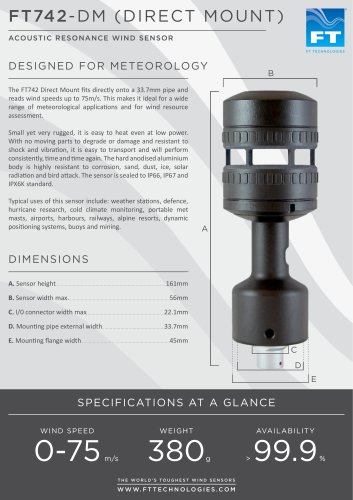 FT742-DM
2 Pages
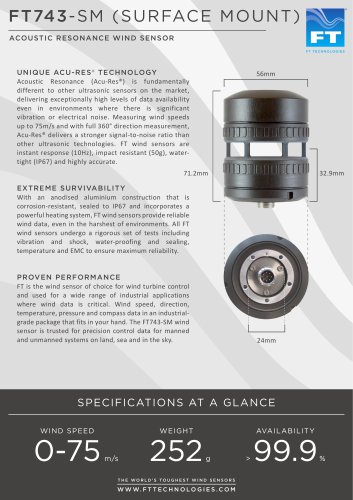 FT743-SM
2 Pages
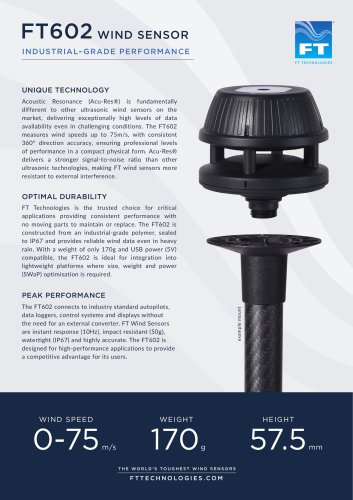 FT602
2 Pages