
- Catalogs
- Geonics Ltd.
- GEONICS Catalogue

GEONICS Catalogue
1 /12Pages
GEONICS Catalogue
1 /12Pages
Catalog excerpts
GEONICS LIMITED LEADERS IN ELECTROMAGNETICS GEOPHYSICAL INSTRUMENTATION FOR EXPLORATION & THE ENVIRONMENT GEONICS LIMITED 1745 Meyerside Drive, Unit 8 Mississauga, Ontario Canada L5T 1C6 Telephone: +1 (905) 670 9580 Telefax: +1 (905) 670 9204 E-mail: [email protected] Website: http://www.geonics.com
Open the catalog to page 1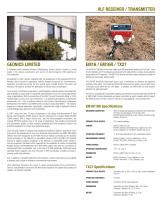
GEONICS LIMITED A Canadian-owned company, located in Mississauga, Ontario, Geonics Limited is a world leader in the design, manufacture and service of electromagnetic (EM) geophysical instrumentation. The EM16 VLF Receiver is the most widely used EM geophysical instrument of all time. Local tilt and ellipticity of VLF broadcasts are measured and resolved into in-phase and quadrature components of VLF response. The EM16 has discovered several base and precious metal ore bodies and many water-bearing faults. Incorporated in 1962, Geonics originated with the development of the patented EM16 VLF...
Open the catalog to page 2
BOREHOLE PROBES GAMMA39 NATURAL GAMMA The EM39 Borehole Induction Probe was designed, in part, for rapid, accurate assessment of groundwater contamination in the soil and rock material surrounding monitoring wells. Because clay materials can produce an electrical conductivity response similar to some groundwater contaminants, however, Geonics introduced the Gamma39 Natural Gamma Probe to resolve ambiguity in interpretation. For example: whereas a conductivity high with a coincident high gamma count often indicates the presence of clay materials, a conductivity high without an associated high...
Open the catalog to page 3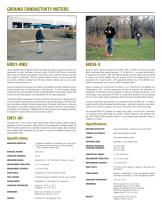
GROUND CONDUCTIVITY METERS Using a patented electromagnetic inductive technique that allows measurement without any requirement for either electrodes or ground contact, the EM31-MK2 Ground Conductivity Meter maps soil materials, groundwater contaminants or any subsurface feature associated with changes in conductivity. With this inductive method, surveys can be conducted over any surface conditions, including those with high-resistivity materials such as sand, gravel, asphalt, permafrost and sea-ice. Using the same inductive technique as the EM31-MK2, the EM34-3 Ground Conductivity Meter incorporates...
Open the catalog to page 4
DATA ACQUISITION SYSTEM The EM38-MK2 provides measurement of both the quad-phase (conductivity) and in-phase (magnetic susceptibility) components within two distinct depth ranges, all simultaneously, without any requirement for soil-to-instrument contact. With a maximum effective depth of exploration of 1.5 m, applications in agriculture, archaeology and general soil sciences are common. The DAS70-MESA2 Data Acquisition System is available as an option for any model of Ground Conductivity Meter with a digital output signal, and all models of EM61/-MK2 Metal Detectors; compatibility with first-generation...
Open the catalog to page 5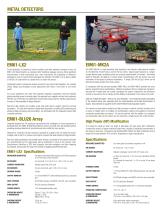
METAL DETECTORS For the detection of subsurface cluster munitions and other explosive remnants of war, the EM61-LX2 Metal Detector, as compared with traditional analogue sensors, offers significant improvements in both productivity and, more importantly, the probability of detection. Designed to meet or exceed critical standards for detection, the EM61-LX2 is able to detect a half BLU-26 submunition to a depth of 60 cm below the sensor. The EM61-MK2A is a high sensitivity, high resolution, time domain metal detector suitable for the detection of both ferrous and non-ferrous metal. Typical target...
Open the catalog to page 6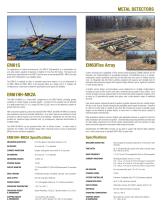
METAL DETECTORS EM61S For applications in marine environments, the EM61S (Submersible) is a submersible coil and cable system capable of operation to depths of more than 60 metres. The feature and performance specifications of the EM61S are the same as the standard EM61-MK2A; the high power (HP) modification is an available option. The EM61S is available as either a complete stand-alone system, or as an attachment to an EM61-MK2A (or EM61-MK2), to be operated either as a single unit or in multiple unit configurations; customized component specifications and layout are available. EM61HH-MK2A The EM61HH-MK2A...
Open the catalog to page 7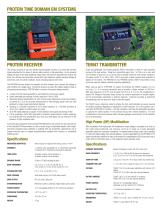
PROTEM TIME DOMAIN EM SYSTEMS PROTEM RECEIVER The primary purpose of any time domain electromagnetic receiver is to record the transient signal generated by the decay of induced eddy currents in the subsurface. As the received voltage will span a very large amplitude range, often more than six decades from early to late times, the receiver must accurately record both high amplitude, rapidly changing voltage at early times, and very small amplitude, slowly changing signal at late times. Small and lightweight, the battery-powered TEM47 transmitter is ideal for rapid resistivity surveys of the near...
Open the catalog to page 8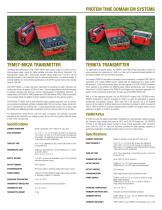
PROTEM TIME DOMAIN EM SYSTEMS The design and performance of the TEM57-MK2A, with a power output of 1,650 W from an internal power supply, makes it a highly portable, mid-power time domain transmitter. The internal power supply, with a continuously variable voltage range from 21 to 60 V, can be perfectly matched to the transmitter loop for optimum performance. A practical number of external batteries can increase these specifications to 4,500 W of power output, and a voltage range to 160 volts. For applications at greater depths, the TEM67A and TEM67APlus transmitters provide the power necessary...
Open the catalog to page 9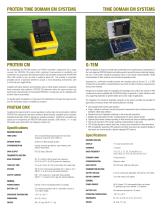
PROTEM TIME DOMAIN EM SYSTEMS TIME DOMAIN EM SYSTEMS By consolidating the PROTEM receiver and TEM47 transmitter components into a single console, the PROTEM CM system offers significant improvements in portability and convenience: As compared to the individual receiver and transmitter components, the PROTEM CM is both smaller in size, and less in weight by about half. The increase in component portability will be of particular benefit for surveys in more demanding environments, both in-mine and over rugged terrain. With the objective to reduce cost while both maintaining the core performance characteristics...
Open the catalog to page 10
SURFACE SENSORS INDUCTION COILS BOREHOLE PROBES Six induction coils are available, each most appropriate for certain depths and applications. For shallow resistivity soundings, the high bandwidth of the high frequency coils is needed for the rapidly changing early-time signal. Comparatively, for deeper soundings, or for measuring late-time signal from conductive ore bodies, the larger effective area of the low frequency coils amplifies the very low amplitude late-time signals to measureable levels. When the stratigraphy of the survey environment is effectively flat-lying, a single component coil...
Open the catalog to page 11