
- Catalogs
- Guettler GmbH
- GreenMaster Successful pastureland management

GreenMaster Successful pastureland management
GreenMaster Successful pastureland management
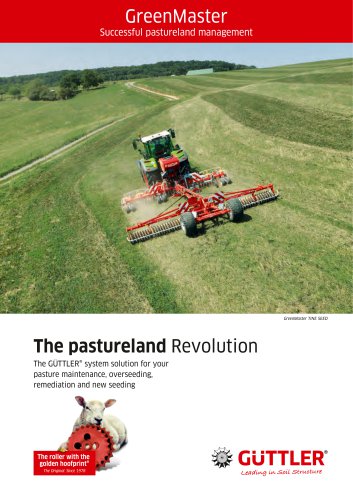
The document introduces the GÜTTLER® system solution for pasture maintenance, overseeding, remediation, and new seeding, emphasizing the importance of high forage performance for economic success. The GreenMaster TINE SEED is highlighted as a flexible solution for various farming needs.
The GreenMaster system offers a comprehensive approach to pasture management, combining levelling, aerating, overseeding, and reconsolidating in a single machine. Key components include the Ripperboard, Levelling bar, and the GÜTTLER® Prismenwalze® roller, which mimics sheep hooves to improve turf density and soil structure.
The document details precision seeding technology, including dosing rollers for BROADCAST SEEDING & TINE SEED, mechanical and electrical seed rate adjustments, and the GÜTTLER® control electronic SeedProfi for precise sowing.
Spring maintenance is crucial for productive pastures. The GreenMaster system efficiently combines harrowing, sowing, and rolling to address challenges like gaps, thatched pastures, and uneven soil. Overseeding is emphasized to improve yield, quality, and resilience.
Post-cut maintenance is essential for managing pastureland. The document outlines the importance of analyzing plant stock, controlling unwanted species, and using mechanical maintenance with the GreenMaster and Prismenwalze®.
Meadow grass is identified as a problematic species affecting yield and forage quality. Strategies for controlling meadow grass include timing, tine adjustment, and overseeding techniques.
Detailed procedures for pasture remediation focus on harrowing, overseeding, and rolling to improve soil conditions and promote seed germination.
Matthias Heckenberger's experience with the GreenMaster system is highlighted, showcasing the benefits of regular maintenance and overseeding for improved yield and forage quality.
The document concludes by emphasizing the importance of autumn overseeding as a foundation for the following year's pasture quality.
- Autumn Overseeding & Maintenance: Overseeding should be done 4-6 weeks before the end of the growing season, depending on weather conditions. Ideal soil temperature is between 6-10°C. The process involves repairing gaps and reseeding dried-out areas.
- Reconsolidation: Regular rolling stimulates tillering, resulting in denser and higher-yielding stocks. The GÜTTLER® system uses a Ripperboard and TINE SEED technology for efficient overseeding.
- GreenMaster System: The system combines aerating, harrowing, overseeding, and soil contact in a single pass, saving time and costs. It is versatile for both pastureland and arable farming.
- Catch Crop Cultivation: The GreenMaster is suitable for sowing catch crops, providing erosion protection, nutrient supply, and improving soil structure.
- Dyke Maintenance: Traditional grazing by sheep is supported by modern technology for effective flood protection.
- Technical Specifications: Detailed specifications of various GreenMaster models, including working width, transport dimensions, and weight, are provided. Options for harrow and pneumatic seeder configurations are also listed.
- Roller weight: 10 kg
- Scraper set for double gauge wheel: 8 kg, 4 sets needed per machine
- Conversion kit for row crops: 85 kg, includes 4 wheel suspension
- Standard equipment includes 2 rows of NonStop sprung tines, hydraulic folding, double gauge wheels, headstock cat. 2 and 3, LED road lighting, and preparation for pneumatic seeder mounting.
Pneumatic Seeder Options:
- 410 litres with 90° electric fan: 6.00 m, 90 kg
- 410 litres with 90° hydraulic fan: 6.00 m to 8.00 m, 100 kg
- 640 litres hydraulic fan: 6.00 m to 8.00 m, 130 kg
Retrofitting Options:
- Coupling kit PREMIUM: 10 kg
- Hydraulic harrow adjustment kits available for different working widths and weights
Standard Machine Specifications:
- GreenMaster harrow 600 Compact: 6.00 m working width, 3.00 m transport width, 3.10 m transport height, weight varies from 3,250 kg to 3,350 kg depending on adjustments
Options for Harrow:
- Levelling bar: 250 kg to 300 kg
- Ripperboard QUATTRO: 320 kg to 390 kg
Additional Equipment:
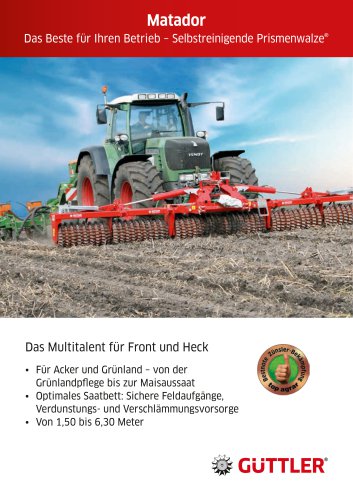
- Matador Prismenwalze®: Suitable for front and rear operations, effective against corn borers
- Mediana Prismenwalze®: Medium-weight roller for various crops
- Trailed rollers: Protect against capping and erosion
- Simplex Prismenwalze®: Lightweight and easy to pull
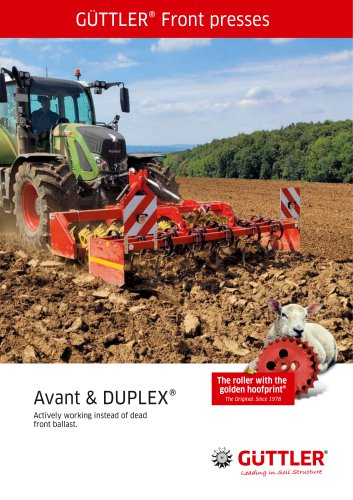
- Front presses Avant and DUPLEX®: Improve seedbed with fewer passes
- Super Maxx® BIO: Efficient for stubble processing and weed control
Contact Information:
For further information or personalized quotes, contact GÜTTLER GmbH at [email protected] or visit www.guettler.de.
Catalog excerpts
Successful pastureland management GreenMaster TINE SEED The pastureland Revolution The GÜTTLER® system solution for your pasture maintenance, overseeding, remediation and new seeding The roller with the golden hoofprint® The Original. Since 1978
Open the catalog to page 1
The pastureland revolution. The solution for anyone who wants to get more from their pastureland. Get your pastureland fit with a system solution that adapts flexibly to your needs. Whether you are a farm, a contractor or a machinery ring: working successfully means keeping an eye on all the factors and being able to rely on dependable equipment. High forage performance is the key to economic success. The forage performance affects 80 % of the costs. It not only ensures high milk yields, but also healthy and vital animals and consistently low feed cost. This requires consistent and efficient...
Open the catalog to page 3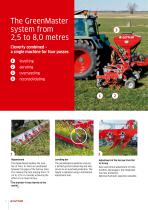
The GreenMaster system from 2,5 to 8,0 metresCleverly combined -a single machine for four passes: O levelling O aerating Q overseeding O reconsolidating Ripperboard The Ripperboard doubles the number of tines. Its tines are positioned between the gaps of the harrow tines. This reduces the tine spacing from 7.5 cm to 3.75 cm, thereby achieving the effect of a 4-rows harrow. ^The shortest 4-rows harrow in the worldjj The parallelogram guidance ensures a perfect ground contouring and also serves as an overload protection. The height is adjusted using a mechanical adjustment tool. Easy and central...
Open the catalog to page 4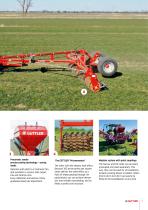
3 Pneumatic seeder precise sowing technology – saving seeds. Optional with electric or hydraulic fan, and available in various tank capacities and control units. Easy calibration and precise, finely graduated seed rate adjustment. 4 The GÜTTLER® Prismenwalze® The roller with the sheep’s hoof effect. Because 305 prism points per square metre deliver the same effect as a flock of sheep passing through. On pastureland, you can achieve denser turf and reliable overseeding, and on fields a perfect soil structure. Modular system with quick couplings The harrow and the roller can be easily uncoupled...
Open the catalog to page 5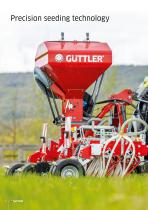
Precision seeding technology
Open the catalog to page 6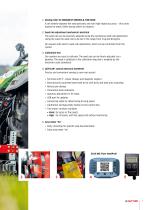
8 cell wheels dispense the seed precisely and with high repeat accuracy - this saves expensive seeds. Other dosing rollers on request. The seed rate can be precisely adjusted using the mechanical seed rate adjustment. Using the scale the seed rate ca be set in the range from 3 kg and 80 kg/ha. On request with electric seed rate adjustment, which can be controlled from the tractor. Our seeders are easy to calibrate. The seed rate can be finely adjusted via a gearbox. The seed is collected in the calibration bag and is weighed by the electronic scale (standard). Precise and convenient sowing is...
Open the catalog to page 7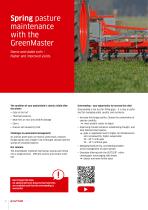
Spring pasture maintenance with the GreenMaster • Thatched pastures • Mole hills or mice and wildlife damage • Uneven soil caused by frost An uneven plant stock can lead to yield losses, reduced forage quality and a higher risk of drought, disease and the spread of unwanted species. The GreenMaster combines harrowing, sowing and rolling into a single process - efficient, precise and results-orien-ted. Overseeding is not just for filling gaps - it is also a useful tool for managing yield, quality, and resilience: • Increase the forage quality: Choose the combination of species carefully — more...
Open the catalog to page 8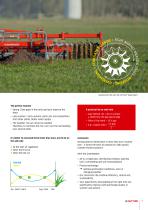
Levelling mole hills with the GUTTLER® Ripperboard A practical tip on seed rate • Gap method: 40 * 40 cm surface ► Determine the gap percentage The perfect moment • Spring: Close gaps in the early spring to improve the stock • Late summer / early autumn: warm soil, less competition from other plants, better water supply • The weather risk can never be exluded! Therefore, to minimise the risk, carry out the overseeding over several dates. Spring pasture maintenance is more than just a routine task - it forms the basis of productive, high-quality, climate-resilient pastures. • All in a single pass:...
Open the catalog to page 9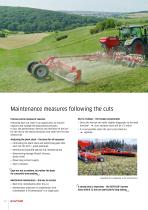
Maintenance measures following the cutsPrecise control instead of reaction Following each cut, there is an opportunity to actively improve and manage the pastureland precisely. In fact, the performance, density and resilience of the turf for the rest of the season becomes clear after the first and second cuts. • Controlling the plant stock and identifying gaps after each cut (30-40 % = great potential) • Identifying unwanted species (e.g. meadow grass) • Determining damage (thatch, dryness, grubs, mice) • Observing nutrient supply • Slurry residues • Best time: immediately after the cut • Maintenance...
Open the catalog to page 10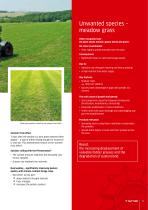
Dark green patches caused by the summer frost-effect 7 days after the second cut, dark green patches often appear - a sign of either lasting drought or excessively wet soil. This phenomenon known as the 'summer frost effect'. • The surface pressure stabilises the disrupted clay-humus complex • Grasses can reabsorb the nutrients the plant stocks initially appear dense and green: • They rapidly spread and take over the area • Significant losses in yield and forage quality • Intensive use (frequent mowing and heavy grazing) • A high nutrient and water supply • Shallow roots — little turf stability...
Open the catalog to page 11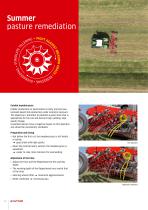
Summer pasture remediation G • FIGHT A GA I Combat meadow grass Fodder production on pastureland is costly and puts pastureland-based milk production under economic pressure. The objective is therefore to establish a plant stock that is appropriate for the site and delivers high-yielding, highquality forage. Unwanted species have a negative impact on this objective and should be consistently combated. Preparation and timing • Not before the first cut: the meadow grass is still healty in spring good yield with high quality Flat adjusted • Ideal: late summer/early autumn, the meadow grass is...
Open the catalog to page 12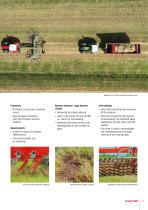
Measures to control common meadow grass Procedure • Driving at a brisk pace, working across • Several passes necessary -even the 3rd pass removes material • A well-cut sward, for greater effectiveness • A dry and crumbly soil, no smearing • Removing the raked material • Gaps in the sward are now visible — ready for overseeding • Determine the seed rate for overseeding based on the number of gaps • Only after harrowing and removing of the material • Only now should the harrow and Prismenwalze® be combined again (optionally, just the roller with the seeder) • The roller is used to reconsolidate...
Open the catalog to page 13All Guettler GmbH catalogs and technical brochures
 MasterCut
2 Pages
 MAYOR The All-Season Roller
24 Pages
 Master & Magnum
2 Pages
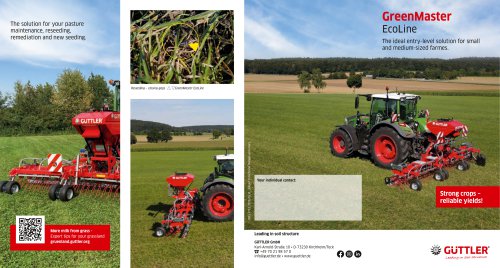 GreenMaster EcoLine
2 Pages
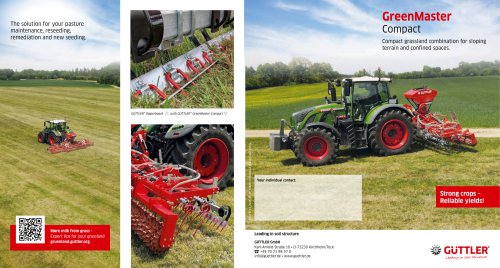 GreenMaster Compact
2 Pages
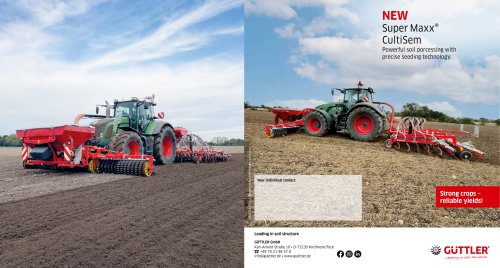 Super Maxx® CultiSem
2 Pages
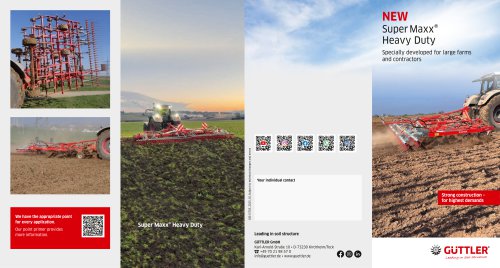 Super Maxx® Heavy Duty
2 Pages
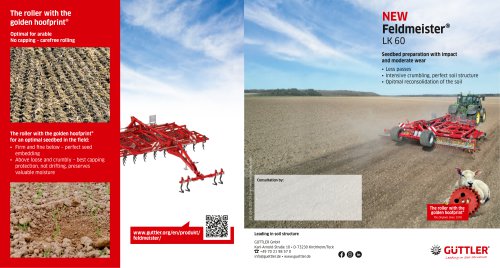 Feldmeister® LK 60
2 Pages
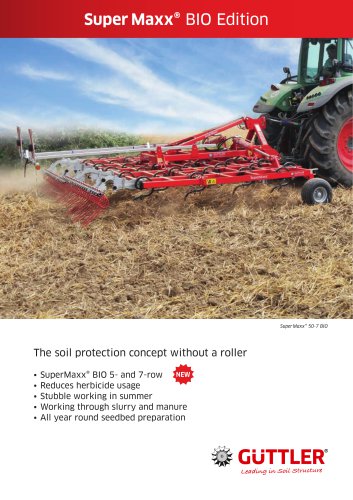 Super Maxx® BIO Edition
12 Pages
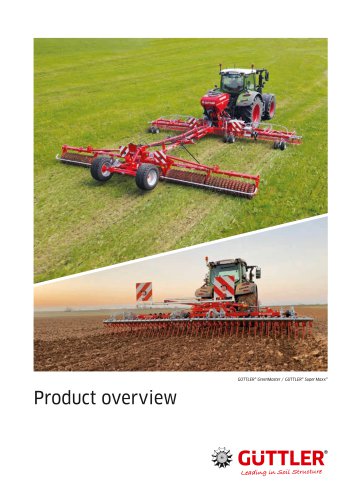 Product overview
60 Pages
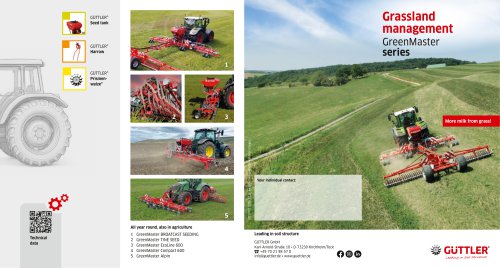
Archived catalogs
 SuperMaxx 30/50/60®
12 Pages
 SuperMaxx 1200®
8 Pages
- Vibro-cultivator
- Mounted vibro-cultivator
- Seed drill
- Vibro-cultivator with roller
- Mechanical in line seeder
- Folding vibro-cultivator
- Tractor-mounted seed drill
- Field cultivator with hydraulic adjustment
- Fixed vibro-cultivator
- Harrow with roller
- Compacting land roller
- Folding harrow
- Spring tine vibro-cultivator
- Towed field cultivator
- Drag harrow
- Cambridge roller
- Tine harrow
- Grading roller
 鄂公网安备42018502009514号 -