

H-1000 TM PTO Driven Tub Grinder

H-1000 TM PTO Driven Tub Grinder
The H-1000 PTO Driven Tub Grinder is engineered for grinding materials like hay, grain, and crop residue into manageable sizes. It accommodates various materials including big round bales, loose hay, square bales, and different types of corn and grains. Screens from 1/8” to 4” are available to achieve the desired cut size.
Operators must read and understand safety information before using the grinder. Essential safety measures include wearing protective gear and avoiding loose clothing. The operator is responsible for their safety and that of others nearby.
The manual provides detailed instructions on machine operation, including pre-operation inspection, tractor setup, and machine operation. It also covers shutdown procedures, storage preparation, and road transport setup.
Regular maintenance is crucial for optimal performance. The manual includes sections on lubrication, hydraulic system maintenance, hammermill maintenance, and hammer replacement.
A troubleshooting section addresses common issues with the electronic governor system and general machine problems.
The manual includes a comprehensive parts reference section detailing various assemblies such as the bull wheel frame, main frame, platform, pressure roller, tub drive, rotor, and conveyor assemblies.
Additional information includes warranty details, machine specifications, and operational requirements.
The document provides detailed operating instructions for the H-1000 Tub Grinder, emphasizing safety and efficiency. Key steps include shutting off the tractor engine, waiting for all movement to stop, and disconnecting the PTO driveline. It warns against using the tractor PTO brake to stop the rotor and advises reducing engine speed before disengaging the PTO.
Grinding materials like wood and hay can produce combustible dust. Proper maintenance, such as frequent removal of dust and debris, is crucial to prevent fires. Operators should avoid grinding materials finer than necessary and ensure the tub grinder is not left unattended while running.
Daily cleaning of the engine compartment and rotor box is recommended to prevent debris buildup. Fuel and hydraulic leaks should be repaired immediately, and electrical wiring should be inspected regularly. Fire extinguishers should be ABC dry chemical types, inspected annually, and recharged after partial use.
Before transporting the tub grinder, secure the conveyor and ensure all parts are fastened. The grinder should be hitched to a tow vehicle with adequate capacity, and safety chains should be attached. Operators must adhere to local travel restrictions and drive carefully, not exceeding 20 mph.
Before performing maintenance, ensure all moving parts have stopped and the engine is off. Hydraulic systems should be depressurized before work. Operators are warned about the dangers of hydraulic fluid under pressure.
Before starting the grinder, a visual inspection is necessary. This includes checking for loose bolts, proper lubrication, and ensuring all safety features are in place. The machine should be on level ground, and unusual vibrations should be addressed immediately.
The H-1000 Tub Grinder is designed for grinding hay, grain, and crop residue. It features a rotating tub, electronic governor, rotor, and hammer assemblies. Operator controls include an electronic governor, hydraulic valves, and a PTO lever.
The governor has two modes: Engine (Auto) and Tub (Manual). The Engine mode adjusts tub speed based on engine load, optimizing efficiency. The Manual mode maintains a constant tub speed.
The rotor is equipped with 64 swinging hammers. Proper maintenance of hammers and screens is essential for efficiency. Operators are cautioned to keep foreign objects away from the rotor to prevent damage.
The document provides detailed specifications for the H-1000 Tub Grinder, including recommended screen sizes for different materials. For hay, use screens with 2” to 4” holes; for ear corn, 5/8” to 1”; for shelled corn, 3/4” dry and 5/8” high moisture; and for small grains, 1/4” to 3/8”. The size of the screen holes determines the coarseness of the grind.
The tub contains material above the rotor. Two tub fins are provided, with specific configurations for different bale types. For large round bales, use one fin in the upper position; for small bales or loose hay, use two fins in the lower position.
A slug buster or mill grate regulates material entering the rotor chamber. The slug buster is for dry hay, while the mill grate is for wet hay or tough grasses.
The discharge conveyor is controlled by a manual valve, with hydraulic oil supplied by the tractor. Different tractors require specific valve types: closed center for John Deere Series 60 and older, open center for others.
Proper tractor setup is crucial to avoid damage. The document outlines steps for connecting and disconnecting the grinder to a tractor, emphasizing alignment and safety precautions.
Materials should be placed directly into the tub, with specific methods for different materials like loose hay, wet or frozen hay, large round bales, crop residue, small grains, and ear corn. Special attachments are recommended for small grains and ear corn.
Normal and emergency shutdown procedures are detailed, highlighting the importance of waiting for all parts to stop moving before maintenance. Storage preparation includes lubrication checks, cleaning, and inspection.
The electronic governor controls the feed rate and tub speed, with modes for manual and automatic operation. Calibration steps ensure optimal performance, adjusting settings based on engine load and speed.
Instructions for setting up the grinder for road transport and returning it to operational status are provided, including folding and unfolding the conveyor.
Regular visual inspections are crucial to identify excessive wear on internal parts such as rotor discs, rods, hammers, and screens. Enlarged holes in discs can lead to rod breakage. Bearings and mounting bolts should be checked to ensure stability and reduce vibration. Foreign objects must be kept away to prevent injury or damage. Hammers are designed for durability but should not be altered as it affects their properties. Periodic rotation of hammers is recommended to maximize lifespan.
Before servicing, ensure the machine is shut down. Follow the hammer pattern diagram to avoid vibration issues. Replace hammers in pairs and ensure they are of equal weight. After replacement, check for unusual vibrations and address any issues before restarting.
Ensure the fuse light is on to confirm power to the electronic governor. Check the tub mode operation by adjusting the tub limit knob and observing the speed lights. If issues persist, refer to the troubleshooting table. For engine mode, follow calibration instructions if tub mode functions correctly.
Test the governor with a voltmeter to ensure proper voltage output. Adjust the tub limit knob to check voltage changes. If the electronic system fails, manual override is possible by adjusting the electro-hydraulic valve.
Refer to the troubleshooting section for common issues and solutions.
DuraTech Industries provides a 12-month warranty against defects in material and workmanship. Misuse, negligence, or unauthorized alterations void the warranty. Claims must be processed through the original dealer.
The H-1000 Tub Grinder weighs 6,830 lbs and requires 80 to 175 HP. It features a 96-inch tub size and various screen sizes. The recommended rotor speed is 2000 RPM.
A tractor with 80 to 175 HP and specific hydraulic requirements is necessary. Approximately 6 gallons of hydraulic oil are needed, with specific brands recommended.
Options include an ear corn kit, grain grinding hopper, and various screen sizes.
This document is a comprehensive parts reference for the H-1000 Tub Grinder, detailing various assemblies and their components. It includes part numbers, quantities, and descriptions for each component used in the assembly of the tub grinder.
- Platform Assembly: Includes components such as tub rollers, pressure rollers, bearings, and various bolts and nuts. Key parts include the #2 Tub Roller and Pillow Block Bearings.
- Pressure Roller Assembly: Details parts like the roller bracket, wheel hub seals, and spindle washers. Notable components include the BRKT\RLLR\PRESS\10” and the Drum\RLLR\PRESS.
- Tub Drive Assembly: Lists sprockets, chains, and bearings essential for the drive mechanism. Important parts include the Spkt\60\30\1-1/4\1/4 and the Orbit Motor Tighten Rod.
- Tub Assembly: Contains parts for the tub itself, such as the AGTTR\TUB\10” and various bolts and washers.
- Rotor Assembly: Includes pulleys, hubs, and spacers. Key components are the Pulley\Cast\11-8B and the Spacer\Hammer\1-1/2X1.028X1.
- Conveyor Drive Assembly: Details the drive components for the conveyor, including sprockets, chains, and bearings. Notable parts include the SPKT\50\15\1\1/4KW\HRN and the Prairie Gear Box 1:1.
- Belly Conveyor Assembly: Lists parts for the belly conveyor, such as sprockets, augers, and seals. Key components include the Spkt\50\17\5/8\Idler and the Auger\RH\9x96.
- Lower Discharge Conveyor Assembly: Details components for the lower discharge conveyor, including seals, bearings, and hydraulic cylinders. Important parts include the SEAL\RBR\FRONT\CNVYR\BELLY and the CYL\HYD\3-1/2X12\1-1/2ROD.
- Upper Discharge Conveyor Assembly: Includes parts like bearings, rollers, and straps. Key components are the BRG\TUU\1-1/8\W-ECC\BSEAL and the RLLR\IDLER\CNVYR\DISCH.
- Lube Line Assemblies: Details the lubrication lines for the grinder, ensuring smooth operation of moving parts.
- Conveyor Hydraulics: Lists hydraulic components for the conveyor system, including hoses and fittings. Notable parts include the FTG\1/2\NPTF\QUICK;CPLR and various hydraulic hoses.
The document provides detailed part numbers and descriptions, which are crucial for maintenance and repair of the H-1000 Tub Grinder. It also specifies different assemblies based on serial numbers, indicating updates or changes in parts used over time.
This document provides a comprehensive parts reference for the Tub Grinder, focusing on hydraulic assemblies, conveyor lift and fold cylinders, and various optional assemblies. It includes detailed part descriptions, quantities, and specifications for each component.
The document lists various hydraulic hoses and fittings, specifying dimensions and connection types. Key components include hydraulic cylinders with specific rod sizes and fittings such as tees, elbows, and orifices. The hydraulic assembly section is divided based on serial numbers, indicating different configurations for different production batches.
This section details the parts required for the conveyor lift and fold mechanisms, including hydraulic cylinders and associated fittings. The parts are categorized by serial number ranges, ensuring compatibility with specific machine models.
Specifications for solenoid valves are provided, including voltage requirements and resistance values. Notes highlight the differences between 12V and 24V solenoids, with specific resistance ranges for each.
The document includes optional components such as the front hay guide assembly and mill grate. Each option is detailed with part numbers and descriptions, allowing for customization based on user needs.
Other assemblies covered include the PTO assembly, wheel assembly, gear box assembly, and tail light schematic. Each section provides a breakdown of parts, ensuring comprehensive coverage of the Tub Grinder's components.
The document emphasizes the importance of matching parts to specific serial numbers to ensure proper fit and function. It also highlights standard flow rates for hydraulic components and provides guidance on identifying non-standard parts.
The document provides a parts reference for the Grain Grinding Hopper option for the 127H-1000 Tub Grinder. Key components include the complete hopper assembly, front and rear covers, bolts, nuts, and washers. The installation procedure involves orienting the tub, attaching covers, ensuring correct baffle orientation, and securing the hopper to the tub floor. A critical note is to avoid rotating the tub with the hopper installed.
This section lists parts for the Ear Corn Kit option, including covers, brackets, cross pipes, bolts, nuts, and washers. The parts are specified with part numbers and quantities required for assembly.
The document details various decals for the H-1000 Tub Grinder, including warning, logo, and information decals. Each decal is listed with its part number and description, emphasizing safety and operational instructions.
Available paint options include yellow and red spray paints, as well as quart and gallon sizes for both colors.
Specific locations for decals on the tub grinder are outlined, ensuring proper placement for visibility and safety.
DuraTech Industries invites feedback on the manual's quality and usefulness, encouraging users to report errors or suggest improvements. Contact information is provided for submitting comments.
Catalog excerpts

Operating Instructions and Parts Reference PTO Driven Tub Grinder Serial Number 4542 & Up Product Information DuraTech Industries International Inc. PO Box 1940, Jamestown, ND 58402-1940 Tel: (701) 252-4601• Fax: (701) 252-0502 0500156 • May 2020
Open the catalog to page 1
A Tradition of Innovation Since 1966
Open the catalog to page 2
PTO Driven Tub Grinder Serial Number 4542 & Up Operating Instructions and Parts Reference DuraTech Industries International Inc. (DuraTech Industries) has made every effort to assure that this manual completely and accurately describes the operation and maintenance of the H-1000 Tub Grinder as of the date of publication. DuraTech Industries reserves the right to make updates to the machine from time to time. Even in the event of such updates, you should still find this manual to be appropriate for the safe operation and maintenance of your unit. This manual, as well as materials provided by component...
Open the catalog to page 3
A Tradition of Innovation Since 1966
Open the catalog to page 4
Foreword All personnel must read and understand the following sections before operating the H-1000 Tub Grinder. • Foreword and Section 1, important safety information. • Section 2, “Machine operation,” which explains normal operation of the machine. • Section 2.1, “Pre-Operation Inspection”. The H-1000 Tub Grinder is designed to grind material into more palatable or manageable rations for your operation. It has multiple uses: 1. Grind most types of hay • Square bales 2. Grind most types of grain • Shell corn • High moisture corn • Most small grains OPERATING INSTRUCTION
Open the catalog to page 5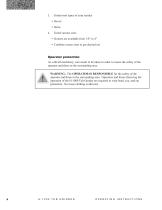
3. Grind most types of crop residue 4. Grind various sizes • Screens are available from 1/8” to 4” • Combine screen sizes to get desired cut As with all machinery, care needs to be taken in order to insure the safety of the operator and those in the surrounding area. WARNING: The OPERATOR IS RESPONSIBLE for the safety of the operator and those in the surrounding area. Operators and those observing the operation of the H-1000 Tub Grinder are required to wear head, eye, and ear protection, No loose clothing is allowed. OPERATING INSTRUCTIONS
Open the catalog to page 6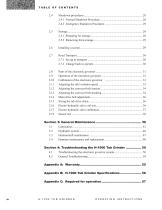
iv H-1000 TUB GRINDER OPERATING INSTRUCTIONS
Open the catalog to page 8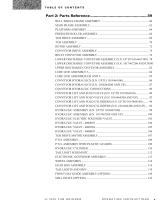
OPERATING INSTRUCTIONS
Open the catalog to page 9
A Tradition of Innovation Since 1966 OPERATING INSTRUCTIONS
Open the catalog to page 10
PTO Driven Tub Grinder Serial Number 4542 & Up Part 1: Operating Instructions OPERATING INSTRUCTIONS
Open the catalog to page 11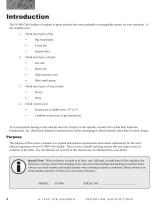
Introduction The H-1000 Tub Grinder is designed to grind material into more palatable or manageable rations for your operation. It has multiple uses: 1. Grind most types of hay • Square bales 2. Grind most types of grain • Shell corn • High moisture corn • Most small grains 3. Grind most types of crop residue 4. Grind various sizes • Screens are available from 1/8” to 4” • Combine screen sizes to get desired cut To avoid possible damage to the machine and risk of injury to the operator, consult with a DuraTech Industries International, Inc. (DuraTech Industries) representative before attempting...
Open the catalog to page 12
How to use this manualManual organization This manual is organized into the following parts: • Part 1: Operating Instructions • Section 1: Safety decals, safety instructions and information • Section 2: Describes the purposes of each part. • Section 3: Describes safe procedures. • Section 4: Tells how to use the H-1000 Tub Grinder. • Section 5: Describes how to maintain the H-1000 Tub Grinder. • Part 2: Part’s reference contains diagrams of each assembly, with the part number of each part. A key on the same or facing page contains a description of the part and the quantity used. • Perform a daily...
Open the catalog to page 13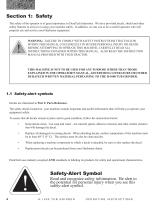
Section 1: Safety The safety of the operator is of great importance to DuraTech Industries. We have provided decals, shield and other safety features to aid you in using your machine safely. In addition, we ask you to be a careful operator who will properly use and service your Haybuster equipment. WARNING: FAILURE TO COMPLY WITH SAFETY INSTRUCTIONS THAT FOLLOW WITHIN THIS MANUAL COULD RESULT IN SEVERE PERSONAL INJURY OR DEATH. BEFORE ATTEMPTING TO OPERATE THIS MACHINE, CAREFULLY READ ALL INSTRUCTIONS CONTAINED WITHIN THIS MANUAL. ALSO READ THE INSTRUCTION MANUAL PROVIDED WITH YOUR TRACTOR. THIS...
Open the catalog to page 14
DANGER: Indicates an imminently hazardous situation that, if not avoided, will result in death or serious injury. This signal word is to be limited to the most extreme situations, typically for machine components that, for functional purposes, cannot be guarded. Signal word - White Lettering/Red Background Safety Alert Symbol - White Triangle/Red Exclamation Point WARNING: Indicates a potentially hazardous situation that, if not avoided, could result in death or serious injury, and includes hazards that are exposed when guards are removed. It may also be used to alert against unsafe practices....
Open the catalog to page 15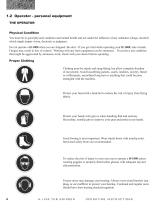
1.2 Operator - personal equipment THE OPERATOR Physical Condition You must be in good physical condition and mental health and not under the influence of any substance (drugs, alcohol) which might impair vision, dexterity or judgment. Do not operate a H-1000 when you are fatigued. Be alert ‑ If you get tired while operating your H-1000, take a break. Fatigue may result in loss of control. Working with any farm equipment can be strenuous. If you have any condition that might be aggravated by strenuous work, check with your doctor before operating Proper Clothing Clothing must be sturdy and snug‑fitting,...
Open the catalog to page 16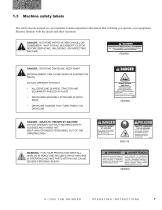
1.3 Machine safety labels The safety decals located on your machine contain important information that will help you operate your equipment. Become familiar with the decals and their locations. DANGER: ROTATING PARTS WITHIN CAN KILL OR DISMEMBER. WAIT FOR ALL MOVEMENT TO STOP BEFORE SERVICING, UNLOADING, OR INSPECTING MACHINE. [ROTATING PARTS WITHIN CAN KILL OR DISMEMBER WAIT FOR ALL MOVEMENT TO STOP BEFORE SERVICING, UNCLOGGING OR INSPECTING MACHINE DANGER: ROTATING DRIVELINE, KEEP AWAY! ENTANGLEMENT CAN CAUSE SERIOUS INJURIES OR DEATH. • ALL DRIVELINE GUARDS, TRACTOR AND EQUIPMENT SHIELDS IN...
Open the catalog to page 17All HayBuster catalogs and technical brochures
 77C/107C DRILLS
164 Pages
 147C DRILL
120 Pages
 3106 ROCK-EZE
84 Pages
 CMF-590 TM VERTICAL MIXER
110 Pages
 CMF-710 TM VERTICAL MIXER
142 Pages
 CMF-830 TM VERTICAL MIXER
178 Pages
 CMF-1200 Vertical Mixer
9 Pages
 H-1030 TM PTO Driven Tub Grinder
237 Pages
 H-1135 TM PTO Driven Tub Grinder
243 Pages
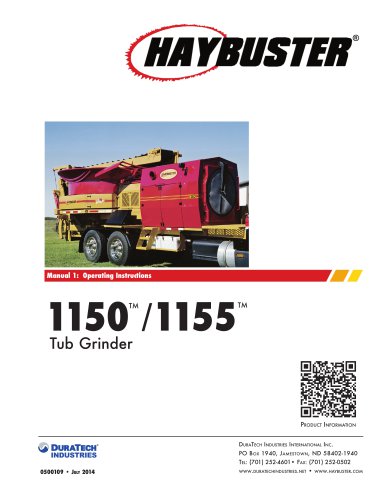 1150 /1155 Tub Grinder TM
106 Pages
 2800 TM BALEBUSTER
136 Pages
 Balebuster 2660
156 Pages
 2574 TM BALEBUSTER
146 Pages
 Balebuster 2100
9 Pages