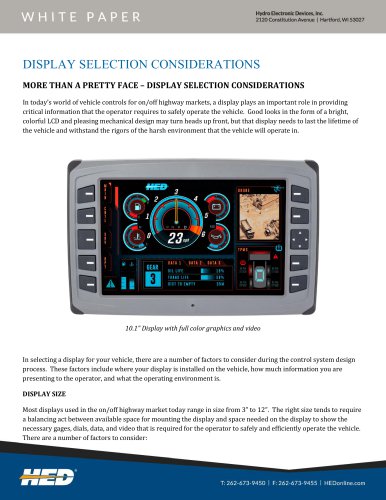

HED Application
HED Application
HED specializes in electronic control systems for mobile vehicles, offering solutions from single components to complete networked systems. Located in Hartford, Wisconsin, HED acts as an extension of its customers' engineering departments to help realize their visions.
Applications Guide Overview
This guide provides insights into the capabilities and possibilities of HED's electronic control systems, particularly for mobile vehicles used in both off-highway and on-highway applications. The focus is on simplifying complex functionalities and reducing costs by replacing traditional mechanical and hydraulic systems with electronic controls.
Key Features of HED Control Systems
- Simplicity: Reduces the need for extensive hydraulic routing, leading to smaller operator stations and cost savings.
- Reliability and Ergonomics: Minimizes leak-prone hydraulics, replacing them with rugged electronics that enhance operator comfort and reduce fatigue.
- Intelligence and Safety: Incorporates safety interlock logic and alarms, optimizing the operation of multiple vehicle functions simultaneously.
- Extended Component Life: Controls transmission shift patterns and component duty cycles to minimize wear and maximize service life.
- Programmability: Offers Windows-compatible software for custom control programming, allowing for differentiation and flexibility in vehicle design.
- Faster New Product Development: Enables quicker transitions from design to production, allowing for rapid exploitation of market opportunities.
Multiplexing Technology
HED's multiplexing technology simplifies control systems by reducing wiring complexity and enabling control of multiple functions through fewer wires. This technology is compatible with various communication protocols like J-1939 and CANopen.
Applications of Multiplexing
- Engine Control: Allows task-based control of engine operations and monitoring of conditions from the operator station.
- Multi-Station Control: Facilitates control from multiple points, including remote operations.
- Self-Diagnosis and Reporting: Simplifies troubleshooting with built-in diagnostics and network checks.
Vehicle Applications
HED's CANLink™ system is used in various applications, such as fire trucks and aerial work platforms, to reduce wiring complexity, enhance performance, and lower ownership costs.
Programming and Diagnostic Tools
- CANLink™ Composer: A user-friendly software tool for creating and modifying vehicle control programs without programming language knowledge.
- CANLink™ Conductor: A diagnostic tool for identifying and troubleshooting vehicle performance issues.
- CANLink™ Tuner: A calibration tool for adjusting signal ranges for precise control performance.
Conclusion
HED provides comprehensive electronic control solutions that enhance vehicle performance, reduce costs, and offer flexibility in design and operation. Their systems are designed to withstand extreme environments and simplify vehicle management.
Catalog excerpts
Realize Your Vision with Intelligent Control Featuring the HED CanLink™ Control System
Open the catalog to page 1
Elec Comple hydraul offer a w specific HED - The Controls Company HED specializes in electronic control systems for mobile vehicles. Located in Hartford, Wisconsin, we provide all your electronic control requirements from single components through complete networked control systems. We operate as an extension of our customers’ engineering department, providing support as needed to make their vision a reality. What this Applications Guide is about. Our customers are experts in their product lines: mobile vehicles for off-highway and on-highway use. Increasingly, mobile vehicles are designed to...
Open the catalog to page 2
Electronic Controls Complex machines require complex controls. Control systems that use traditional hydraulic conduit and mechanical linkages can quickly get out-of-hand. Electronics offer a way to simplify control while actually offering greater precision for specific tasks. Benefits include: Simplicity Instead of routing hydraulic conduit to the operator station and then to the tool, hydraulics only need to go from the power source to the tool. This allows for a smaller, easier-to-use operator station and cost savings, especially when the operator is located some distance from the tool. Reliability...
Open the catalog to page 3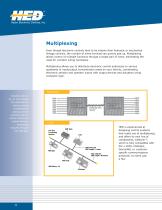
Multiplexing Even though electronic controls tend to be simpler than hydraulic or mechanical linkage controls, the number of wires involved can quickly add up. Multiplexing allows control of multiple functions through a single pair of wires, eliminating the need for complex wiring harnesses. Multiplexing allows you to distribute electronic control judiciously to various quadrants or input/output concentration areas on your vehicle, coordinating electronic sensors and operator inputs with output devices and actuators using computer logic. Systems with 2, 22, or more nodes can dramatically reduce...
Open the catalog to page 4
Engine Control Communications with Engine Control Modules (ECM), enables task-based control of engine operating/idle speed. In addition, you can monitor engine conditions (overheating, transmission status, etc) from the operator station and automatically control vehicle load conditions to prevent engine stall. Multi-Station Control Multiplexing simplifies control of vehicle or tool operation from multiple points on the vehicle: from the operator’s cab, from a station near the tool, or even remotely (off-vehicle) through a wired or wireless connection. More and easier to read information is available...
Open the catalog to page 5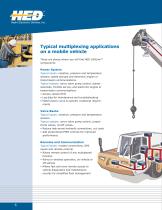
Typical multiplexing applications on a mobile vehicle These are places where you will find HED CANLink™ components: Power System Typical inputs: resistive, pressure and temperature sensors, speed pickups and electronic engine or transmission communications. Typical outputs: servo valve pump control, starter solenoids, throttle servos, and electronic engine or transmission communications. • Access vehicle ECM • Log data for maintenance and troubleshooting • Match power curve to specific vocational requirements Valve Banks Typical inputs: resistive, pressure and temperature sensors. Typical outputs:...
Open the catalog to page 6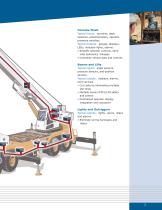
Console/Dash Typical Inputs: joysticks, dash switches, potentiometers, operator presence switches. Typical Outputs: gauges, displays, LEDs, indicator lights, alarms. • Simplify operator controls, eliminate hydraulics, linkages • Centralize vehicle data and controls Booms and Lifts Typical inputs: angle sensors, pressure sensors, and position sensors. Typical outputs: displays, alarms, limit controls. • Cut costs by eliminating multiple slip-rings • Multiple levels of RCL/LMI safety and control • Centralized operator display, integration with actuators Lights and Outriggers Typical outputs: lights,...
Open the catalog to page 7
Vehicle Applications CAN Multiplexing Offers Increased Performance, Added Flexibility, Reduced Development Time, and Lower Lifetime Vehicle Ownership Cost Reduce wiring complexity and cost Easily add production or aftermarket options while keeping base unit cost low Quickly introduce new vehicle features with little or no hardware modifications Locate I/O modules close to the source Simplify vehicle troubleshooting Fire Aerial Ladder Application The number of wires exiting a fire truck cab can number in the hundreds without the use of CAN multiplexing technology. The reduction in vehicle wiring...
Open the catalog to page 8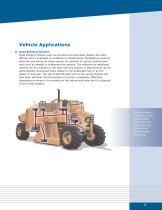
Vehicle Applications Road Building Machine Road building vehicles such as recyclers and skid-steer loaders are often offered with a multitude of variations or attachments. Multiplexing systems allow the pre-wiring for these options for addition of control module hardware only as needed to implement the options. The software for additional options can be included on the base unit and options or attachments can be automatically recognized when added on the production line or by the dealer or end user. The use of identification pins in the wiring harness can also allow identical control modules...
Open the catalog to page 9
Windows-based programming expands the capabilities of CANLink™ CANLink™ modules can be programmed at HED and shipped ready for your single application, or they may be programmed by your own design team. This allows designers to give vehicles different performance characteristics for different applications without changing the basic production hardware components. The benefits include simplified design, reduced inventory and the ability to quickly deliver customer-specific products. Do-It-Yourself Windows-Based Software Programming Tool CANLink™ Composer This easy-to-use software requires no programming...
Open the catalog to page 10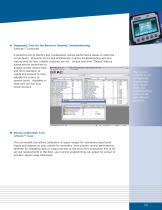
Diagnostic Tool for On-Board or Remote Troubleshooting CANLink™ Conductor A powerful tool to identify and troubleshoot vehicle performance issues or electrical circuit faults. Pinpoints errors and dramatically reduces troubleshooting and wire tracing time for fast, reliable customer service. Unique real-time “Debug” feature allows service technician to bypass normal control logic and force operation of inputs and outputs to help identify the source of system faults. Available in read-only and full functional versions. Improve your customer service by diagnosing programming logic, system faults,...
Open the catalog to page 11All HED Inc. catalogs and technical brochures
 Basic Electronics
32 Pages
 CAN and Multiplexing
30 Pages