

Cucumber Green Mottle Mosaic Virus

Cucumber Green Mottle Mosaic Virus
This document provides guidance for cucurbit growers on managing Cucumber Green Mottle Mosaic Virus (CGMMV), sponsored by the American Seed Trade Association (ASTA) after its first U.S. appearance in 2013.
About CGMMV
CGMMV is a tobamovirus affecting cucurbits like watermelon, melon, and cucumber. It spreads easily through sap and seed, surviving in plant debris, soil, and on surfaces, leading to significant yield losses.
Causes and Sources
The virus spreads via contaminated soil, water, mechanical transfer, infected rootstock, and seeds. It can persist on surfaces and tools, with pollen transmission noted in greenhouses but not confirmed in fields. No insect vectors are identified.
Diagnosis and Symptoms
Symptoms include leaf and fruit mottling and mosaic, which can be mistaken for other viruses. Diagnosis should use ELISA, RT-PCR, and ImmunoStrip tests rather than visual symptoms alone.
Factors Influencing Symptom Expression
Symptom severity is affected by environmental conditions, virus strain, growing conditions, tissue type, host species, and infection timing. Early seedling infections cause more severe symptoms and yield losses.
Recommendations for CGMMV Control
Seed Use: Use tested seeds free of CGMMV. Seed treatments like thermotherapy and chemotherapy can reduce infectivity.
Transplant Production: Use tested seeds, inspect seedlings, and maintain hygiene. Destroy infected plants and sterilize tools.
Commercial Production: Use tested seeds, adhere to sanitation practices, and inspect fields regularly. In protected culture, prevent cross-contamination and limit handling post-transplant.
Seed Increase Growers: Use tested seeds, inspect fields, and disinfect between fields.
Equipment Cleaning Procedures
Thoroughly clean all seed harvest equipment with high-pressure washers to prevent disease outbreaks like CGMMV.
CGMMV Diagnostic and Management
The ImmunoStrip® kit from Agdia® offers preliminary CGMMV diagnosis. For confirmation, symptomatic samples should be sent to local extension offices or diagnostic labs. Resistance exists in some cucumber varieties, but most cucurbits remain susceptible.
Resistance and Control Measures
Developing CGMMV-resistant cultivars is a priority. Some transgenic materials show resistance, but application is challenging. Seed treatments with thermotherapy or trisodium phosphate may reduce virus infectivity but require further research.
Acknowledgements
Contributions from experts and organizations, including Dr. Kai Shu Ling, Dr. Bryce Falk, Monsanto Vegetable Seeds, and Syngenta Seeds, Inc., are acknowledged.
Catalog excerpts

Cucumber Green Mottle Mosaic Virus Photo credits (clockwise from left): HM.CLAUSE, Inc., Monsanto Vegetable Seeds, HM.CLAUSE, Inc. A Seed Production and Commercial Growers Guide This educational pamphlet is intended to provide commercial and seed crop cucurbit growers with information about CGMMV and to provide recommendations for reducing the risk of occurrence of the disease in their crop productions. Contributors to this brochure include academic and industry CGMMV experts. It is sponsored and distributed by the American Seed Trade Association (ASTA), and was initiated as a response to the 2013 occurence of the disease in California. This is the first reported incident of CGMMV in the United States. Date: April 2014.
Open the catalog to page 1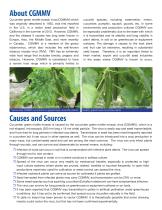
About CGMMV Cucumber green mottle mosaic virus (CGMMV) which was originally described in 1935, was first reported in the U.S. in a melon seed production field in California in the summer of 2013. However, CGMMV, and the disease it causes has long been known in Europe, Asia, the Middle East, and more recently in Canada. CGMMV is a member of the genus tobamovirus, which also includes the well-known tobacco mosaic virus (TMV). TMV has an extremely wide host range that includes tomato, pepper, and tobacco. However, CGMMV is considered to have a narrow host range which is primarily limited to (Courtesy...
Open the catalog to page 2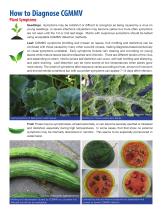
Plant Symptoms Seedlings: Symptoms may be indistinct or difficult to recognize as being caused by a virus on young seedlings. In severe infections cotyledons may become yellow but more often symptoms are not seen until the 1st or 2nd leaf stage. Plants with suspicious symptoms should be tested using acceptable CGMMV detection methods. Leaf: CGMMV symptoms (mottling and mosaic on leaves, fruit mottling and distortion) can be confused with those caused by many other cucurbit viruses, making diagnosis based exclusively on visual symptoms unreliable. Early symptoms include vein clearing and crumpling...
Open the catalog to page 3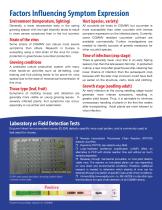
Factors Influencing Symptom Expression Environment (temperature, lighting) Host (species, variety) Generally, a lower temperature early in the spring growing season with low light intensity tends to result in more severe symptoms than in the hot summer. All cucurbits are hosts to CGMMV but cucumber is more susceptible than other cucurbits with intense symptom expression on the infected plants. Currently, some CGMMV resistant cucumber cultivars are available commercially. Further investigations are needed to identify sources of genetic resistance for other cucurbit species. Strain of the virus...
Open the catalog to page 4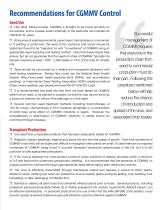
Successful management of CGMMV requires that everyone in the production chain from seed to commercial production must do their part. Following the practices mentioned below will help reduce the chance of introduction and spread of the virus, and associated crop losses. Recommendations for CGMMV Control Seed Use □ Like other tobamoviruses, CGMMV is thought to be found primarily on the surface, and to a lesser extent internally, in the seed and can maintain its infectivity for years. □ All sources of seed (experimental, parent seed, trial varieties or commercial, or if grafting is performed, the...
Open the catalog to page 5
Transplant Production (cont’d) Inspect areas surrounding the transplant greenhouse or growing facility and destroy all cucurbit weeds that could serve as a host for the virus. CGMMV can easily spread in the grafting process. Ensure that tools are sterilized by dipping in 2% Virkon or freshly prepared 10% bleach. Be sure to rinse tools and hands afterwards to remove residue. Inspect grafted plants often for the presence of the symptoms. It is strongly recommended that nurseries/transplant operations implement a comprehensive hygiene program which includes the use of disinfectants/sanitizers and...
Open the catalog to page 6
Commercial Production Growers: Protected culture (cont'd) □ The growing plants should be inspected by experienced technicians for early disease symptoms, confirmation tests on suspect plants conducted by lab analysis and diseased plants carefully removed and placed in a container (plastic bag, etc.) for disposal. Take care to avoid touching the container to remaining plants in the greenhouse during removal. □ Sanitize cutting tools after each plant with disinfectants (such as 2% Virkon, freshly prepared 10% bleach solution or NFDM in de-leafing, fruit picking, pruning and other crop plant handling...
Open the catalog to page 7
What to do if CGMMV is Suspected An easy to use, rapid diagnostic kit from Agdia®, the ImmunoStrip® is commercially available. This type of test can be useful for developing a preliminary diagnosis, but a more thorough, comprehensive evaluation for confirmation is recommended. Take a sample of symptomatic tissue to the local extension office, state university or private diagnostic laboratory for the confirmation. Question and Answers What makes CGMMV such a problematic disease for greenhouse cucurbit produce production? Because of many hands-on activities associated with greenhouse cucumber and...
Open the catalog to page 8
Acknowledgements The ASTA and California Seed Association (CSA) would like to extend its appreciation to Dr. Kai Shu Ling of the USDA-ARS and Dr. Bryce Falk of the University of California-Davis for their contributions to this bulletin. Special thanks to HM.CLAUSE Communications Department for formatting and developing this bulletin. Monsanto Vegetable Seeds Syngenta Seeds, Inc. In cooperation with Magnum Seed Inc. HM.CLAUSE, Inc. Sakata Seed Additional sources of information on CGMMV: CABI Crop Protection Compendium (http://www.cabi.org/cpc/) Kim SM, Nam SH, Lee JM, Yim KO, Kim KH, 2003....
Open the catalog to page 9All HM.CLAUSE catalogs and technical brochures
 Magic Lantern
1 Page
 WYATT
WYATT1 Page
 CAPRICE
1 Page
 NAVIGATOR
1 Page
 SAHARA
1 Page
- Fruiting vegetable seed
- Corn seed
- Hybrid corn seed
- Grain corn seed
- Tomato seed
- Pepper seed
- Red tomato seed
- Round tomato seed
- Pumpkin seed
- Watermelon seed
- Hybrid pumpkin seed
- Bean seed
- Early pumpkin seed
- Early tomato seed
- Cereal seed
- Powdery mildew resistant pumpkin seed
- Grain cereal seed
- Fusarium resistant tomato seed
- Mosaic virus resistant bean seed