

- Products
- Catalogs
- News & Trends
- Exhibitions
Ridder ProDrain

Ridder ProDrain
- Control Based on Undersaturation Level: ProDrain allows irrigation based on the substrate's undersaturation level, ensuring precise water application tailored to crop needs.
- Unique Transpiration Measurement: The system measures real-time transpiration rates, aiding in climate control strategies and serving as a research tool for model validation.
- Growth Monitoring for Hanging Crops: ProDrain can measure crop growth by weighing plants, providing data on fruit load and growth rates.
- Suitable for All Substrate-Grown Crops: The system is versatile, applicable to various crops like tomatoes, cucumbers, and roses.
- 24/7 Irrigation Scheduling: ProDrain provides continuous data for precise irrigation, even at night, enhancing water management.
- Maximum CO2 Assimilation: By monitoring plant activity, ProDrain helps optimize photosynthesis and crop yields.
- Tailored Water Management: The system prevents over or under-irrigation, reducing risks like root rot or stunted growth.
- Real-Time Measurements: ProDrain measures irrigation water, drain water, and plant transpiration with high accuracy.
- Data Utilization: The system provides management information for stress detection, growth monitoring, and production planning.
Catalog excerpts

Accurate irrigation and transpiration monitoring ridder.com ridder.com Ridder ProDrain
Open the catalog to page 1
Make your crops thrive with precision irrigation Ridder ProDrain allows you to monitor the water uptake, transpiration level and growth rate of your crop plants. ProDrain Control based on undersaturation level Growth monitoring for hanging crops displays real-time information on irrigation, water uptake, transpiration, growth, the substrate’s saturation level and the Every grower knows that you should avoid a wet root If used for hanging crops (e.g. high-wire tomatoes or drain water volume 24 hours a day. It even displays this information when there is no solar irradiance (incoming sunlight)...
Open the catalog to page 2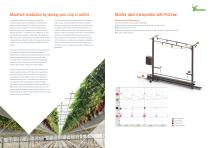
Maximize production by placing your crop in control Monitor plant transpiration with ProDrain Commercial growers have always been taught that That’s why growers are extremely interested in the actual Measures plant transpiration maximum crop production depends on maintaining the water uptake and transpiration rate of their crop plants. ProDrain accurately measures plant transpiration: ideal greenhouse climate. This makes sense, of course, What not many growers know, however, is that it has been ♦Weight measurement of irrigation water, gutter weight and drain water ♦ and up to now, most growers...
Open the catalog to page 3
TranspirationPeter van Beveren vs. model measurement October 15, 2013 Peter van Beveren Radiation (W m−2 ) Transpiration (g m−2 h−1 ) Radiation (W m−2 tot (−) τ) Transpiration (g m−2 h−1 ) τtot (−) Wageningen University and Research Centre (WUR) findings Real-time symbolic view Real-time transpiration measurement Plant transpiration under normal and diffuse glass Plant transpiration under normal glass is much more irregular than under diffuse glass. This is shown clearly in the graphs below. 13-Apr-12 14-Apr-12 15-Apr-12 16-Apr-12 17-Apr-12 18-Apr-12 19-Apr-12 20-Apr-12 13-Apr-12 14-Apr-12 15-Apr-12...
Open the catalog to page 4
How does ProDrain work? ProDrain constantly measures the weight of the irrigation Fully automated irrigation based on water uptake Paul Selina water, the drain water, the substrate slab and the plants The desired water quantity in the substrate slabs can be (the last-named in the case of hanging crops). The system represented as the moisture content from 0-100%. The We’ve been using Ridder ProDrain since 2007. First keeps track of all fluctuations in weight. Since measurements problem is that irrigation is applied in volume (e.g. litres) at our GATES™ greenhouse and now all our Texas are performed...
Open the catalog to page 5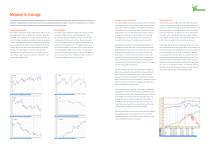
Measure to manage All growers aim to produce the best-quality product, in maximum quantities, at the right times and with as few resources as Experiences from the field possible. Tracking daily crop performance is the key to producing maximum yields. To monitor crop performance, ProDrain Paul Selina Village Farms has been working with ProDrain for The increase in plant weight is far from stable throughout determines the actual crop growth rate by measuring the increase in fresh weight. over seven years. He uses the plant weight and growth data the day. At night, water uptake and plant transpiration...
Open the catalog to page 6
Real-time comparison of measured and simulated crop transpiration in greenhouse process control A.N.M. de Koning and I. Tsafaras as for conditioning the greenhouse climate. With numerous rules (if …then) and mutual influences and associated settings, Applying more intelligent algorithms in the process computers that control the greenhouse climate and irrigation In modern greenhouses a process control computer takes care of the integrated control of installations for irrigation as well may help growers to optimize crop growth and yields as well as save energy. A greenhouse process computer has...
Open the catalog to page 7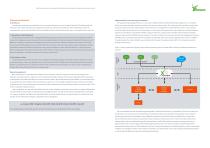
Real-time comparison of measured and simulated crop transpiration in greenhouse process control Implementation in process control computers which was running through a separate controller in the process control system. The script controller was able to transfer data In the present study data were obtained from two commercial greenhouses; one located in Pijnacker (The Netherlands) and The programming language Python 3.3.5 was used to implement the described mathematical algorithms in a script file, the other in Texas (USA). The growers provided historical data for calibration and validation of...
Open the catalog to page 8
Real-time comparison of measured and simulated crop transpiration in greenhouse process control Results Validation of transpiration model The validation and the calibration of the transpiration model were carried out with historical data from April and May 2014, from greenhouse A in The Netherlands. Firstly, the model was calibrated for the characteristics of a tomato crop by adjusting a crop specific parameter in the model (Tsafaras and De Koning, in preparation). Then, the model was tested over a wide range of the climatic variables. During the simulated days the daily radiation sum varied...
Open the catalog to page 9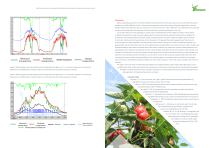
Real-time comparison of measured and simulated crop transpiration in greenhouse process control Without adjusting parameters the model predicted the transpiration of the tomato crop very well under different climatic conditions as well for different cultivars. Therefore the transpiration model seems robust for general application in tomato. Implemented in the greenhouse process computer at commercial nurseries, when a difference was noticed between predicted and measured transpiration, the computer warned the grower for unexpected behavior of his crop. Due to the architecture of the greenhouse...
Open the catalog to page 10All HORTIMAX catalogs and technical brochures
 Ridder HortiMaX MultiMa
2 Pages
 Ridder HortiMaX-Go!
8 Pages
 Ridder FertiMiX Range
3 Pages
 Ridder VitaLite
6 Pages
 HortiMaX CX500
2 Pages
 HortiMaX PAR sensor
2 Pages