

The Role of Air Preparation Units
The Role of Air Preparation Units
The document discusses the organization of air intake in buildings using air preparation units as part of the Exatop® ventilation system. It highlights the drawbacks of direct air intake, such as condensation and moisture accumulation, which can harm animal health and increase operating costs over time.
System Overview
The Exatop® ventilation system, developed by I-TEK, is designed for optimal climate control, animal health, and energy efficiency. It has been implemented globally and includes air preparation units for heating, cooling, and filtration.
Main Air Intake
Air enters through automatic main inlets, regulated by fans and static pressure sensors. The air is treated (pre-heated or cooled) before being distributed through underground corridors.
Air Pre-Heating
In winter, only 15-20% of airflow is heated, reducing energy costs. Pre-heated air helps absorb moisture, maintaining a healthier environment.
Air Cooling
In summer, pad cooling systems are used without needing external wall openings. The "cellar effect" naturally adjusts air temperature by 3-5°C.
Air Distribution
Conditioned air is distributed via underground ducts and Exatop® ventilation columns, ensuring uniform airflow over large distances.
Alternative Cooling and Filtration
The system can use fogging as an alternative cooling method. Effective air filtration is crucial for maintaining sanitary conditions, especially on breeding farms.
Air Extraction
Air is extracted from beneath slatted floors to keep them dry and remove harmful gases. Centralized extraction with turbines and air scrubbing for odor control are also options.
Heat Recovery
The system allows for heat recovery from exhaust air to heat technical rooms and service corridors.
Conclusion
The Exatop® system integrates multiple functions into a single concept, enhancing microclimate stability, animal health, and production performance while reducing costs.
Author
Mykhailov Viacheslav, Commercial Manager of Export Department of I-Tek
Catalog excerpts
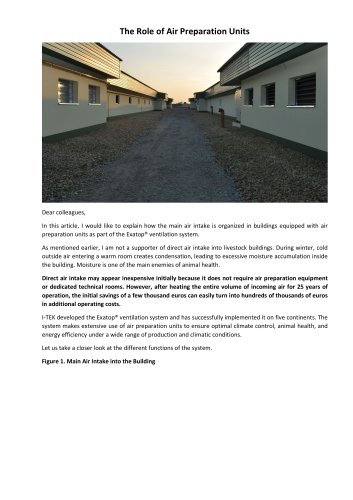
The Role of Air Preparation Units Dear colleagues, In this article, I would like to explain how the main air intake is organized in buildings equipped with air preparation units as part of the Exatop® ventilation system. As mentioned earlier, I am not a supporter of direct air intake into livestock buildings. During winter, cold outside air entering a warm room creates condensation, leading to excessive moisture accumulation inside the building. Moisture is one of the main enemies of animal health. Direct air intake may appear inexpensive initially because it does not require air preparation equipment or dedicated technical rooms. However, after heating the entire volume of incoming air for 25 years of operation, the initial savings of a few thousand euros can easily turn into hundreds of thousands of euros in additional operating costs. I-TEK developed the Exatop® ventilation system and has successfully implemented it on five continents. The system makes extensive use of air preparation units to ensure optimal climate control, animal health, and energy efficiency under a wide range of production and climatic conditions. Let us take a closer look at the different functions of the system. Figure 1. Main Air Intake into the Building
Open the catalog to page 1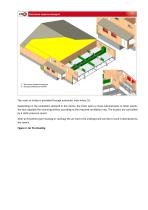
The main air intake is provided through automatic main inlets (1). Depending on the ventilation demand in the rooms, the inlets open or close automatically. In other words, the fans regulate the incoming airflow according to the required ventilation rate. The louvers are controlled by a static pressure sensor. After air treatment (pre-heating or cooling), the air enters the underground corridor (2) and is distributed to the rooms. Figure 2. Air Pre-Heating
Open the catalog to page 2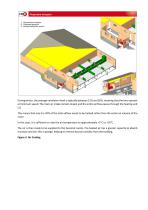
During winter, the average ventilation level is typically between 15% and 20%, meaning that the fans operate at minimum speed. The main air intake remain closed, and the entire airflow passes through the heating unit (1). This means that only 15-20% of the total airflow needs to be heated rather than the entire air volume of the room. In this case, it is sufficient to raise the air temperature to approximately +5°C to +10°C. The air is then ready to be supplied to the livestock rooms. Pre-heated air has a greater capacity to absorb moisture and acts like a sponge, helping to remove excess humidity...
Open the catalog to page 3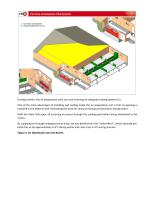
During summer, the air preparation units can cool incoming air using pad cooling systems (1). One of the main advantages of installing pad cooling inside the air preparation unit is that no opening is required in the external wall, eliminating the need for seasonal closing and insulation during winter. With the inlets fully open, all incoming air passes through the cooling pads before being distributed to the rooms. By supplying air through underground air ducts, we also benefit from the “cellar effect”, which naturally preheats the air by approximately 3–5°C during winter and cools it by 3–5°C...
Open the catalog to page 4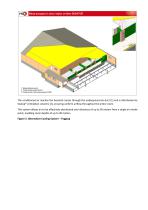
2 * Ctomio noflann BoaAyxa Stoaran 3 • OTBepcTMe aha ctomkm noflasu Boaayxa (14x42) The conditioned air reaches the livestock rooms through the underground air duct (1) and is distributed via Exatop® ventilation columns (2), ensuring uniform airflow throughout the entire room. This system allows air to be effectively distributed over distances of up to 30 meters from a single air intake point, enabling room depths of up to 30 meters.
Open the catalog to page 5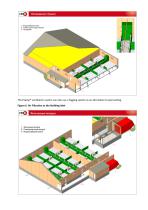
Oxna>K,qeHne (TyMaH) 2 - Ctomk3 noflann Boaayxa SiaaTon The Exatop® ventilation system can also use a fogging system as an alternative to pad cooling.
Open the catalog to page 6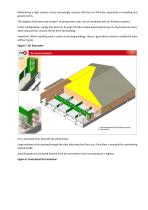
Maintaining a high sanitary status increasingly requires effective air filtration, especially on breeding and genetic farms. The diagram illustrates how Exatop® air preparation units can be combined with air filtration systems. In this configuration, supply fans force air through the filter media before delivering it to the livestock rooms, while exhaust fans remove the air from the building. Important: When installing such a system in existing buildings, there is generally no need to modify the main airflow routes. Air is extracted from beneath the slatted floor. Large volumes of air passing...
Open the catalog to page 7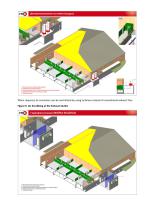
1 * BenTM^PUHOHHbiH koqoC ewBoaa eoaayxa 2 - OroepcTMe am Bwxoaa Boaayxa 3 - BeHTH/inutfOHMan maxTa are* qeHTpareooeaHHoro ewxoaa aoaayxa 4 • T ypBMHHbM flBKaTenb am Bbeoaa aoiayxa When required, air extraction can be centralized by using turbines instead of conventional exhaust fans. Figure 9. Air Scrubbing at the Exhaust Outlet fkiApocbti/ibTpauMB (MOUKA B03flYXA) 2 - OTeepc Tut Ann awxcwia BOiflyxa 3 - BeHTMTuiurtOMHaA uiaxra nns ue*«TpanMJoeaMMoro Btixcuia eoxoyxa 4 - TypOwiHbiM a&nra renb Ann BMBoaa Boaayxa 5 - r MApO$M/lfaTpBUMfl
Open the catalog to page 8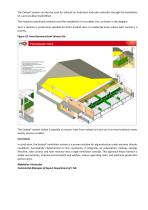
The Exatop® system can also be used for exhaust air treatment and odor reduction through the installation of a wet scrubber (hydrofilter). This requires centralized extraction and the installation of a scrubber unit, as shown in the diagram. Such a solution is particularly valuable for farms located close to residential areas where odor control is a priority. PeKynepaqkm tenna I BenTMnnuMOHHMri *opoC BuBoaa eoiayxa 2 - BeHTMnnuMOHHan uiaxTa ore qeHTpasiMJceaHHoro BbtxoAa aosflyxfl 4 Typoaow'MM naMrarenb one* smboob BoaiQraa 5 - Ocmobmoh nanan pe«ynef>au»»H Teona 7 flonorxrtteribHbtt) pe«ynepau»«M...
Open the catalog to page 9All I-TEK catalogs and technical brochures
 DRY Finishing
2 Pages
 EXA+: Ventilation control
2 Pages
 TEMPO FEEDER
2 Pages
 GEVISPACE & FEEDING STALLS
2 Pages
 GEVITOP feeding station
2 Pages
- Nipple drinker
- Floor grating
- Stainless steel nipple drinker
- Non-slip flooring
- Pig nipple drinker
- Pig pen
- Livestock building
- Floor panel for farm buildings
- Feeding equipement
- Livestock partition
- Plastic flooring
- Pig breeding floor panel
- Plastic floor panel
- Plastic partition
- Hygienic flooring
- Non-slip floor panel
- Heating lamp
- Calving
- PVC partition
- Metal flooring