
- Catalogs
- Irriquip CC
- WHY I-FEEDER

WHY I-FEEDER

WHY I-FEEDER
I-Feeder Dosing Systems emphasizes growth through service and innovation, offering various types of effective liquid chemical dosing systems.
- Centrifugal Pumps with Flowmeter and Fluid Control Valve: Utilizes a centrifugal pump and flowmeter for dosing, with control via a tap.
- Positive Displacement Pump with Piston Liquid-End Drive: Uses an electric motor-driven piston to create a vacuum for fluid suction and dosing.
- Positive Displacement Pump with Diaphragm Liquid-End Drive: Similar to the piston drive but uses a diaphragm, offering variable dosing options.
- Option 1 (Centrifugal Pumps): Low cost and high flow but high maintenance and unreliable due to pressure variations.
- Option 2 (Piston Liquid-End Drive): Highly accurate and high pressure but sensitive to air and impurities, and labor-intensive.
- Option 3 (Diaphragm Liquid-End Drive): Accurate, durable, and economical, with easy maintenance but sensitive to blockages.
- History: Founded in 1981, with a focus on quality control and innovation.
- Engineering: Durable materials and design for longevity and ease of maintenance.
- Functionality: Versatile dosing capabilities with low stock requirements and upgrade options.
- Service: Easy on-site serviceability with minimal maintenance parts.
- Exports: Proven design with global footprint, lightweight for low freight costs, and easy installation.
Considerations include volume, pressure, product type, power supply, and control type.
- Before Installation: Ensure proper pipe lengths and valve positioning, and have an electrician ready.
- During Installation: Ensure correct motor rotation and airtight connections.
- De-aeration and Calibration: Necessary steps for initial setup and accuracy.
Automated systems offer proportional dosing, pH/EC control, cloud reporting, and more, enhancing crop yields and reducing costs.
I-Feeder Dosing Systems provides reliable and innovative solutions for liquid chemical dosing, supported by a strong service network and global presence.
Catalog excerpts

WHY I-FEEDER DOSING SYSTEMS
Open the catalog to page 1
growth through service and innovation
Open the catalog to page 2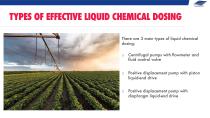
There are 3 main types of liquid chemical dosing: o Centrifugal pumps with flowmeter and fluid control valve o Positive displacement pump with piston liquid-end drive o Positive displacement pump with diaphragm liquids drive
Open the catalog to page 3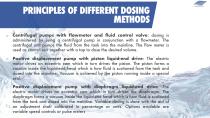
PRINCIPLES OF DIFFERENT DOSING METHODS o Centrifugal pumps with flowmeter and fluid control valve: dosing is administered by using a centrifugal pump in conjunction with a flowmeter. The centrifugal unit pumps the fluid from the tank into the mainline. The flow meter is used as control unit together with a tap to dose the desired volume. Positive displacement pump with piston liquid-end drive: The electric motor drives an eccentric cam which in turn drives the piston. The piston forms a vacuum inside the liquid-end head which is how fluid is suctioned from the tank and dosed into the mainline....
Open the catalog to page 4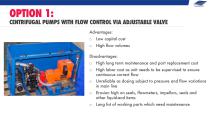
Advantages: o Low capital cost o High flow volumes Disadvantages: o High long term maintenance and part replacement cost o High labor cost as unit needs to be supervised to ensure continuous correct flow o Unreliable as dosing subject to pressure and flow variations in main line o Erosion high on seals, flowmeters, impellors, seals and other liquid-end items o Long list of working parts which need maintenance
Open the catalog to page 5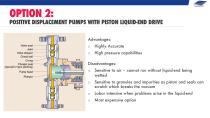
POSITIVE DISPLACEMENT PUMPS WITH PISTON LIQUID-END DRIVE Advantages: o Highly Accurate High pressure capabilities Sensitive to air – cannot run without liquid-end being wetted Sensitive to granules and impurities as piston and seals can scratch which breaks the vacuum Labor intensive when problems arise in the liquid-end Most expensive option
Open the catalog to page 6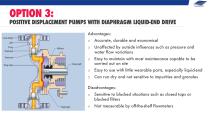
OPTION 3: POSITIVE DISPLACEMENT PUMPS WITH DIAPHRAGM LIQUID-END DRIVE Advantages: o Accurate, durable and economical o Unaffected by outside influences such as pressure and water flow variations o Easy to maintain with most maintenance capable to be carried out on site o Easy to use with little wearable parts, especially liquid-end o Can run dry and not sensitive to impurities and granules Disadvantages: o Sensitive to blocked situations such as closed taps or blocked filters o Not measurable by off-the-shelf flowmeters
Open the catalog to page 7
1: History o Company founded in 1981 o Main shareholder control in hands of founding family ensuring a high level of quality control o Main business unit has at its core dosinq systems Growth through service and innovation o Company ethos is growth through service and innovation Footprints through all of Africa, Middle east, Europe and Asia
Open the catalog to page 9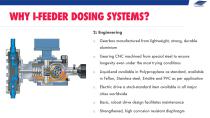
2: Engineering o Gearbox manufactured from lightweight, strong, durable aluminium o Gearing CNC machined from special steel to ensure longevity even under the most trying conditions o Liquid-end available in Polypropylene as standard, available in Teflon, Stainless steel, Ertalite and PVC as per application o Electric drive a stock-standard item available in all major cities worldwide o Basic, robust drive design facilitates maintenance o Strengthened, high corrosion resistant diaphragm
Open the catalog to page 10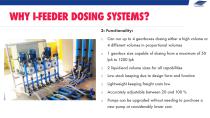
3: Functionality: o Can run up to 4 gearboxes dosing either a high volume or 4 different volumes in proportional volumes o 1 gearbox size capable of dosing from a maximum of 50 Iph to 1200 Iph o 2 liquid-end volume sizes for all capabilities o Low stock keeping due to design form and function o Lightweight keeping freight costs low o Accurately adjustable between 20 and 100 % Pumps can be upgraded without needing to purchase a new pump at considerably lower cost.
Open the catalog to page 11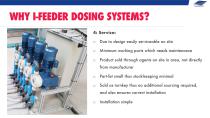
4: Service: o Due to design easily serviceable on site o Minimum working parts which needs maintenance o Product sold through agents on site in area, not directly from manufacturer o Part-list small thus stock-keeping minimal o Sold as turnkey thus no additional sourcing required, and also ensures correct installation o Installation simple
Open the catalog to page 12
5: Exports: o Proven design with footprint in all of Africa, Europe, Asia and the Middle East o Light-weight for low freight cost o Turn-key supply for instant installation, ease of use o Accuracy with simple operation o Basic training from installation manual sufficient, ensuring the sales agents need not be on site to install.
Open the catalog to page 13
WORKING HAND-IN-HAND WITH OUR AGENTS
Open the catalog to page 14
Determinants: o Volume of product to be dosed o Maximum operating pressure o Product to be dosed o Power supply o Manual of automated control If automated, what are results required
Open the catalog to page 15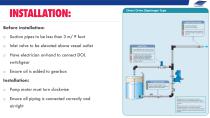
INSTALLATION: Before installation: o Suction pipes to be less than 3 m/9 foot o Inlet valve to be elevated above vessel outlet o Have electrician on-hand to connect DOL switchgear o Ensure oil is added to gearbox Installation: o Pump motor must turn clockwise o Ensure all piping is connected correctly and air-tight Direct Drive Diaphragm Type I To prevent overfeeding ^ siphoning-2 and dripping ‘ Install the back pressure valve n< the injection point on the discharge piping.
Open the catalog to page 16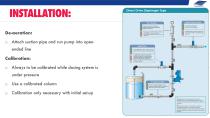
De-aeration: o Attach suction pipe and run pump into open-ended line Calibration: o Always to be calibrated while dosing system under pressure o Use a calibrated column o Calibration only necessary with initial set-up Direct Drive Diaphragm Type
Open the catalog to page 17
We have automated dosing systems, capable of: o Proportional dosing o pH/ EC control o Volume dosed setting o Cloud reporting o Time control o Block controlled dosing
Open the catalog to page 18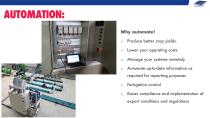
Why automate? o Produce better crop yields. o Lower your operating costs. o Manage your systems remotely o Automate up-to-date information as required for reporting purposes o Fertigation control o Easier compliance and implementation of export conditions and regulations
Open the catalog to page 19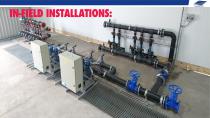
IN-FIELD INSTALLATIONS:
Open the catalog to page 21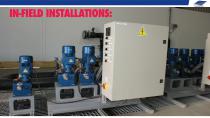
IN-FIELD INSTALLATIONS:
Open the catalog to page 22All Irriquip CC catalogs and technical brochures
 MIXER INSTALLATION MANUAL
2 Pages
 MXD DOSING PUMP MANUAL 2020
16 Pages

