
- Catalogs
- Kaeser Kompressoren
- Magnetic Bearing Turbo Blowers

- Products
- Catalogs
- News & Trends
- Exhibitions
Magnetic Bearing Turbo Blowers
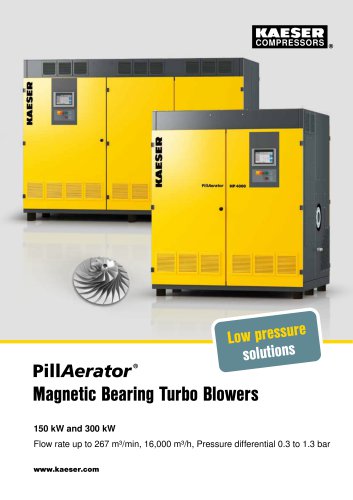
Magnetic Bearing Turbo Blowers
Catalog excerpts
Magnetic Bearing Turbo Blowers 150 kW and 300 kW Flow rate up to 267 m³/min, 16,000 m³/h, Pressure differential 0.3 to 1.3 bar www.kaeser.com
Open the catalog to page 1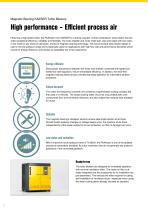
Magnetic Bearing KAESER Turbo Blowers High performance – Efficient process air Featuring a high-speed motor, the PillAerator from KAESER is a directly coupled, oil-free compression turbo blower that provides exceptional efficiency, reliability and flexibility. The turbo impeller and motor shaft start, stop and rotate with zero wear, or the need for any need for lubrication, thanks to magnetic bearing technology. This future-forward turbo blower design is used in the low pressure range and is especially useful for applications with high flow rate and performance demands where maximum energy efficiency...
Open the catalog to page 2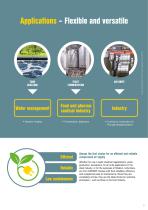
TANK AERATION YEAST FERMENTATION Water management Food and pharmaceutical industry Efficient Reliable Low maintenance Montage uses images from: © Valenty, navintar, industrieblick - stock.adobe.com Applications – Flexible and versatile Industry ► Cooling air, combustion air Flue gas desulphurisation Always the first choice for an efficient and reliable compressed air supply Whether for use in water treatment applications, yeast production, bioreactors, for air knife applications in the steel industry, or for the purposes of flotation, turbo blowers from KAESER impress with their reliability,...
Open the catalog to page 3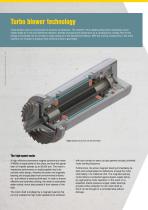
Turbo blower technology © KEBA Industrial Automation Germany GmbH, Simone Schuldis - Fotolia Turbo blowers work on the principle of dynamic compression. The impeller of the radially-acting turbo compressor accelerates intake air in the circumferential direction, thereby increasing flow speed and, as a consequence, energy. Part of this energy is converted into an increase in static pressure in the downstream diffuser. With few moving components in this turbo machine, an increase in pressure with continuous flow is generated. Image: Magnetic bearing motor with attached impeller The high-speed motor...
Open the catalog to page 4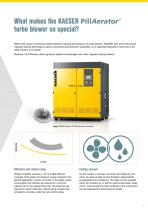
Rather than using conventional aviation-based air bearing technology for its turbo blowers, KAESER uses smart astronautic magnetic bearing technology to assure uncompromising long-term availability, as is especially expected of machines in the water industry, for example. Moreover, the PiMAerator offers significant additional advantages over other magnetic bearing blowers. Efficiency and control range Different impeller versions (L, M, H) enable efficient coverage of the power and pressure range required by the specific application at hand. As shown in the graph, power consumption can therefore...
Open the catalog to page 5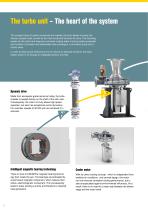
The turbo unit – The heart of the system The compact heart of system comprises the impeller, the turbo blower housing, the directly coupled motor, as well as the inlet nozzle and the blow-off valve. The recooling system for the motor and frequency converter cooling water is just as easily accessible and consists of air/water and water/water heat exchangers, a circulation pump and a control valve. In order to keep sound emissions at the air inlet to an absolute minimum, the turbo blower draws in air through an integrated silencer and filter. Dynamic drive Image: © KEBA Industrial Automation Germany...
Open the catalog to page 6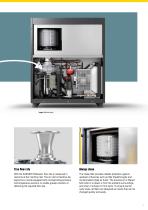
Image: Machine layout True flow rate Always clean With the KAESER PillAerator, flow rate is measured in real-time at the machine inlet. The air inlet is therefore designed as a nozzle equipped with corresponding pressure and temperature sensors, to enable greater precision in delivering the required flow rate. The intake filter provides reliable protection against upstream influences such as filter breakthroughs and contaminated intake air ducts. The process air is filtered both when it is drawn in from the ambient surroundings and when it is drawn in from ducts. To ensure low life cycle costs,...
Open the catalog to page 7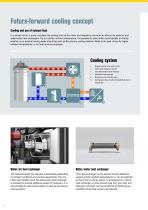
Future-forward cooling concept Cooling and use of exhaust heat In a closed circuit, a pump circulates the cooling fluid via the motor and frequency converter, as well as via water/air and water/water heat exchangers. Up to a certain ambient temperature, it is possible to select either automatically or directly whether air or external cooling water should be used as the primary cooling medium. Water is the best choice for higher ambient temperatures, or for heat recovery purposes. Magnetic bearing motor, water-cooled Water-cooled frequency converter Controllable water/air heat exchanger Water/water...
Open the catalog to page 8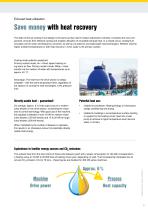
Exhaust heat utilisation Save money with heat recovery The state-of-the-art cooling circuit design is the same as that used in today’s advanced e-vehicles. It protects the core components, ensures their effective cooling and enables utilisation of recyclable exhaust heat. In a closed circuit, cooling fluid circulates via the motor and frequency converter, as well as via water/air and water/water heat exchangers. Whether used for higher ambient temperatures or with heat recovery in mind, water is the primary coolant. Cooling mode selection explained: Primary coolant mode: Air = Direct space heating...
Open the catalog to page 9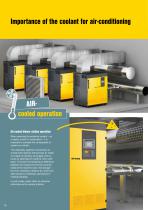
Importance of the coolant for air-conditioning AIRcooled operation Air-cooled blower station operation When selecting the preferred coolant – air or water, or both in combination – it is important to consider the compressed air system as a whole. This especially applies to exclusively aircooled turbo stations with process air intake via supply air ducting, and supply and exhaust air openings for machine room ventilation. The lower the temperature difference between the outside environment and the inside of the machine room, the stronger the room ventilation needs to be, which can often present...
Open the catalog to page 10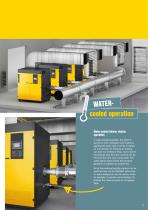
WATERcooled operation Water-cooled blower station operation In water-cooled operation, the effort required for room ventilation and cooling is significantly lower, both in terms of supply air and exhaust air. Exhaust air ducting can even be omitted entirely, since most of the exhaust heat from the machine can be removed from the room using water. The water piping shown below the pressure pipework is sufficient to achieve this. Since the preferred cooling medium can be switched over via the KAESER turbo blower, warm exhaust air can be used in winter, for example, to provide room heating or to...
Open the catalog to page 11All Kaeser Kompressoren catalogs and technical brochures
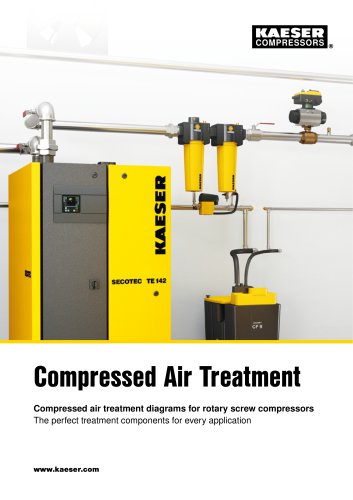 Compressed Air Treatment
4 Pages
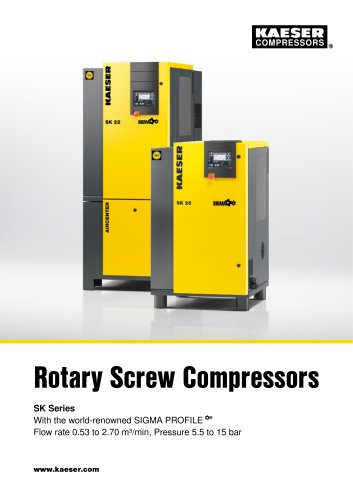 SK Series
9 Pages
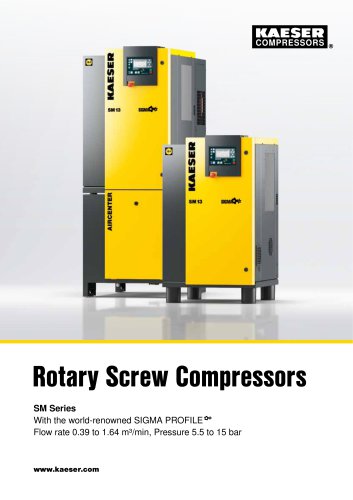 SM Series
9 Pages
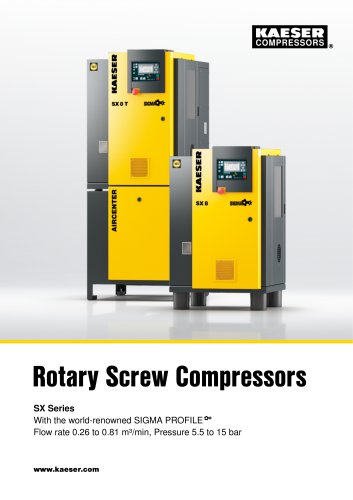 SX Series
9 Pages
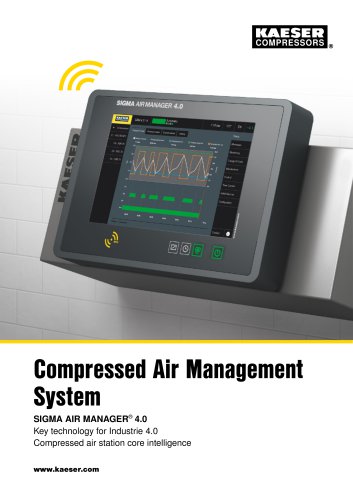 Compressed Air Management System
20 Pages
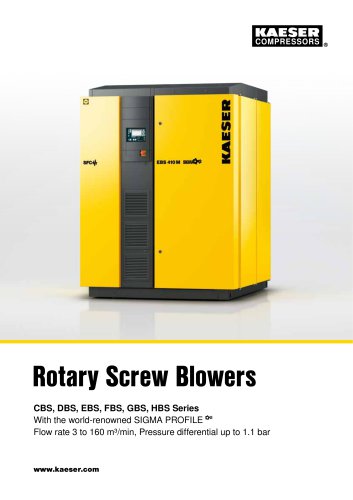 Rotary Screw Blowers
11 Pages
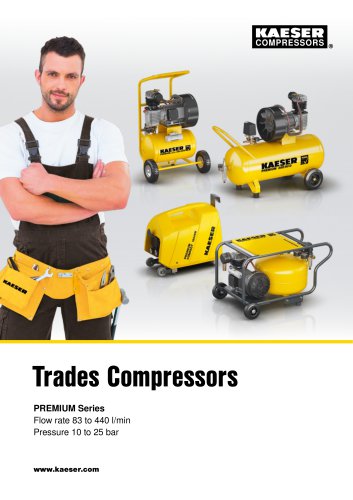 Trades Compressors
16 Pages
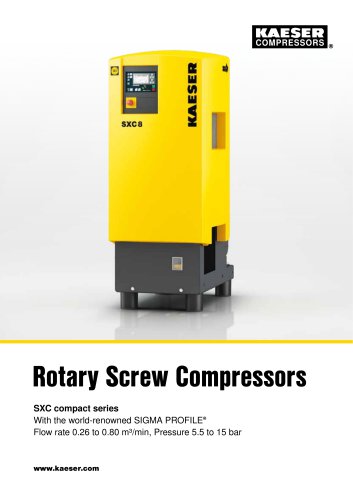 Rotary Screw Compressors
8 Pages