
- Catalogs
- Kinze Manufacturing, Inc.
- MODEL 3505 - OPERATOR'S MANUAL

MODEL 3505 - OPERATOR'S MANUAL

MODEL 3505 - OPERATOR'S MANUAL
This manual provides comprehensive instructions for the operation and maintenance of the Model 3505 Pivot Fold Planters, applicable from the 2021 production year onwards. It includes essential information such as model and serial numbers for obtaining replacement parts and service.
Dealers must ensure the planter is fully assembled, lubricated, adjusted, and tested before delivery. Key checks include proper spacing of row units, lubrication of grease fittings, tension and alignment of drive chains, and correct installation of safety decals and lights. The checklist emphasizes explaining operational adjustments, safety precautions, and warranty details to the customer.
This section covers initial preparation, tractor requirements, and various adjustments for optimal planter operation. It includes detailed instructions on hydraulic operations, PTO pump drive options, and planting speed adjustments.
Instructions for setting planting depth, adjusting closing wheels, and maintaining seed meters are provided. The section also covers the operation of various seed metering systems and the importance of proper maintenance.
Details on different fertilizer opener options and attachments for both dry and liquid fertilizers are included. This section provides guidance on setup and maintenance to ensure effective fertilizer application.
Regular lubrication and maintenance are critical for the longevity of the planter. This section outlines lubrication points, chain tension adjustments, and maintenance procedures for various components, including seed meters and hydraulic systems.
The manual includes detailed hydraulic diagrams for different planter configurations, providing essential information for troubleshooting and maintenance of the hydraulic systems.
Kinze Manufacturing, Inc. provides this manual for the operation and maintenance of the Model 3505 planter. It emphasizes the importance of understanding safety, operation, lubrication, and maintenance instructions before using the equipment. The manual includes safety symbols and terms such as DANGER, WARNING, and CAUTION to highlight potential hazards.
The Kinze Limited Warranty covers registered products operated and maintained as per the manual. Abuse or modification beyond factory specifications voids the warranty. Registration must be completed within 5 business days of delivery. Warranty does not cover travel time, mileage, hauling, or labor costs.
The Model 3505 planter specifications include the number of rows, weight, transport and planting dimensions, seed capacity, and hydraulic requirements.
Key safety rules include understanding and following all manual instructions and warning labels, ensuring the planter is operated by knowledgeable individuals only, maintaining awareness of bystanders, using appropriate protective gear, and following regulations for towing on public highways.
Safety signs and decals are crucial for hazard warnings and operational guidance. Users are advised to keep signs clean and replace any that are damaged or missing.
Before operating the planter, ensure all instructions in the Operator Manual are followed. Key safety warnings include checking and torquing transport wheel lug bolts, inflating tires to specified pressures, and ensuring hydraulic pressures are within specified limits.
The planter requires a 12-volt DC electrical system and two dual remote hydraulic outlets. Additional requirements include a PTO pump for vacuum and bulk fill equipped planters.
Includes safety lockup pin, stroke limiter pin, transport latch locking pin, and hitch length adjustment.
The hydraulic system includes a lift cylinder, counterbalance valve, and selector valve for row marker or fold functions. A PTO pump drive and oil cooler option is available for tractors with insufficient hydraulic output.
Instructions for adjusting the tractor drawbar and connecting the planter are provided. A safety chain must be used to prevent disconnection in case of hitch failure.
Transporting planters with hoppers over half full can lead to loss of control. Tow only with a suitable farm tractor and adhere to road and bridge load limits.
Operate planters within a speed range of 2 to 8 mph. Seed spacing may be affected at speeds above 5.5 mph.
Avoid contact with power lines or high energy sources. Ensure all safety/warning lights and reflective decals are visible before transporting on public roads.
The document provides detailed instructions for operating the Model 3505M0302-01, focusing on various components and procedures essential for efficient machine operation.
Instructions for shutting down the bulk fill system and accessing the entrainer for maintenance.
Instructions for cleaning out the bulk fill tanks.
Adjustments for the transport axle and tire scraper to prevent dirt buildup.
Optional package includes halogen or LED flood lamps with mounting hardware and wiring harness.
Used for towing wagons, with specific weight and clearance requirements to prevent damage.
Conduct field tests to ensure proper seed placement and operation.
Measure and calculate seed population per acre using specific row width distances.
Attach calibrated vials to meters, drive a specified distance, and weigh the chemical to determine application rates.
Fill with clean or potable water for emergency chemical exposure.
Adjust planting depth using gauge wheels and ensure proper alignment of closing wheels.
Details on disc color codes, seed size ranges, and lubricants for various crops.
Information on crop-specific finger assemblies and lubricants.
Settings for different crops, including seed disc kits, vacuum levels, and recommended lubricants.
The machine's safety signs and decals conform to ANSI/ASABE standards.
Key safety warnings include checking and torquing transport wheel lug bolts, inflating tires to specified pressures, and ensuring hydraulic pressures are within specified limits.
The planter requires a 12-volt DC electrical system and two dual remote hydraulic outlets.
Includes safety lockup pin, stroke limiter pin, transport latch locking pin, and hitch length adjustment.
The hydraulic system includes a lift cylinder, counterbalance valve, and selector valve for row marker or fold functions.
Instructions for adjusting the tractor drawbar and connecting the planter are provided.
Transporting planters with hoppers over half full can lead to loss of control.
Operate planters within a speed range of 2 to 8 mph.
Avoid contact with power lines or high energy sources.
Down pressure springs are preset and usually require no adjustment.
Adjust row marker extension to match the total planting width.
The vacuum meter system includes seed meters, discs, and a hydraulic-driven vacuum fan.
The document provides detailed instructions for operating the Model 3505M0302-01.
Instructions for shutting down the bulk fill system and accessing the entrainer for maintenance.
Instructions for cleaning out the bulk fill tanks.
Adjustments for the transport axle and tire scraper to prevent dirt buildup.
Optional package includes halogen or LED flood lamps with mounting hardware and wiring harness.
Used for towing wagons, with specific weight and clearance requirements to prevent damage.
Conduct field tests to ensure proper seed placement and operation.
Measure and calculate seed population per acre using specific row width distances.
Attach calibrated vials to meters, drive a specified distance, and weigh the chemical to determine application rates.
Fill with clean or potable water for emergency chemical exposure.
Adjust planting depth using gauge wheels and ensure proper alignment of closing wheels.
Details on disc color codes, seed size ranges, and lubricants for various crops.
Information on crop-specific finger assemblies and lubricants.
Settings for different crops, including seed disc kits, vacuum levels, and recommended lubricants.
The document outlines various seed disc kits, each identified by a part number and color code, designed for different crops.
Instructions are provided for installing seed discs, adjusting vacuum levels, and operating the vacuum fan.
The use of graphite, talc, and Bayer Fluency Agent is discussed.
Regular cleanout of seed meters is crucial to maintain genetic purity and prevent underplanting.
The document describes the seed meter drive release mechanism, row unit extension brackets, and the pneumatic down pressure package option.
The document advises regular inspection and maintenance of row unit chains, springs, and other components.
This document provides detailed instructions for operating and maintaining various components of a planting machine.
Instructions for calculating down pressure and locking up push row units.
Designed to keep push row units in a raised position.
Includes vacuum hose shutoff and clutch sprocket engagement/disengagement for push row units.
Details on granular chemical hoppers, including capacity and calibration instructions.
Warnings about potential hazards when handling agricultural chemicals and operating machinery.
Ensure proper torque settings for hardware to maintain equipment integrity.
This document provides detailed instructions and specifications for the maintenance and operation of the Model 3505 fertilizer and seed planting equipment.
Disassemble and clean hoppers and auger assemblies.
Optional low rate check valves are available to ensure equal distribution at low rates.
Planting rates are affected by seed size, shape, and planting speed.
Follow all chemical and equipment manufacturer instructions to prevent injury or damage.
Detailed charts provide approximate seeds per acre for different row widths and seed types.
This document provides detailed planting rate charts for various row widths using different types of seed meters.
Data is provided for 15" and 30" rows.
Field Check: It is advised to always field check seed population to verify planting rates.
Planting rates over 250,000 seeds/acre are not recommended with the specified seed disc and drive ratio.
Tables provide approximate seeds per acre for various configurations.
Use of a 28 tooth drive sprocket and a 27 tooth driven sprocket is specified for certain configurations.
This document provides detailed instructions for the lubrication and maintenance of various components of the Model 3505 equipment.
All transmission and drive chains should be lubricated daily with high-quality chain lubricant.
Wheel bearings should be repacked annually and checked for wear.
The PTO shaft coupling should be cleaned and greased each time the pump is installed.
The crankcase oil level should be checked daily and maintained at the plug level.
Bushings should be lubricated at the indicated frequency, and bolts should be checked for proper torque.
All hardware should be checked for tightness before the first operation and periodically thereafter.
Proper tire pressure is crucial to prevent tire explosions.
Drive chains are self-adjusting with spring-loaded idlers.
The seed meter should be inspected and adjusted regularly to ensure proper operation.
High-quality seed should be used to prevent foreign materials from affecting meter accuracy.
The wear band protects the meter housing from damage.
The document outlines the specifications for various components of a seed planting machine.
The document provides detailed procedures for the lubrication and maintenance of various components.
Instructions for cleaning and storing the brush-type seed meter are provided.
The document details the procedures for adjusting and replacing gauge wheel arm bushings, seals, and pivot spindles.
Instructions for maintaining the row unit mounted no-till coulter, spiked closing wheel, and granular chemical attachment are included.
The document provides guidelines for adjusting and replacing wear pads.
Ensure correct check balls and springs are installed in each valve bore during reassembly.
Drain the reservoir, clean the strainer, and change the filter annually.
Inspect check valves for foreign material and leaks.
For row marker bearings, remove and clean components, replace if necessary, and lubricate thoroughly.
Disassemble, clean, and inspect the check valve.
Store the planter in a dry area, remove debris, lubricate parts, and clean seed meters.
Store hoses in a clean, cool, dry area away from sunlight and corrosive chemicals.
Several diagrams illustrate the hydraulic systems for different planter configurations.
Common issues such as closing wheel imprints, seed flow problems, and pump issues are addressed with potential causes and solutions.
This document provides a comprehensive troubleshooting guide for various equipment issues.
Common issues include air leaks, broken valve springs, and excessive oil usage.
Problems such as markers lowering incorrectly or not moving are addressed.
Issues like low seed count and high seed count are discussed.
Problems include one row not planting and irregular seed spacing.
Common issues include low seed count, poor seed spacing, and irregular seed population.
Regular maintenance and inspection are crucial to prevent equipment failures.
Catalog excerpts

MODEL 3505 PIVOT FOLD PLANTER OPERATOR’S MANUAL This manual applies to: Model: 3505 Pivot Fold Planters 2021 production and on Record the model number and serial number of your planter along with date purchased: Serial Number____________________________________ Date Purchased___________________________________ Monitor Serial Number________________________________________________ Measured Pulses Per Mile/Km (Radar Distance Sensor)_____________________ Measured Pulses Per Mile/ Km (Magnetic Distance Sensor) __________________ SERIAL NUMBER The serial number plate is located on the planter frame as shown below. The serial number provides important information about your planter and is needed to obtain correct replacement parts. Always provide model number and serial number to your Kinze Dealer when ordering parts or when contacting Kinze Manufacturing, Inc. Kinze®, the Kinze® logo, Twin-Line®, and Interplant® are registered trademarks of Kinze Manufacturing, I
Open the catalog to page 1
This page left blank intentionally.
Open the catalog to page 2
Predelivery/Delivery Checklist TO THE DEALER Predelivery service includes assembly, lubrication, adjustment and test. This service helps to ensure planter is delivered to retail customer/end user ready for field use. PREDELIVERY CHECKLIST Use the following checklist after planter is completely assembled to inspect planter. Check off each item as it is found satisfactory or after proper adjustment is made. Row units properly spaced and optional attachments correctly assembled. grease fittings in place and lubricated. All working parts are moving freely. Bolts are tight and cotter pins are...
Open the catalog to page 3
Predelivery/Delivery Checklist DELIVERY CHECKLIST Use the following checklist when planter is delivered as a reminder of important information which should be conveyed to retail customer/end user. Check off each item as it is fully explained. Check for proper operation of vacuum fan and PTO driven pump (If Applicable) with tractor to be used with planter. Life expectancy of this or any other machine is dependent on regular lubrication as directed in the Operator Manual. applicable safety precautions. All Along with retail customer/end user, check reflective decals and SMV sign are clearly...
Open the catalog to page 4
Auxiliary Work Lights Package. . . . . . . . . . . . . . . . . . . . . 2-26 Rear Trailer Hitch. . . . . . . . . . . . . . . . . . . . . . . . . . . . . . . 2-27 Check Seed Population. . . . . . . . . . . . . . . . . . . . . . . . . . 2-28 Determining Pounds Per Acre (Brush-Type Meter). . . . . 2-29 Determining Bushels Per Acre. . . . . . . . . . . . . . . . . . . . . 2-29 Tractor Hydraulic Requirements . . . . . . . . . . . . . . . . . . . . 1-6 Granular Chemical Application Field Check . . . . . . . . . . 2-30 General Safety Rules. . . . . . . . . . . . . . . . . . . . . . . . . . . . . 1-7...
Open the catalog to page 5
LUBRICATION AND MAINTENANCE Lubrication . . . . . . . . . . . . . . . . . . . . . . . . . . . . . . . . . . . . . 6-1 Lubrication Symbols . . . . . . . . . . . . . . . . . . . . . . . . . . . . . 6-1 Sealed Bearings . . . . . . . . . . . . . . . . . . . . . . . . . . . . . . . . 6-1 Wrap Spring Wrench Assembly . . . . . . . . . . . . . . . . . . . . . 6-1 Drive Chains . . . . . . . . . . . . . . . . . . . . . . . . . . . . . . . . . . . 6-2 Center Post . . . . . . . . . . . . . . . . . . . . . . . . . . . . . . . . . . . . 6-4 Wheel Bearings . . . . . . . . . . . . . . . . . . . . . . . . . ....
Open the catalog to page 6
Kinze Manufacturing, Inc. thanks you for your patronage. We appreciate your confidence in Kinze farm machinery. Your Kinze planter has been carefully designed to provide dependable operation in return for your investment. This manual has been prepared to aid you in the operation and maintenance of the planter. It should be considered a permanent part of the machine and remain with the machine when you sell it. It is the responsibility of the user to read and understand the Operator Manual in regards to safety, operation, lubrication and maintenance before operation of this equipment. It is the...
Open the catalog to page 7
Improperly operating or working on this equipment could result in death or serious injury. Read and follow all instructions in Operator Manual before operating or working on this equipment. Some photos in this manual may show safety covers, shields, or lockup devices removed for visual clarity. NEVER OPERATOR OR WORK ON machine without all safety covers, shields, and lockup device in place as required. NOTE: Some photos in this manual may have been taken of prototype machines. Production machines may vary in appearance. NOTE: Some photos and illustrations in this manual show optional attachments...
Open the catalog to page 8
The Kinze Limited Warranty for your new machine is stated on the retail purchaser’s copy of the Warranty And Delivery Receipt form. Additional copies of the Limited Warranty can be obtained through your Kinze Dealer. Warranty, within the warranty period, is provided as part of Kinze’s support program for registered Kinze products which have been operated and maintained as described in this manual. Evidence of equipment abuse or modification beyond original factory specifications will void the warranty. Normal maintenance, service and repair is not covered by Kinze warranty. To register your Kinze...
Open the catalog to page 9
GENERAL INFORMATION This manual covers all production years of the Model 3505 planter. Contact your Kinze dealer for additional options which may be available for your specific model year planter. Information in this manual was current at time of printing. However, due to Kinze’s ongoing product improvement, production changes may cause your machine to appear slightly different in detail. Kinze Manufacturing, Inc. reserves the right to change specifications or design without notice and without incurring obligation to install the same on machines previously manufactured. To obtain the most recent...
Open the catalog to page 10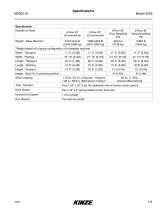
Specification Number of Rows Weight - Base Machine* 8 Row 30" (True Rate/Bulk Fill) *Weight based off a typical configuration of a complete machine. Width - Transport Width - Planting Length - Transport Length - Planting Height - Transport Height - Bulk Fill (In planting position) Seed Capacity 1.75 bu. (61.6 L) (Vacuum / Hopper); 1.90 bu. (66.8 L) (Mechanical / Hopper) Tires - Transport Four 7.50" x 20" 8 ply rib implement tires w/custom center groove Drive System Two 4.10" x 6" spring-loaded contact drive tires Hydraulic Lift System
Open the catalog to page 11All Kinze Manufacturing, Inc. catalogs and technical brochures
 PLANTERS
15 Pages
 DUAL AUGER GRAIN CARTS
4 Pages
 GRAIN CARTS
16 Pages
 KINZE Grain Carts
16 Pages
 KINZE Planters
40 Pages


- Agricultural trailer
- Seeder
- Vertical tiller
- 2-section disc tiller
- Single-axle wagon
- Trailer with hydraulic braking
- Precision seed drill
- Towed vertical tiller
- Mounted disc tiller
- Disc harrow with hydraulic adjustment
- Disc tiller with roller
- Pneumatic precision seed drill
- Tractor-mounted precision seed drill
- Foldable disc harrow
- Precision seed drill with fertilizer applicator
- Grain trailer
- Chaser bin
- 6-rows precision seed drill
- Folding precision seed drill