The ultimate combination for freshness. MAPAX® modifi ed atmosphere packaging
The ultimate combination for freshness. MAPAX® modifi ed atmosphere packaging
Modified Atmosphere Packaging (MAP) is a technology developed by Linde Gas to preserve food freshness and flavor without chemical preservatives. It addresses consumer demand for fresh, minimally processed food by extending the shelf-life of perishable products using natural gases and suitable packaging materials.
MAP extends food shelf-life, reduces spoilage, and increases market share by allowing products to be distributed over longer distances and stored for extended periods without quality loss. This technology also facilitates the introduction of new products and market expansion.
MAP uses specific gas mixtures to inhibit microbial activity and oxidation, preserving food quality. Carbon dioxide (CO2) inhibits aerobic microorganisms, nitrogen (N2) replaces oxygen to prevent oxidation, and oxygen (O2) maintains the red color of meat. The gas mixture is tailored to the specific food product.
Effective MAP requires packaging materials with high barrier properties to protect against oxygen, light, and other deteriorating factors. Common materials include polyester, polypropylene, and polyethylene, often laminated or coextruded. Research is ongoing to develop eco-friendly materials and optimize packaging.
Five main types of packaging machines are used with MAP: vertical flow-pack, horizontal flow-pack, tray-sealer, deep-drawing, and vacuum chamber machines. Each type has specific applications and operational principles, such as gas flushing or vacuum extraction, depending on the product type and production volume.
Linde Gas supplies gases like CO2, N2, and O2 under the brands BIOGON® and MAPAX®. These gases are used alone or in mixtures, tailored to food product and packaging needs. MAPAX® solutions are optimized in collaboration with food research institutes.
MAPAX® significantly extends the shelf-life of various foods compared to traditional air packaging. For instance, raw red meat's shelf-life increases from 2-4 days to 5-8 days, and raw light poultry from 4-7 days to 16-21 days.
MAP technology extends the shelf-life of meat and poultry by using specific gas mixtures. For red meat, high oxygen concentrations maintain color, while CO2 inhibits bacterial growth. Poultry requires CO2 levels above 20% to inhibit spoilage microorganisms.
MAPAX® extends the shelf-life of fish and seafood by inhibiting aerobic bacteria with CO2 levels above 20%. For dairy, CO2 prevents mold in hard cheeses, while soft cheeses use increased CO2 and low oxygen to inhibit bacteria.
Packaging material permeability is crucial for MAP of fresh produce. Optimal Equilibrium Modified Atmosphere (EMA) with 3–10% O2 and CO2 extends shelf-life. For dry foods, low oxygen levels prevent oxidation and rancidity.
MAPAX® technology helps maintain quality in prepared foods by using low oxygen and high CO2 levels. It allows for advanced preparation and improves economic efficiency in catering operations.
Specific storage requirements under MAP vary by product, with typical gas mixtures of CO2 and N2 and temperatures between 2–4 °C. The document lists conditions for microorganism growth associated with chilled MAP foods.
Advanced packaging materials interact with the internal gas environment to extend food shelf-life. The document includes a glossary of terms related to food packaging and preservation.
Linde Gas is a leader in innovative gas solutions, offering tailored and standardized solutions to enhance productivity and profitability across industries.
Catalog excerpts
The ultimate combination for freshness. MAPAX® modified atmosphere packaging.
Open the catalog to page 1
Treating Food Better.
Open the catalog to page 2
MAP - Modified Atmosphere Packaging 8 Linde: BIOGON® and gas supply 18 MAPAX® - best for meat and meat products 24 MAPAX® - best for fish and seafood 28 MAPAX® - best for dairy products 32 MAPAX® - best for fruits and vegetables 36 MAPAX® - best for dry foods and bakery products 40 MAPAX® - best for prepared foods and catering 44 MAPAX® and BIOGON® are registered trademarks of the Linde Group.
Open the catalog to page 3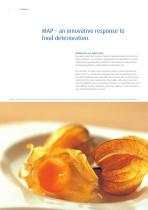
MAP – an innovative response to food deterioration. Winning the race against time Nowadays, good food has to be healthy, minimally processed and attractively packaged – as consumers’ expectations from foodstuffs are continuously rising. Consequently, demands on food producers and producers of packaging machines and materials are increasing, too. The consumer of today reacts sensitively when it comes to artificial additives. There is a strong trend towards being able to purchase and prepare fresh foodstuffs and ready-made dishes at any time, as if they came directly from the food manufacturer....
Open the catalog to page 4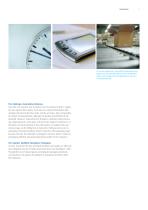
In the race against time, you profit by rationalising your logistics. Even perishable products can be transported farther, still arriving fresh and appetising for sale over an extended period. The challenge: maintaining freshness From the very moment fruit is picked, corn is harvested or fish is caught, the race against time begins. From now on, natural deterioration and spoilage (internal factors like water activity, pH-value, type and quantity of product microorganisms) endanger the quality and shelf-life of the foodstuff. However, external factors (hygienic conditions while processing, temperature...
Open the catalog to page 5
MAP benefits. A short story about long-term profits The success story begins with the consumers’ buying decision. Which foodstuffs do they buy and which ones do they refuse? And why? MAP individual packaging solutions are based on consumer statistics and intensive market research in order to be able to react directly to consumer preferences and buying patterns. By packaging the foodstuff in a modified atmosphere, it is possible to maintain high quality and extend shelf-life by days or even weeks. Products that previously could not be stored fresh throughout the distribution chain can now be offered...
Open the catalog to page 6
MAP – Modified Atmosphere Packaging MAP – Modified Atmosphere Packaging. Deterioration processes and appropriate gases Food is a biological, sensitive substance. Original freshness and shelf-life are affected by the inherent properties of the product just as much as by external factors. Internal factors affecting quality are: – the type and quantity of microorganisms – water activity aw – pH-value – cell respiration – food composition External factors affecting the inherent quality: – temperature – hygienic conditions – gas atmosphere – processing methods Low temperatures are very important for...
Open the catalog to page 8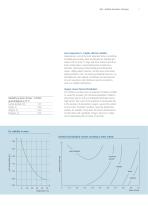
Solubility in water at Pgas = 100 KPa gram/kilogram at 15 °C MAP - Modified Atmosphere Packaging Low temperature is a highly effective inhibitor Temperature is one of the most important factors controlling microbiological activity. Most microorganisms multiply optimally in the 20 to 30 °C range and show reduced growth at lower temperatures. Careful temperature monitoring is therefore vital during all food handling and distribution stages. Chilling alone, however, will not solve all microbiological problems. There are some psychrophilic bacteria, e.g. Pseudomonas, that multiply at relatively low...
Open the catalog to page 9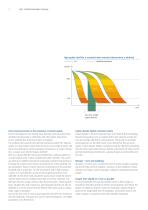
MAP - Modified Atmosphere Packaging High-quality shelf-life is extended when microbial deterioration is inhibited -Air ----Modified atmosphere From food preservation to the protection of natural quality Present developments are moving away from the previous preservative methods that physically or chemically alter the product toward less severe methods that leave the product unchanged. The methods that represent the ultimate attempt to protect the inherent quality of a food product range from processes such as high-pressure and microwave methods to various packaging techniques, e.g. oxygen...
Open the catalog to page 10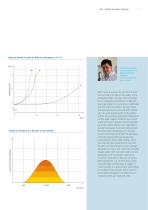
MAP – Modified Atmosphere Packaging Dr. Michael Washuettl, Head of Department of Modified and Active Packaging ofi Packaging Institute Vienna, Austria MAP is used to increase the shelf-life of foodstuffs as well as to improve the quality of the packaged product. The key to this technology lies in varying the concentration of different gases (generally CO2, N2 and O2) in coordination with the respective product. The most important prerequisites for successful MAP technologies are: good original quality of the product and the raw materials, appropriate temperature control, good hygienic conditions...
Open the catalog to page 11
Packaging materials Perfect food comes in perfect packaging. Tailored solutions for any kind of product Packaging materials are of decisive importance for food quality and shelf-life. Many sophisticated packaging solutions have been developed to prevent rapid deterioration caused by oxygen, light and bacteria or by foreign odour and taste substances that come into contact with the product. The manufacturer of foodstuffs faced with choosing suitable packaging designs and materials has many important decisions to make, and also has to comply with general legal demands for packaging materials. What...
Open the catalog to page 12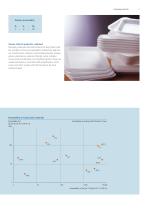
Various material properties combined Packaging materials used with all forms of MAP foods (with the exception of fruit and vegetables) should have high barrier characteristics. Polymers used include polyester, polypropylene, polystyrene, polyvinyl chloride, nylon, ethylene vinyl acetate and ethylene vinyl alcohol polymers. These are usually laminated or coextruded with polyethylene, which comes into direct contact with the food and is the heatsealing medium.
Open the catalog to page 13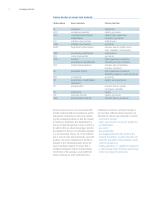
Packaging materials Primary function of various basic materials Research work strives to use environmentally friendly materials both for manufacture and for subsequent combustion as well as for optimising the packaging material, so that the amount of material is minimised. One development is the use of foamed materials in trays in order to be able to offer an attractive package. Another development is the use of reclosable packages, e.g. for sliced ham, cheese etc. In the table below is a list of some typical materials used with products. The exact composition of the film is adapted to the individual...
Open the catalog to page 14All Linde-gas catalogs and technical brochures
 SOLVOX® cone
2 Pages
 Hydrogen for forklift trucks
8 Pages
 The driving force
16 Pages