MAINPEX
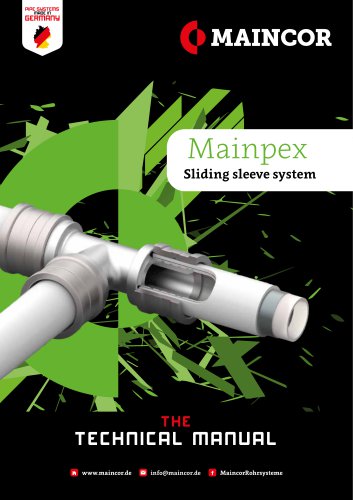
MAINPEX
The MAINPEX sliding sleeve system is designed for heating and sanitation applications, offering quick and secure assembly with structural stability. It is suitable for multi-storey and central heating systems, particularly low-temperature systems, and sanitation systems. The system is energy-efficient, environmentally friendly, and made from a pressure-resistant multi-layer composite pipe (PE-RT/Alu/PE-RT) that is 100% oxygen impermeable.
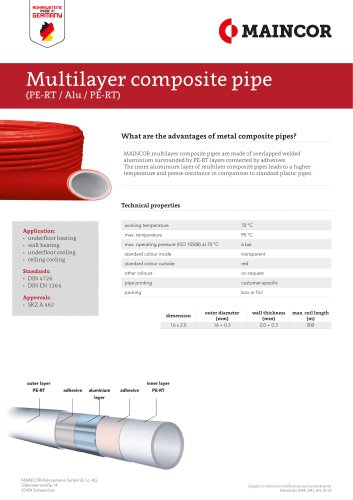
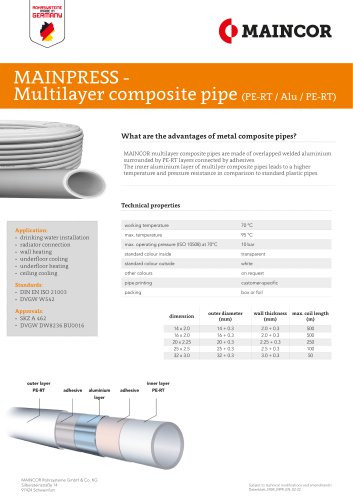
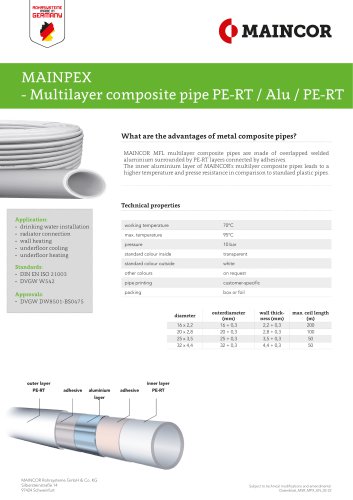
The Pipe: MAINPEX pipes are metal composite pipes with an aluminium core, providing higher temperature and pressure resistance compared to standard plastic pipes. They comply with standards such as DIN EN ISO 21003.
The Fitting: Made from brass, MAINPEX fittings are corrosion-resistant and suitable for all drinking water qualities.
Fitting Assembly: Involves cutting the pipe, widening it, and sliding the sleeve over the fitting. Specific tools are required.
Bends: Pipes can be bent by hand or with tools, adhering to specified minimum bending radii. Hot bending is prohibited.
Pipe Laying and Fastening: Pipes should be laid straight and parallel to walls, avoiding crossings.
The system is suitable for drinking water supply, adhering to the Drinking Water Ordinance and DIN 1988 standards.
Details on rinsing and pressure testing procedures are provided to ensure system integrity.
The system complies with various standards and has received necessary approvals.
MAINPEX pipes can move axially within insulation, requiring right-angled diversions to manage length changes. Insulated pipelines laid in floors must be protected during construction.
- Thermally insulate and acoustically decouple pipelines.
- Avoid pipe crossings and lay pipelines parallel to walls.
- Ensure pipelines flow into adjacent walls at right angles.
Insulate pipelines to compensate for length expansion forces and avoid plaster damage.
Fasten with pipe clips according to thermal and sound insulation requirements.
Protect MAINPEX fittings from external corrosion with coatings if necessary.
Drinking Water Installation
- Differentiate between hot and cold water installations for insulation purposes.
Heating Installation
Insulate heating pipelines against heat loss.
Follow Model Building Code and DIN 4102 for fire protection.
Adhere to DIN 4109 for sound insulation requirements.
MAINPEX system components must be protected from mechanical damage and UV radiation. Processing temperature should not fall below -10°C.
Threaded connections should follow DIN 30660, using hemp and approved sealing paste.
Proper dimensioning of pump hot water systems is crucial, including hydraulic compensation as per DIN 18380.
Planning must adhere to standards like DIN 1988 and DIN EN 806.
Drinking water must meet specific quality standards, being colorless, odorless, and pathogen-free.
Pressure and leakage testing for MAINCOR drinking water installations must comply with DIN EN 806-4 and the ZVSHK data sheet.
Testing requires devices with a measurement accuracy of +/- 1 mbar.
Devices must have a measurement accuracy of +/- 0.1 mbar, using filtered water.
Rinsing should occur before start-up using filtered water.
Tables provide data on pipe friction pressure drops for various pipe dimensions and flow rates.
The document provides detailed specifications and data on MAINPEX pipe friction resistance under various conditions.
The document lists applicable standards and directives for heating and sanitary installations, primarily focusing on DIN standards.
MAINPEX provides an extended warranty for DVGW certified components, covering defects in production or material for a period of 10 years.
Catalog excerpts
Sliding sleeve system TECHNICAL MANUAL [email protected]
Open the catalog to page 1
Sliding sleeve system All legal and technical information has been carefully compiled to the best of our knowledge. No liability can be accepted for any errors or omissions. This document including the contents is protected by copyright. Any use prohibited by copyright is not allowed without the permission of MAINCOR Rohrsysteme GmbH & Co. KG. All rights reserved. In particular reprinting, editing, storage and processing in electronic systems, translations and microfilms. Subject to printing errors and technical changes. All previous versions lose their validity. Please consider legal provisions,...
Open the catalog to page 2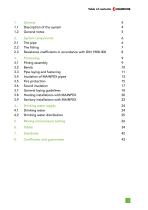
Table of contents MAINCOR 2.3 Resistance coefficients in accordance with DIN 1988-300 8 3.3 Pipe laying and fastening 11 3.4 Insulation of MAINPEX pipes 13 3.7 General laying guidelines 18 3.8 Heating installations with MAINPEX 20 3.9 Sanitary installations with MAINPEX 22 4. Drinking water supply 24 4.2 Drinking water distribution 25 5. Rinsing and pressure testing 26
Open the catalog to page 3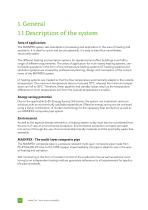
1. General 1.1 Description of the system Area of application The MAINPEX system sets standards in processing and application in the area of heating and sanitation. It is ideal for quick and secure assembly; it is easy to bend but nevertheless structurally stable. The different heating and sanitation systems for residential and office buildings must fulfil a range of different requirements. The areas of application for multi-storey heating systems, central heating systems in the form of low temperature heating systems (LT heating systems) and sanitation systems are covered by professional planning,...
Open the catalog to page 4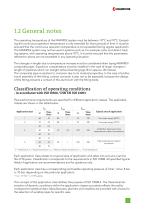
The operating temperature of the MAINPEX system must be between -10°C and 70°C. Exceeding the continuous operation temperature is only intended for short periods of time. It must be ensured that the continuous operation temperature is not exceeded during regular application. The MAINPEX system may not be used in systems such as, for example, solar and district heating systems, with operating temperatures above 70°C. It must be ensured that the parameters referred to above are not exceeded in any operating situation. The changes in length due to temperature increase must be considered when laying...
Open the catalog to page 5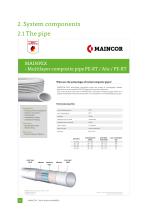
MAINPEX- Multilayer composite pipe PE-RT / Alu / PE-RT What are the advantages of metal composite pipes? MAINCOR MFL multilayer composite pipes are made of overlapped welded aluminium surrounded by PE-RT layers connected by adhesives. The inner aluminium layer of MAINCOR‘s multilyer composite pipes leads to a higher temperature and presse resistance in comparison to standard plastic pipes. Technical properties • drinking water installation • radiator connection • wall heating • underfloor cooling • underfloor heating working temperature standard colour inside standard colour outside other colours...
Open the catalog to page 6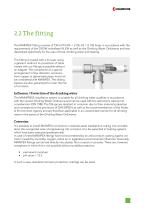
2.2 The fitting The MAINPEX fitting consists of CW 617N (Pb < 2.2%; Ni < 0.1%) brass in accordance with the requirements of the DVGW worksheet W 534 as well as the Drinking Water Ordinance and was developed specifically for the area of food, drinking water and heating. The fitting is coated with a tin layer using a galvanic method. A connection of other metals with our fittings is possible without an adapter. The compliance of a special arrangement in flow direction, as known from copper or galvanised pipes, must not be considered with MAINPEX. The sliding sleeves are also galvanised to lower...
Open the catalog to page 7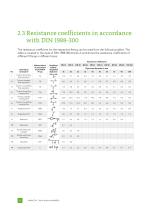
2.3 Resistance coefficients in accordance with DIN 1988-300 The resistance coefficient for the respective fitting can be read from the following tables. The table is created in the style of DIN 1988-300 Annex A and shows the resistance coefficients of different fittings in different sizes: Resistance coefficient ξ Individual resistanceb Abbreviations in accordance with DVGW W 575 Graphical symbola, simplified depiction Pipe outer diameter da mm T-piece, branching, flow separation T-piece, passage, flow separation T-piece, counterflow, flow separation T-piece, branching, merging flow T-piece,...
Open the catalog to page 8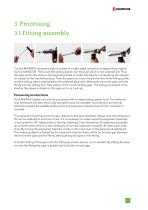
3. Processing 3.1 Fitting assembly Cut the MAINPEX composite pipe to length at a right angle using the corresponding original tool by MAINCOR. Then push the sliding sleeve over the pipe which is not widened yet. Plug the pipe end to the stop on the expansion head to widen the pipe by compressing the expansion caliper to the mechanical stop. Then the pipe has to be moved over the whole fitting profile and the sliding sleeve positioned to the widened pipe end. Afterwards insert the pipe with the fitting into the sliding tool. Take notice of the correct sliding jaws. The sliding procedure is finished...
Open the catalog to page 9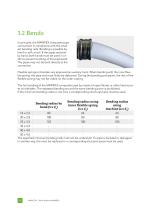
In principle, the MAINPEX composite pipe can be bent in compliance with the smallest bending radii. Bending is possible by hand or with a tool. If the pipes are bent by hand, both hands must be used in order to prevent buckling of the pipe bend. The pipes may not be bent directly at the connection. Flexible springs or benders are approved as auxiliary tools. When bending with the inner flexible spring, the pipe end must firstly be deburred. During the bending procedure, the ribs of the flexible spring may not be visible on the outer coating. The hot bending of the MAINPEX composite pipe by means...
Open the catalog to page 10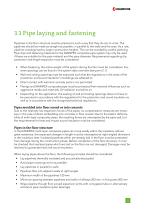
Pipelines in the floor structure must be planned in such a way that they do not to cross. The pipelines should be made as straight as possible, in parallel to the walls and the axes. As a rule, pipeline crossings lead to larger construction heights. This can be avoided by careful planning. Pipe clips and fastening materials for the MAINPEX composite pipe system may only be used if these are suitable for the pipe material and the pipe diameter. Requirements regarding clip protection and length expansion must be considered. • When fastening, the entire weight of the system during function must...
Open the catalog to page 11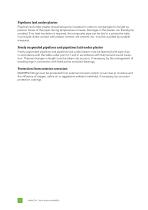
Pipelines laid under plaster Pipelines laid under plaster should always be insulated in order to compensate for length expansion forces of the pipes during temperature increase. Damages in the plaster can thereby be avoided. If no heat insulation is required, the composite pipe can be laid in a protective tube. In principle, direct contact with plaster, cement, tile cement, etc. must be avoided by suitable measures. Freely suspended pipelines and pipelines laid under plaster Freely suspended pipelines and pipelines laid under plaster must be fastened with pipe clips in accordance with the table...
Open the catalog to page 12All MAINCOR Rohrsysteme GmbH & Co. KG catalogs and technical brochures
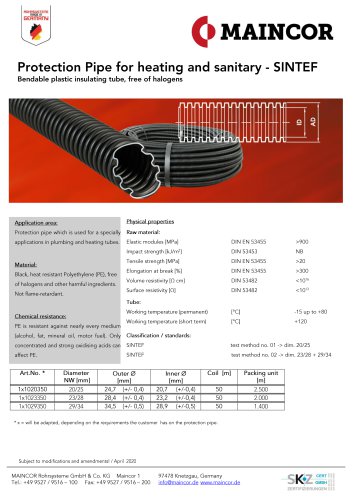 SINTEF Corrugated pipe
1 Page
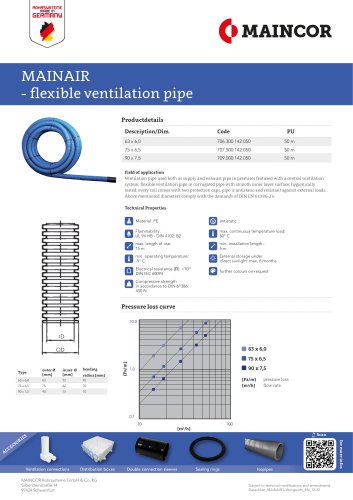 MAINAIR Ventilation pipe
1 Page
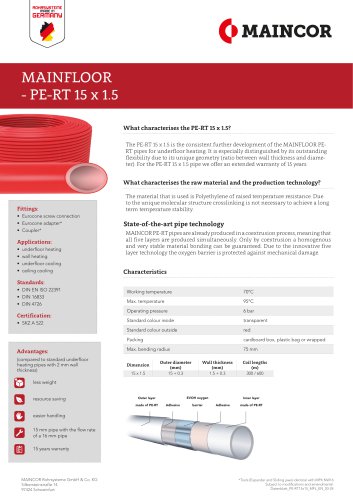 PE-RT 15 x 1,5
1 Page
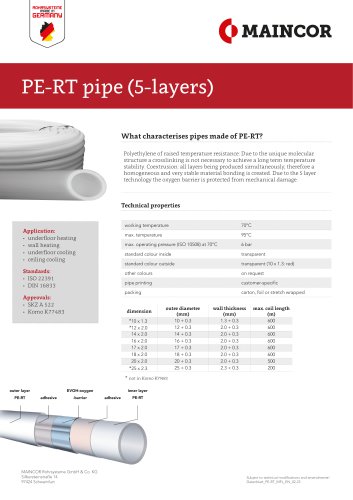 MAINFLOOR PE-RT pipe
1 Page
 Mainair
36 Pages
 MAINFLOOR
96 Pages
 MAINPRESS
61 Pages
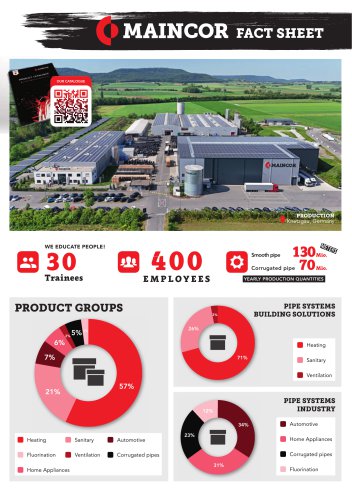 Company Facts
2 Pages
 Product Catalogue
40 Pages