MAINPRESS
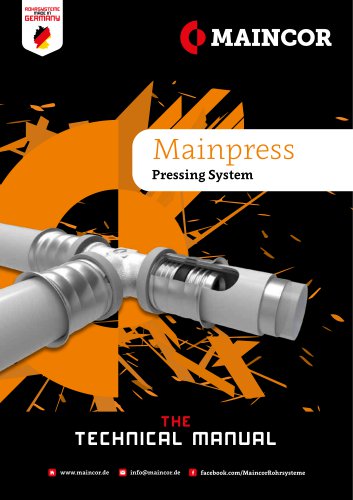
MAINPRESS
The MAINPRESS system is designed for heating and sanitation applications, offering quick and secure assembly with structural stability. It is suitable for multi-storey and central heating systems, particularly low-temperature systems, and sanitation systems. The system is environmentally friendly, using materials that minimize waste during assembly.
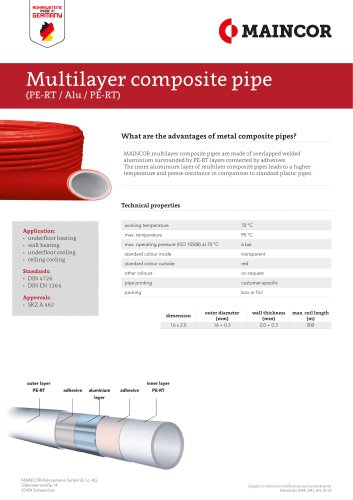
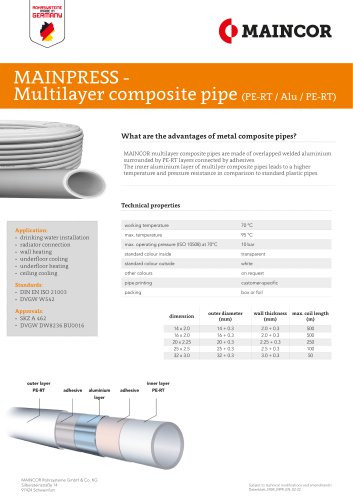
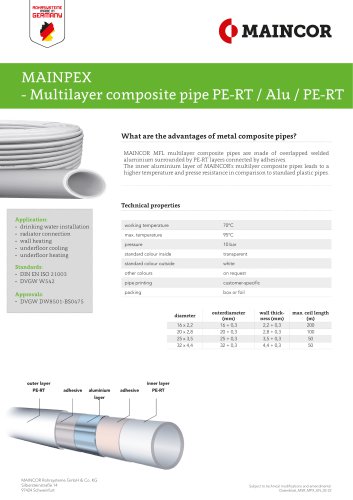
The Pipe: MAINPRESS pipes are multi-layer composite pipes made from PE-RT/Alu/PE-RT, offering 100% oxygen impermeability, making them ideal for heating and sanitation. They are resistant to corrosion and have a working temperature range of -10°C to 70°C.
The Fitting: Made from CW 617N brass, MAINPRESS fittings are suitable for drinking water and heating applications. They are corrosion-resistant and can be installed in various environments, provided certain conditions are met.
Press Connection: Pipes must be cut, deburred, and checked for correct insertion depth before pressing. Compatibility with pressing machines and jaws is specified, ensuring proper installation.
Bending and Fastening: Guidelines for bending pipes and securing them in place are provided, ensuring stability and compliance with standards.
The system supports efficient tap water distribution, adhering to relevant standards and ensuring safe and reliable water supply.
Procedures for rinsing and pressure testing are outlined to ensure system integrity and performance.
The system complies with DIN EN ISO 21003 and other relevant standards, ensuring quality and safety in its applications. It holds various approvals, including DVGW and ÖVGW certifications.
Resistance coefficients and technical properties of pipes and fittings are detailed, providing essential data for system design and installation.
- Pressing Dimension 63: The MAINPRESS multilayer composite pipe 63 can be pressed using new press jaws without adapter jaws. The press jaws must fully enclose the fitting, ensuring all parts are rectangular and flush to the fitting.
- Bending the Pipe: MAINPRESS pipes can be bent by hand or with tools, adhering to minimum bending radii. Hot bending is prohibited, and damaged pipes must be replaced.
- Pipes should be laid straight, parallel to walls, avoiding crossings to minimize construction height. Fastening materials must be suitable for the pipe material and diameter.
- Direct contact with walls and concrete is not allowed, and pipes must be protected from external influences.
- Insulation requirements differ for hot and cold water installations, with specific thicknesses regulated by DIN 1988-200 and the EnEV.
- Heating pipelines must also be insulated against heat loss, with specific requirements outlined in the EnEV 2014.
Fire protection regulations are outlined in the Model Building Code, requiring pipelines to prevent fire spread and adhere to MLAR/LAR/RbALei guidelines. Building materials must comply with DIN 4102 for preventive fire protection.
According to DIN 4109, sound insulation is crucial to prevent noise transfer in buildings. Measures include using sound-absorbing materials, proper pipe dimensioning, and sound insulation inserts. Agreements on sound insulation levels should be documented, and compliance with DIN 4109 is mandatory.
MAINPRESS system components must be protected from mechanical damage and UV radiation. Assembly guidelines include precise cutting, calibrating, and pressing of pipes. Potential equalization is not required for MAINPRESS systems, and processing temperatures should not fall below -10°C. Ethylene glycol is recommended as an antifreeze agent.
Threaded connections should follow DIN 30660, using hemp and approved sealing pastes. Contact with solvent-containing materials should be avoided. Maintenance manuals must be created for systems requiring qualified personnel, and compliance with DIN 12170 is necessary.
Proper dimensioning and hydraulic compensation are required for heating systems. Acceptance involves system testing and compliance with regulations. Maintenance and operating manuals are essential, and MAINPRESS offers free calculation programs for clients.
Planning must adhere to DIN standards, ensuring hygiene and operational safety. Proper dimensioning prevents oversized pipelines, and pressure losses must be calculated accurately. Maximum flow velocities are specified for various components.
- Drinking water is not sterile but should not affect human health. It is used for drinking, cooking, personal hygiene, and cleaning objects in contact with food or the human body.
- According to the Drinking Water Ordinance, drinking water must be colorless, odorless, pathogen-free, contain specific mineral concentrations, and be neutral and cool in taste.
- Recent changes require planners, installers, and operators to ensure high-quality drinking water up to the user's withdrawal location.
- Regulations prioritize hygienic protection, with responsibilities divided among operators, planners, and installers.
- Different distribution methods include T-piece distribution, series connection with U-shaped wall brackets, and closed circular pipelines, each with specific hygiene considerations.
- Closed circular pipelines are recommended for systems with irregular use, such as in hotels and hospitals, to minimize hygiene risks.
- Pressure and leakage testing must follow DIN EN 806-4 and ZVSHK guidelines, using compressed air, inert gas, or water.
- All components must be accessible, and a pressure test with compressed air or inert gas is recommended if water exchange is not ensured within seven days.
- Testing involves specific pressures and times, with detailed procedures for different systems (MAINPRESS, MAINPEX, MAINOX).
- Reports and certificates must document the testing process and confirm system impermeability.
- Rinsing should occur just before start-up using filtered drinking water.
- Two techniques are available: water/air mixture rinsing and water-only rinsing, each with specific guidelines.
- A report must confirm proper rinsing of the system.
- Pipe friction pressure drops are detailed based on peak flow rates and flow velocities, providing essential data for system design and analysis.
The document provides detailed tables showing the pipe friction pressure drops for water at an average temperature of 50°C with different temperature spreads (15k and 20k). The tables list various pipe dimensions and corresponding values for mass flow (kg/h), velocity (m/s), and pressure drop (Pa/m).
The document lists applicable standards and directives for heating and sanitary installations, including several DIN standards related to drinking water installations, heating systems, and pipeline systems. These standards cover technical regulations, planning, installation, and maintenance requirements.
The document includes a certificate confirming an extended warranty for DVGW certified components of the MAINPEX and MAINPRESS systems. The warranty covers defects in production or material for a period of 10 years, with specific coverage details and insurance information provided.
The MAINPRESS Pressing-System is compatible with various composite pipes and press fittings from different manufacturers, with specific compatibility requirements outlined.
The document is a technical approval-with-product certificate issued by Kiwa for MAINCOR Rohrsysteme GmbH & Co. KG. It certifies that the products comply with the Kiwa evaluation guideline BRL-K536 G for plastics piping systems intended for hot and cold drinking water transport.
- Warranty and Compatibility: MAINCOR assumes warranty for third-party products if they are technically impeccable and processed according to guidelines. The legal warranty of the manufacturer remains unchanged.
- Technical Approval: Issued on November 15, 2015, the certificate confirms compliance with specific guidelines and allows the use of the Kiwa®-mark.
- Certification Process: Involves initial and regular assessment of the quality system and product.
- Contact Information: Provides contact details for MAINCOR and Kiwa for further inquiries.
It is advised to consult the Kiwa website to ensure the certificate's validity.
Catalog excerpts
Pressing System TECHNICAL MANUAL www.maincor.de
Open the catalog to page 1
Mainpress Pressing System All legal and technical information has been carefully compiled to the best of our knowledge. No liability can be accepted for any errors or omissions. This document including the contents is protected by copyright. Any use prohibited by copyright is not allowed without the permission of MAINCOR Rohrsysteme GmbH & Co. KG. All rights reserved. In particular reprinting, editing, storage and processing in electronic systems, translations and microfilms. Subject to printing errors and technical changes. All previous versions lose their validity. Please consider legal provisions,...
Open the catalog to page 2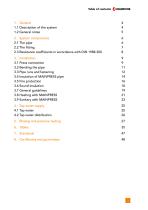
Table of contents MAINCOR 2.3 Resistance coefficients in accordance with DIN 1988-300 8 3.3 Pipe runs and fastening 12 3.4 Insulation of MAINPRESS pipe 14 3.8 Heating with MAINPRESS 21 3.9 Sanitary with MAINPRESS 23 5. Rinsing and pressure testing 27
Open the catalog to page 3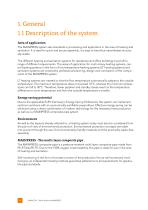
1. General 1.1 Description of the system Area of application The MAINPRESS system sets standards in processing and application in the area of heating and sanitation. It is ideal for quick and secure assembly; it is easy to bend but nevertheless structurally stable. The different heating and sanitation systems for residential and office buildings must fulfil a range of different requirements. The areas of application for multi-storey heating systems, central heating systems in the form of low temperature heating systems (LT heating systems) and sanitation systems are covered by professional planning,...
Open the catalog to page 4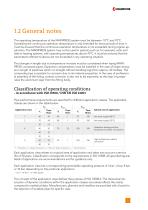
The operating temperature of the MAINPRESS system must be between -10°C and 70°C. Exceeding the continuous operation temperature is only intended for short periods of time. It must be ensured that the continuous operation temperature is not exceeded during regular application. The MAINPRESS system may not be used in systems such as, for example, solar and district heating systems, with operating temperatures above 70°C. It must be ensured that the parameters referred to above are not exceeded in any operating situation. The changes in length due to temperature increase must be considered when...
Open the catalog to page 5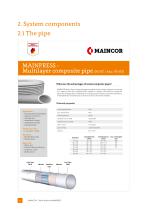
MAINPRESS - Multilayer composite pipe (pe-rt / Aiu / pe-rt) What are the advantages of metal composite pipes? MAINCOR multi-layer composite pipes are aluminium composite pipes consisting of 5 layers which are longitudinally welded to overlap. Aluminium composite pipes are distinguished compared to all-plastic pipes by their increased resistance to temperature and pressure, as well as by their structural stability. Technical properties • drinking water installation • radiator connection • wall heating • underfloor cooling • underfloor heating • ceiling cooling working temperature max. temperature...
Open the catalog to page 6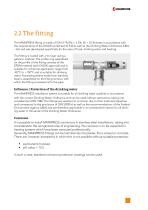
2.2 The fitting The MAINPRESS fitting is made of CW 617N (Pb < 2.2%; Ni < 0.1%) brass in accordance with the requirements of the DVGW worksheet W 534 as well as the Drinking Water Ordinance (UBA - list) and was developed specifically for the area of food, drinking water and heating. The fitting is coated with a tin layer using a galvanic method. The profile ring assembled on the profile of the fitting consists of the EPDM material (with DVGW approval) and is suitable for a thermal application range from -40°C to +150°C and is suitable for drinking water. A pressing sleeve made from stainless...
Open the catalog to page 7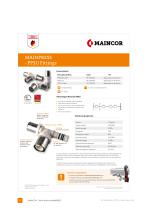
(* MAINCOR MAINPRESS - PPSU Fittings Productdetails PPSU Elbow 90°PPSU Tee PPSU Coupler unpressed leaking Advantages Material PPSU Code PU 'ppsUcorrosion not possible (polymer) • very robust high performance polymer • outstanding impact resistance • proven since years in sanitary applications • hygenically non hazardous (medical use) • lead free Inspection window explicit recognition of the correct pipe positioning Technical properties Fitting body made of PPSU steel sleeve for safe guidance of the press jaw Glas transition temperature 220°C Thermal expansion coefficient 5,6 10-5/K It is not...
Open the catalog to page 8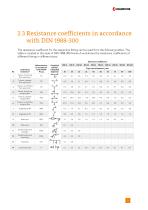
2.3 Resistance coefficients in accordance with DIN 1988-300 The resistance coefficient for the respective fitting can be read from the following tables. The table is created in the style of DIN 1988-300 Annex A and shows the resistance coefficients of different fittings in different sizes: Resistance coefficient ξ Individual resistanceb Abbreviations in accordance with DVGW W 575 Graphical symbola, simplified depiction Pipe outer diameter da mm T-piece, branching, flow separation T-piece, passage, flow separation T-piece, counterflow, flow separation T-piece, branching, merging flow T-piece,...
Open the catalog to page 9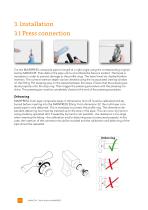
3. Installation 3.1 Press connection Cut the MAINPRESS composite pipe to length at a right angle using the corresponding original tool by MAINCOR. Then deburr the pipe until a circumferential bevel is evident. The bevel is necessary in order to prevent damage to the profile rings. The bevel must be checked before insertion. The correct insertion depth can be checked using the incorporated viewing window on the fitting. Put pressing jaws on the sleeve between the stops. Ensure that the pressing jaw abuts properly onto the stop ring. Then trigger the pressing procedure with the pressing machine....
Open the catalog to page 10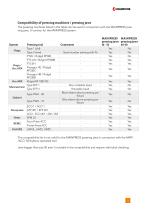
The pressing machines listed in the table can be used in connection with the MAINPRESS pressing jaws, U-contour for the MAINPRESS system: pressing jaws j pressing jaws System Pressing tool Comments 16 - 32 40-50 This compatibility list is not valid for the MAINPRESS pressing jaws in connection with the MAP1 /ACO 102 battery-operated tool. Jaws bigger than size 50 aren't included in the compatibility and require individual checking.
Open the catalog to page 11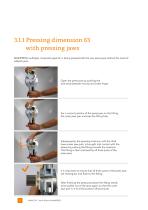
3.1.1 Pressing dimension 63 with pressing jaws MAINPRESS multilayer composite pipe 63, is being pressed with the new press jaws without the need of adapter jaws. Open the press jaws by pushing the axle strub between thump and index finger. For a correct position of the press jaws on the fitting, the outer jaws pair encloses the fitting fully. Subsequently, the pressing machine, with the third lower press jaws part, is brought into contact with the sleeve by pushing the fitting towards the machine. The fitting is then enclosed by all three parts of the press jaws. It is important to ensure that...
Open the catalog to page 12All MAINCOR Rohrsysteme GmbH & Co. KG catalogs and technical brochures
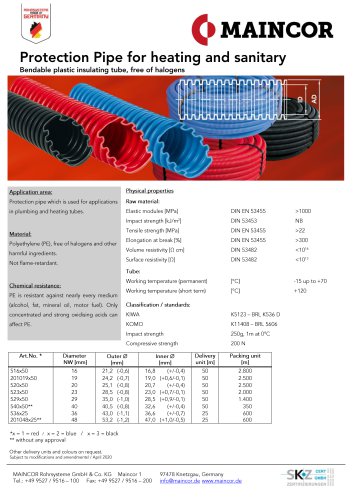
 SINTEF Corrugated pipe
1 Page
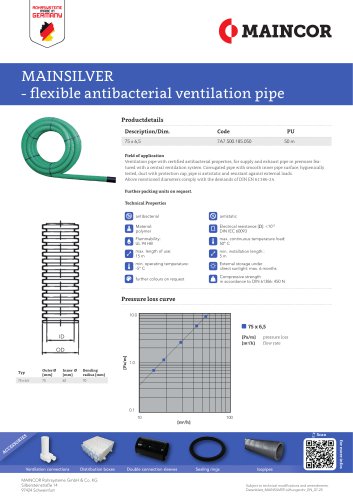
 MAINAIR Ventilation pipe
1 Page
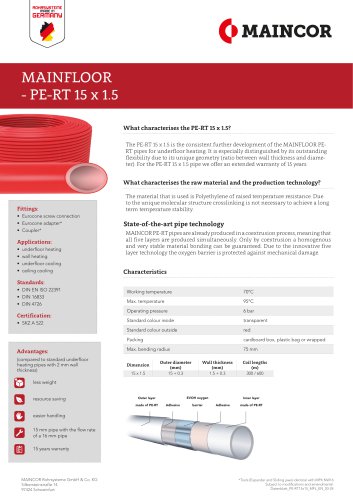 PE-RT 15 x 1,5
1 Page
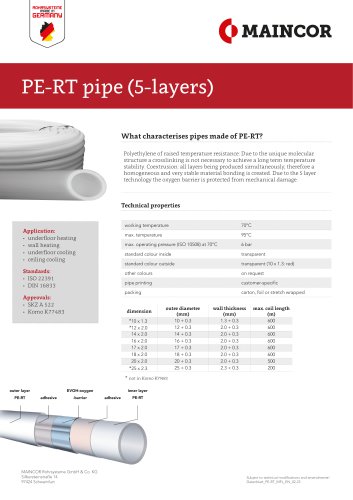 MAINFLOOR PE-RT pipe
1 Page
 Mainair
36 Pages
 MAINFLOOR
96 Pages
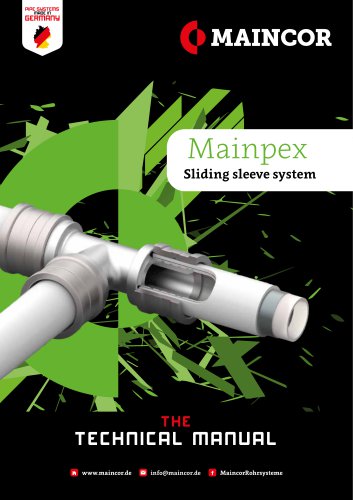 MAINPEX
50 Pages
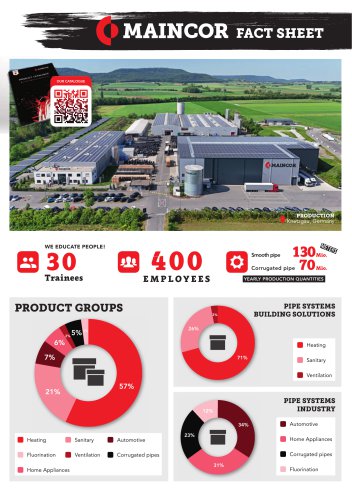 Company Facts
2 Pages
 Product Catalogue
40 Pages