
- Catalogs
- Mecàniques SEGALES, S.L.
- Catalogue Segalés Group

Catalogue Segalés Group
Catalogue Segalés Group
The document is a catalogue from a company with over 55 years of experience in livestock farming equipment, focusing on slurry separation, handling, and treatment since 2004. The aim is to enhance environmental impact and profitability for livestock enterprises.
Advantages of Slurry Separation
Slurry separation reduces odor and volume, and the liquid fraction can be used for irrigation. The solid fraction, with 30-35% dry matter, is suitable for composting.
Slurry and Digestate Separators
The catalogue describes separators like MS 300, MS 250 BG, and MS 250 XL, with capacities from 6 m3/h to 80 m3/h. Efficiency depends on slurry age and feed.
Technical Features
Features include solid plug signal detectors, adjustable necks, and pressing gates with counterweights. Made of stainless steel, the equipment is durable and wear-resistant.
Supporting Platforms
Modular platforms made of hot-dip galvanized steel are available for easy installation and maintenance.
Kompack® Equipment
Kompack® models improve separation performance, reducing costs by up to 60%, suitable for slurry with less than 8% solids.
Mobile Separation Plants
Designed for flexibility, these plants can be used across multiple farms, ideal for associations or owners with several locations.
Separators for Drip Irrigation
These separators are designed for drip fertigation, optimizing the application of the liquid fraction for plant growth.
Conclusion
The catalogue offers a range of products for efficient slurry management, focusing on environmental benefits and cost-effectiveness.
The document discusses technologies for treating slurry in agriculture, focusing on nutrient recovery and environmental impact reduction, aiming for a nutrient-rich liquid product for drip irrigation.
Slurry Treatment and Nutrient Recovery
Equipment used under the LifeArimeda Project shows the agronomic value of nutrients in slurry, with significant nitrogen reduction through biological denitrification.
Nitrification-Denitrification (NDN) Process
The NDN process uses alternating aeration phases in a Sequencing Batch Reactor to convert nitrogen into N2, achieving a 58.3% nitrogen reduction.
Microfiltration and Decanting Systems
The microfiltration plant concentrates phosphorus and nitrogen in the solid fraction, achieving an 85-90% nitrogen reduction in the liquid fraction.
Acidification Systems
Using sulfuric acid, the system reduces ammonia emissions by lowering pH to 5.5, increasing ammonium concentration.
Slurry Evaporation Tunnel
This system uses solar radiation to concentrate nutrients in the solid fraction, reducing ammonia emissions by over 90%.
Separation and Flocculation
Flocculants concentrate nutrients in the solid fraction, with Dissolved Air Flotation technology achieving up to 70% nitrogen concentration.
AGV Sucker® Cleaning Robot
The robot extracts slurry from pig farms, improving hygiene and reducing emissions, operating automatically.
Biogas Systems
Biogas systems with stirrer supports and mixers facilitate nutrient recovery and reduce emissions.
Sustainability and Animal Welfare
Technologies like Airesa slurry trays and slurry for cow bedding enhance sustainability and animal welfare.
Conclusion
The document provides an overview of innovative slurry treatment technologies for nutrient recovery, emission reduction, and sustainability.
The document details filtration and separation systems for agricultural and industrial settings, focusing on slurry separation and handling.
1. FICA Channel Filter
Flow rates range from 30 to 470 m3/h, designed for secondary roughing with features like a Johnson type mesh screen and automatic cleaning.
2. FIES Static Filter
Ideal for filtering cleaning fluids, operates by gravity with no maintenance, and is made from stainless steel.
3. FILVI Vibrating Screen
Suitable for fine screening, separating solids up to 80 microns, with automatic self-cleaning and remote control capabilities.
4. Control Panels (PTP and PTPX)
For remote monitoring and control, featuring real-time tank level monitoring and alarm notifications.
5. Accessories
Includes cleaning systems, auger conveyors, and electric winches, focusing on water savings and energy efficiency.
Conclusion
Mecàniques Segalés SL offers solutions for slurry separation and handling, emphasizing efficiency and adaptability.
Catalog excerpts

SLURRY SEPARATION, HANDLING AND TREATMENT SPECIALISTS We are technology, profitability, and environment.
Open the catalog to page 1
We are technology, profitability, and environment Thank you for taking the time to look through our catalogue. This catalogue is the result of more than 55 years dedicated to materials and equipment for livestock farming since our founder, coming from the stockbreeding world and motivated by the needs of the sector, began to manufacture the first products. Since 2004, the company has been dedicated exclusively to the manufacture of products related to slurry from the inside of the farm to the outside, with the most sophisticated treatment systems for the revaluation or purification of slurry....
Open the catalog to page 2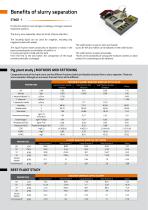
Benefits of slurry separation STAGE 1 It is the first step for most nitrogen scrubbing or nitrogen reduction treatment systems. The slurry, once separated, does not smell. Volume reduction. The resulting liquid can be used for irrigation, including drip irrigation (mixed with water). The liquid fraction leaves practically no deposits or solids in the basin, preventing the accumulation of solids in it. It is easy and quick to load with the tank. From the first to the last tanker, the composition of the liquid remains practically unchanged. The solid fraction is easy to store and handle. Up to...
Open the catalog to page 4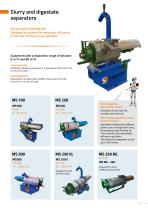
Slurry and digestate separators SOLID/LIQUID SEPARATOR Designed to achieve the maximum utilisation of the two fractions once separated Equipment with a separation range of between 6 m3/h and 80 m3/h SOLID FRACTION Possibility of pressing regulation. It is possible to obtain from 20% to 35% of dry matt. LIQUID FRACTION Depending on its destination, different sieve sizes from 250 microns to 1 mm can be used. Which separator separates the most? Definitely, the one with the smallest sieve hole size. Will all farms separate the same amount of slurry? Separation is influenced by different factors such...
Open the catalog to page 5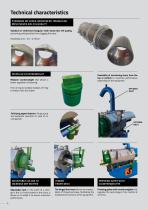
Technical characteristics STANDARD OR SUPER-REINFORCED TRIANGULAR MESH SIEVES AISI 316 QUALITY Standard or reinforced triangular mesh sieves Aisi 316 quality, preventing solid particles from clogging the sieve. Possibility 0.25 - 0.5 - 0.75mm MODULAR COUNTERWEIGHT Possibility of introducing slurry from the top or bottom to maximize performance depending on the equipment. Modular counterweight that allows a better regulation of pressing. From 2.5 kg to multiple modules of 10 kg to obtain more dry matter. OPTIONAL INLET Solid plug signal detector. Stops pump and separator operation in case of no...
Open the catalog to page 6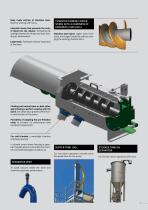
Body made entirely of stainless steel. Ideal for working with slurry. Labyrinth device that prevents the entry of liquid into the reducer, facilitating the sealing between the thread and thus avoiding its deterioration. Large hatch. Facilitates internal inspection of the sieve. TUNGSTEN CARBIDE COATED SPIRAL WITH A HARDNESS OF HARDNESS 2.500 HV0,2 Stainless steel spiral, higher wear resistance, and longer thread life without changing the working characteristics. Floating and centred sieve on both sides, guaranteeing a perfect coupling with the spiral and obtaining a greater performance and duration...
Open the catalog to page 7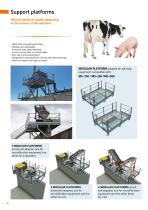
Support platforms Different platform models depending on the location of the separator - Made of hot-dip galvanised steel. - Modular and expandable. - Protected with safety handrails. - Access via cat ladder or normal ladder. - Non-slip Tramex grating floor. - Designed for easy placement of liquid and electrical piping. - Option of support with legs or on wall. MODULAR PLATFORM adapted for splitting equipment compatible with: 2 MODULAR PLATFORMS joined and adapted, one for microfiltration equipment, the other for a separator. 3 MODULAR PLATFORMS joined and adapted, one for microfiltration equipment...
Open the catalog to page 8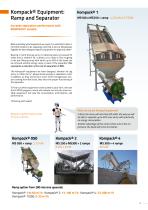
Kompack® Equipment: Ramp and Separator Increase separation performance with KOMPACK® models. Before deciding what equipment we need, it is essential to bear in mind the product to be separated, and that is why at Mecàniques Segalés we have designed specific equipment for pigs and cattle*. Bearing in mind that pig slurry in fattening does not exceed 5% solids and in mothers 3%, it allows us to make a first roughing in the pre-filtering ramp with which up to 60% of the liquid can be removed without energy costs or wear of the separator; this represents a reduction in the cost of separation of 60%....
Open the catalog to page 9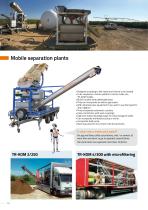
Mobile separation plants • Designed according to the needs and volume to be treated. • To be coupled to a tractor platform, tractor trailer, etc., TR-KOM models. • BLOCK models with palletisable base. • They can incorporate an electric generator. • With vibrating sieve equipment if you wish to use the liquid for drip irrigation. • They incorporate volumetric counters. • Hose connections with quick couplings. • High and mobile discharge auger for easy storage of solids. • Can incorporate nitrification pump or stirrer. • Incorporate feed pump. • Electrical panel for the control of all the elements....
Open the catalog to page 10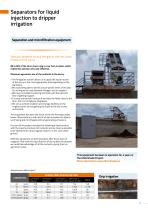
Separators for liquid injection to dripper irrigation Separation and microfiltration equipment Specially designed for drip fertigation with the liquid fraction of the slurry. 80 to 90% of the slurry from a pig or cow farm is water, which makes this solution very cost-effective. Maximum agronomic use of the nutrients in the slurry. • The fertigation system allows us to apply the liquid fraction of the slurry at the most appropriate time depending on the plantation. • We avoid being able to do this only at specific times of the year. So, as long as the crop demands nitrogen, we can supply it. •...
Open the catalog to page 11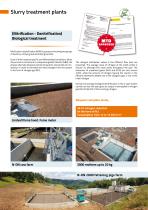
Slurry treatment plants (Nitrification - Denitrification) Biological treatment APPROVED Nitrification-denitrification (NDN) is a process involving two groups of bacteria, nitrifying and denitrifying bacteria. Each of them requires specific and differentiated conditions. When this process is carried out in a Sequencing Batch Reactor (SBR), the phases alternate between periods of aeration and periods of nonaeration in order to eliminate the initial nitrogen from the system in the form of nitrogen gas (N2). The nitrogen distribution values in the different flow lines are presented. The average value...
Open the catalog to page 12All Mecàniques SEGALES, S.L. catalogs and technical brochures
 Segalés_Catalogue
11 Pages
- Irrigation filter
- Electric pump
- Slurry pump
- Screen irrigation filter
- Mecàniques SEGALES slurry separator
- Horizontal agitator
- Mobile pump
- Electrically-powered agitator
- Water treatment system
- Vertical agitator
- Farm robot
- Sweep auger
- Stainless steel agitator
- PTO-driven agitator
- Wastewater treatment system
- Autonomous farm robot