
- Catalogs
- nutrition.basf
- Natuphos® 5000


Natuphos® 5000

Natuphos® 5000
Natuphos® 5000 is a feed additive identified as Phytase, manufactured by BASF Corporation in Florham Park, NJ, USA. Emergency contacts include CHEMTREC and the BASF Hotline.
Classified as a respiratory and skin sensitizer and poses a combustible dust hazard. Precautionary measures include wearing protective gloves and avoiding inhalation of dust.
Contains Phytase (3.0 - 7.0%) and Soybean oil (1.0 - 5.0%).
For inhalation, move to fresh air. For skin contact, wash with soap and water. Rinse eyes with water for 15 minutes. If swallowed, rinse mouth and drink water.
Use water spray, foam, dry powder, or carbon dioxide. Avoid water jets. The product poses a dust explosion hazard.
Avoid dispersing dust, ensure ventilation, use protective equipment, and dispose of waste according to regulations.
Avoid dust formation and contact with skin and eyes. Store in a cool, dry place. Use explosion-proof equipment and follow NFPA guidelines.
Use local exhaust ventilation and wear respiratory protection if dust is present. Protective gloves and goggles are recommended.
Yellow to brown powder with a pH of 5.5 - 6.0, sparingly soluble in water, bulk density of 350 kg/m3.
Stable under recommended storage conditions but poses a dust explosion risk. Avoid dust formation and ignition sources.
Not acutely toxic but may cause sensitization. Not irritating to skin or eyes, but prolonged contact may cause irritation.
Not expected to be harmful to aquatic organisms. Readily biodegradable with low bioaccumulation potential and low soil mobility.
Dispose of waste and containers according to national and local regulations.
Not classified as a dangerous good under USDOT, IMDG, or IATA/ICAO regulations.
Registered under Feed TSCA in the US, not listed under Chemical TSCA. Categorized under EPCRA 311/312 for acute hazards.
NFPA: Health: 2, Fire: 1, Reactivity: 0. HMIS III: Health: 2, Flammability: 1, Physical hazard: 0.
Classified for respiratory and skin sensitization and acute oral toxicity.
SDS prepared by BASF NA Product Regulations on 2016/08/15. Supports Responsible Care initiatives.
Catalog excerpts
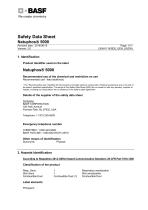
Safety Data Sheet Natuphos® 5000 Revision date : 2016/08/15 Page: 1/11 1. Identification Product identifier used on the label Natuphos® 5000 Recommended use of the chemical and restriction on use Recommended use*: feed additive(s) * The “Recommended use” identified for this product is provided solely to comply with a Federal requirement and is not part of the seller's published specification. The terms of this Safety Data Sheet (SDS) do not create or infer any warranty, express or implied, including by incorporation into or reference in the seller's sales agreement. Details of the supplier of the safety data sheet Company: BASF CORPORATION 100 Park Avenue Florham Park, NJ 07932, USA Telephone: +1 973 245-6000 Emergency telephone number CHEMTREC: 1-800-424-9300 BASF HOTLINE: 1-800-832-HELP (4357) Other means of identification Synonyms: Phytase 2. Hazards Identification According to Regulation 2012 OSHA Hazard Communication Standard; 29 CFR Part 1910.1200 Classification of the product Resp. Sens. 1 Respiratory sensitization Skin Sens. 1 Skin sensitization Combustible Dust Combustible Dust (1) Combustible Dust Label elements
Open the catalog to page 1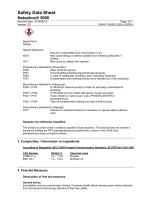
Safety Data Sheet Natuphos® 5000 Revision date : 2016/08/15 Version: 2.0_ Signal Word: Danger May form combustible dust concentration in air. May cause allergy or asthma symptoms or breathing difficulties if inhaled. May cause an allergic skin reaction. Precautionary Statements (Prevention): P280 Wear protective gloves. P261 Avoid breathing dust/fume/gas/mist/vapours/spray. P284 In case of inadequate ventilation wear respiratory protection. P272 Contaminated work clothing should not be allowed out of the workplace. Precautionary Statements (Response): P304 + P340 IF INHALED: Remove person to...
Open the catalog to page 2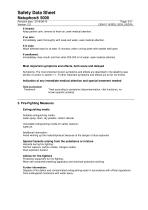
Safety Data Sheet Natuphos® 5000 Revision date : 2016/08/15 Page: 3/11 Version: 2.0(30041116/SDS GEN US/EN) If inhaled: Keep patient calm, remove to fresh air, seek medical attention. If on skin: Immediately wash thoroughly with soap and water, seek medical attention. If in eyes: Wash affected eyes for at least 15 minutes under running water with eyelids held open. If swallowed: Immediately rinse mouth and then drink 200-300 ml of water, seek medical attention. Most important symptoms and effects, both acute and delayed Symptoms: The most important known symptoms and effects are described in...
Open the catalog to page 3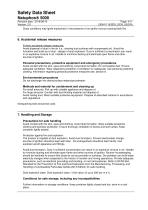
Safety Data Sheet Natuphos 5000 Revision date : 2016/08/15 Version: 2.0 Dusty conditions may ignite explosively in the presence of an ignition source causing flash fire. 6. Accidental release measures Further accidental release measures: Avoid dispersal of dust in the air (i.e., clearing dust surfaces with compressed air). Avoid the formation and build-up of dust - danger of dust explosion. Dust in sufficient concentration can result in an explosive mixture in air. Handle to minimize dusting and eliminate open flame and other sources of ignition. Personal precautions, protective equipment and...
Open the catalog to page 4
Safety Data Sheet Natuphos® 5000 Revision date : 2016/08/15 Page: 5/11 Version: 2.0(30041116/SDS GEN US/EN) 8. Exposure Controls/Personal Protection Components with occupational exposure limits Soybean oil OSHA PEL PEL 5 mg/m3 Respirable fraction ; PEL 15 mg/m3 Total dust ; TWA value 15 mg/m3 Total dust ; TWA value 5 mg/m3 Respirable fraction Advice on system design: It is recommended that all dust control equipment such as local exhaust ventilation and material transport systems involved in handling of this product contain explosion relief vents or an explosion suppression system or an oxygen...
Open the catalog to page 5
Safety Data Sheet Natuphos® 5000 Revision date : 2016/08/15 Page: 6/11 Upper explosion limit: Autoignition: Vapour pressure: Bulk density: Vapour density: Partitioning coefficient n-octanol/water (log Pow): Self-ignition temperature: Thermal decomposition: Viscosity, dynamic: Solubility in water: Evaporation rate: Other Information: For solids not relevant for classification and labelling. not applicable negligible 350 kg/m3 The product is a non-volatile solid. not applicable for mixtures not applicable No decomposition if stored and handled as prescribed/indicated. not applicable, the product...
Open the catalog to page 6
Safety Data Sheet Natuphos 5000 Revision date : 2016/08/15 Version: 2.0 No hazardous decomposition products if stored and handled as prescribed/indicated. Thermal decomposition: No decomposition if stored and handled as prescribed/indicated. 11. Toxicological information Primary routes of exposure Routes of entry for solids and liquids are ingestion and inhalation, but may include eye or skin contact. Routes of entry for gases include inhalation and eye contact. Skin contact may be a route of entry for liquefied gases. Acute Toxicity/Effects Acute toxicity Assessment of acute toxicity: Virtually...
Open the catalog to page 7
Safety Data Sheet Natuphos 5000 Revision date : 2016/08/15 Version: 2.0 Assessment of mutagenicity: Results from a number of mutagenicity studies with microorganisms, mammalian cell culture and mammals are available. Taking into account all of the information, there is no indication that the substance is mutagenic. ---------------------------------- Carcinogenicity Assessment of carcinogenicity: Based on available Data, the classification criteria are not met. Reproductive toxicity Assessment of reproduction toxicity: Based on available Data, the classification criteria are not met. Teratogenicity...
Open the catalog to page 8
Safety Data Sheet Natuphos 5000 Revision date : 2016/08/15 Version: 2.0 Assessment biodegradation and elimination (H2O) Information on: Phytase Readily biodegradable (according to OECD criteria). ---------------------------------Elimination information Information on: Phytase > 95 % BOD of COD (30 d) (DIN 38409 Part 51) (aerobic, activated sludge, domestic) ---------------------------------- Bioaccumulative potential Assessment bioaccumulation potential Significant accumulation in organisms is not to be expected. Mobility in soil Assessment transport between environmental compartments The substance...
Open the catalog to page 9All Nutrition.basf catalogs and technical brochures
 Natupulse® TS
7 Pages
 Natuphos® E 5000 Combi
5 Pages
 Lucantin® Red
12 Pages
 BalanGut® AQ
2 Pages
 BalanGut® LS
2 Pages
 Guide to Feed Preservation
36 Pages
 Natuphos® E
11 Pages
 Natugrain® TS 5XG
11 Pages
 Natugrain® TS DL
11 Pages



- Supplementary feed
- Animal supplementary feed
- Dry nutritional supplement
- Cattle supplementary feed
- Vitamin supplementary feed
- Digestion supplementary feed
- Feed supplement for the immune system
- Poultry supplementary feed
- Deficiency corrector feed supplement
- Liquid supplementary feed
- Pig supplementary feed
- Powder feed supplement
- Sheep supplementary feed
- Reproduction supplementary feed
- Goat supplementary feed
- BASF dry feed additive
- Metabolism supplementary feed
- Equine supplementary feed
- BASF poultry feed additive