

PSP32

PSP32
- Daylight Dark Adaptation: Facilitates the measurement of quenching processes such as qE, qM, qT, and qI at different times of the day.
- Probe Heads: Supports 1 to 32 measuring probe heads per controller, allowing for long-term monitoring of larger plant populations.
- Saturation Flash: Provides a 10,000 μmol square topped saturation flash for dependable results, with FM’ correction options.
- Light Probes: Available in blue, red, and chlorophyll content probes.
- Offers a variety of quenching protocols and programmable dark adaptation at any time of day.
- Includes a stable actinic light source and reliable leaf temperature measurement using a thermistor.
- Features a sensitive touch screen interface for straightforward setup and data management.
- Hendrickson Lake Model: Y(II), Y(NPQ), Y(NO), NPQ.
- Kramer Lake Model: New fast quenching parameters available with red light version.
- Puddle Model: Includes Y(II), qP, qN, NPQ.
- 2 GB internal storage for extensive data collection.
- Data access via Wi-Fi, cellular modem, Ethernet, USB, or satellite.
- Remote programming and data collection through a web interface.
- F’ correction based on Loriaux (2013) for precise Y(II) and ETR measurements.
- Studies indicate potential underestimation of measurements under high actinic light conditions without correction.
Catalog excerpts
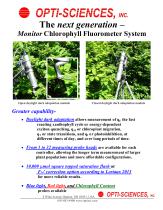
The next generation – Monitor Chlorophyll Fluorometer System Open daylight dark adaptation module Closed daylight dark adaptation module Greater capability· Daylight dark adaptation allows measurement of qE the fast reacting xanthophyll cycle or energy-dependent exciton quenching, qM or chloroplast migration, qT or state transitions, and qI or photoinhibition, at different times of day, and over long periods of time. · From 1 to 32 measuring probe heads are available for each controller, allowing the longer term measurement of larger plant populations and more affordable configurations. · 10,000 :mol square topped saturation flash or FM’ correction option according to Loriaux 2013 for more reliable results. · Blue light, Red light, and Chlorophyll Content probes available 8 Winn Avenue Hudson, NH 03051, USA 603-883-4400 www.optisc
Open the catalog to page 1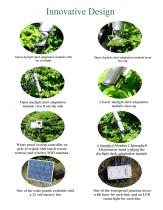
Innovative Design Open daylight dark adaptation module with far red light Open daylight dark adaptation module view from the side Water proof system controller on pole or tripod with touch screen control, and wireless WiFi antenna. One of the solar panels available with a 12 volt battery box Open daylight dark adaptation module from the top Closed daylight dark adaptation module close up A Standard Monitor Chlorophyll Fluorometer head without the daylight dark adaptation module One of the waterproof junction boxes with fuses for each line, and an LED status light for each line.
Open the catalog to page 2
Innovative Design Quenching: Programable Dark Adaptation ...at any time of day ...or several times a day ...allows quenching relaxation qE - fast acting xanthophyll cycle qM - chloropast migration qT - state transitions qI - photoinhibition Kramer’s new NPQ(T), qE(T), & qI(T) Ruban / Murchie protocol - pNPQ & qPd The new monitor fluorometer includes the widest range of quenching protocols available. Hendrickson lake model parameters Y(II) Quantum yield of PSII Y(NPQ) Photoprotective non-photochemical quenching Y(NO) All other non-photo-protective non-photochemical quenching NPQ Non-photochemical...
Open the catalog to page 3
Attention to Detail Algorithm that prevents saturation pulse NPQ issue The instrument measures the highest 25 ms. - 8 point rolling average to determine FM and FM’. This prevents saturation pulse NPQ from being a problem for all samples, even if the flash width is set too wide. It also eliminates any electronic noise from being a factor. More reliable leaf temperature measurement Instead of measuring air temperature, the Monitor Fluorometer System offers a leaf thermistor that attaches to the bottom of the leaf for more reliable measurement. It is completely non-destructive, extremely durable,...
Open the catalog to page 4
Attention to Detail Interface & Data Management Data is collected by a single controller and it may be retrieved in various ways. All systems come with Wi-Fi, and at time of purchase, investigators can also select other options as needed. They will include cellular modem, Ethernet, Radio point to point, USB stick or satellite phone. The system interface is a daylight color touch screen on the system controller that can be used for programming an data collection. However, remote system programming and data collection are possible with Smart phones and PCs. The remote interface is presented as...
Open the catalog to page 5
Attention to Detail Previous research finds that while a high frequency of saturation flashes on light adapted plants will not damage plant tissue, frequent saturation flashes on dark adapted plants, on the same spot, can damage plant tissue. For that reason, the frequency of saturation flashes during the day and night can be programmed separately. Previous research recommends once per hour in the dark. The measuring trace can be recorded and viewed over very long periods of time Furthermore, the highest FM value during the night, the last FM value before dawn, or the highest FM value over longer...
Open the catalog to page 6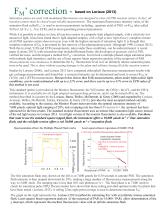
Saturation pulses are used with modulated fluorometers are designed to close all PSII reaction centers. In fact, all reaction centers must be closed to get reliable measurements. The maximum fluorescence intensity value, of the saturation flash called FM’, is used in most measurements including, quantum yield of PSII or FPSII (also called Y(II) or DF /FM’ ), J (or ETR), and in most quenching protocol parameters. While it is possible to reduce or close all reaction centers in a properly dark adapted sample, with a relatively low amount of light, it has been found that in light adapted samples,...
Open the catalog to page 7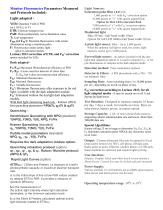
Monitor Fluorometer Parameters Measured and Protocols included: Light adapted Y(II): Quantum Yield of PSII (or ) DF/FM’ or Y) ETR: Electron transport rate PAR: Photosynthetically Active Radiation value T: Leaf temperature FMS (or FM’): Maximal fluorescence with actinic illumination using a saturation pulse F: Fluorescence under actinic light (prior to saturation pulse) Loriaux 2013 correction of ETR, and FM’ correction option included for Y(II). Dark adapted FV/FM: Maximum Photochemical efficiency of PSII FV/FO: A more sensitive detector of stress than FV/FM, but it does not measure plant efficiency....
Open the catalog to page 8
Optional features & accessories: · Tripods · Articulating arms · Solar panels · Daylight dark adaptation module with far red light · Additional measuring heads · Junction boxes · Cellular modem · Radio - point-to-point link available · Satellite communications · Stainless 1.5 inch pipe mount with ¼ inch 20 thread mount hole for articulating arms used to mount measuring heads to pole or pipe mounts. · Integration of other data is possible such as weather station data, humidity, wind speed, infrared radiometer output, soil moisture sensor output, and other radiation sensor output. Contact Opti-Sciences...
Open the catalog to page 9All Opti-Sciences Inc catalogs and technical brochures
 GFPIII
2 Pages
 Lambda T
2 Pages
 PGA
PGA2 Pages
 EGA60
EGA602 Pages
 EGA41
EGA412 Pages
 EGA30
EGA302 Pages
 SRS-SD 1000
4 Pages
 ACE
ACE10 Pages
 AM350
AM3502 Pages
 LCpro-SD
6 Pages
 LCi-SD
6 Pages
 ACM-200plus
2 Pages
 os1p
os1p9 Pages
 CCM-200plus
2 Pages
 PSK
PSK14 Pages
 Integrated Fluorometer iFL
16 Pages
 OS5p+
OS5p+14 Pages


