
- Catalogs
- Penergetic International AG
- Penergetic_References_Book2018


- Products
- Catalogs
- News & Trends
- Exhibitions
Penergetic_References_Book2018
Penergetic_References_Book2018
Penergetic International AG is a Swiss company focused on natural biotechnology for agriculture, aiming to improve soil, plant, and animal health through sustainable practices.
- Penergetic b: Enhances soil fertility, used in the USA and Brazil.
- Penergetic p: Improves plant health and yield, applied to crops like soybeans and corn.
- Penergetic t: Supports livestock health, used in dairy and goat farms.
- Penergetic g: Manages liquid manure, used in South Korea and Switzerland.
- Penergetic k: Enhances composting processes, used in Canada.
- AquaKat: Vitalizes water for better agricultural use.
Emphasizes biodynamic agriculture and bioactive materials to reduce chemical fertilizer use and enhance crop yields.
Collaboration with experts highlights benefits of cover crops and no-till methods for soil protection and biodiversity.
Aims to bioactivate productive systems through cover crops, balancing soil-water-plant relationships.
Penergetic International AG is committed to sustainable agricultural practices for future generations.
Details on cover crops like Crotalaria juncea, Buckwheat, Sunflower, and others, focusing on specifications, benefits, and considerations for soil improvement.
Provides seeding rates and characteristics for crops like Forage Oat, Flax, Buckwheat, and others, emphasizing adaptability and biomass production.
Highlights the importance of legumes in crop rotations for diversity and nitrogen fixation.
Describes blends aimed at maximizing biomass and biodiversity, including mixtures of mustard, phacelia, pea, and vetch.
Designed to stimulate biological systems, enhancing soil quality and plant growth, with benefits like reduced fertilizer needs and improved plant resistance.
Includes examples from Minnesota and Alberta, showing improved soil structure and fertility with Penergetic products.
Studies in Brazil show increased plant height and yield with Penergetic products.
Emphasizes sustainable agriculture and the role of Penergetic products in enhancing soil and plant health.
- Grain Yield: Highest yield with Penergetic and mineral fertilizer.
- Plant Height: Increased with Penergetic treatments.
- Chlorophyll Index: Slight improvements noted.
- USA: Taller plants and increased yield with Penergetic.
- Sri Lanka: Higher yields with Penergetic and full NPK fertilizer.
- Higher yields and improved quality with Penergetic treatments.
Penergetic products improve yield and quality across various crops, offering a high return on investment.
Trials in South Africa and Quebec show increased yields and cost-effectiveness with Penergetic products.
In Chile, Penergetic products improved yield and fruit quality.
In Costa Rica, Penergetic products reduced nutrient loss and improved uptake.
Penergetic products enhance productivity and quality while being cost-effective.
Details on nutrient absorption efficiency in various crops, highlighting economic benefits.
- Carrots: Increased yield and quality.
- Okra: Enhanced quality and production.
- Onions: Improved size and nutritional composition.
Reduction in chemical use and improved soil and plant health with Penergetic products.
Penergetic products lead to increased yields, improved quality, and reduced reliance on conventional fertilizers and pesticides.
Use of Penergetic p improves plant health and reduces chemical pesticide use.
Increased yields in wheat, oats, and oil seed rape with Penergetic products.
Significant yield improvements with Penergetic products and cover crops.
Penergetic t improves livestock conditions and productivity.
Penergetic technology enhances plant and animal health, reducing chemical inputs and increasing yields.
Improvements in milk production, cheese quality, and carcass quality with Penergetic t.
Penergetic g improves slurry conditions and reduces odors.
Penergetic products improve production efficiency and product quality in livestock operations.
Penergetic products reduce nutrient excretion and improve meat quality.
Increased productivity in rice and potato cultivation with Penergetic-treated slurry.
Penergetic products offer sustainable alternatives to traditional fertilizers and additives.
Enhances composting processes and reduces odors.
Improves water quality for agricultural use.
Penergetic products provide sustainable solutions for modern agricultural challenges.
Catalog excerpts
penergetic the natural biotechnology With the impulse of nature
Open the catalog to page 1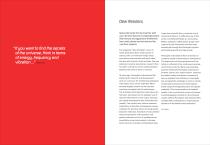
Dear Readers, Nature demands that we treat her with care. We have become increasingly aware that overuse and aggressive treatments harm soils, plants and animals and disrupt their systems. “ If you want to find the secrets of the universe, think in terms of energy, frequency and vibration ...” Nikola Tesla Large farms benefit from a reduced use of chemical fertilizers. In different area of this world, overfertilized fields are recovering. Wheat, potatoes, coffee plants, grape vines respond to the information that has been transferred through the Penergetic system The magazine “Geo Kompakt”, issue...
Open the catalog to page 2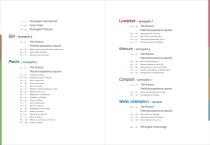
Practical experience reports 38 — 39 Observation in soil structure in the U.S.A. 40 — 41 Soil fertility in Brazil 40 — 41 Alkaline soil in Canada Practical experience reports 48 — 49 Soybean in Brazil - Photos 58 — 57 Alfalfa in Central California, U.S.A. 60 — 61 Potatoes in South Africa 70 — 77 Rice in Costa Rica Practical experience reports 106 — 109 Milk goat farm in France 110 — 111 Dairy Cows in Costa Rica 112 — 113 Dairy farm Willenbring, U.S.A. 114 — 117 Carcass quality in Thailand Practical experience reports 120 — 126 Slurry in South Korea 126 — 127 Manure Lagoon in the U.S.A. 128 —...
Open the catalog to page 3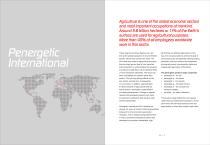
Agriculture is one of the oldest economic sectors and most important occupations of mankind. Around 5.6 billion hectares or 11% of the Earth’s surface are used for agricultural purposes. More than 40% of all employees worldwide work in this sector. These may be enormous figures, but if we look at the global population of around 8 billion people, whose food comes from those 11% of surface area used for agricultural purposes, then we might get an idea of how important food production is. Unfortunately, this pressure to produce enough food, has an adverse effect on food production standards. The...
Open the catalog to page 4
Cover Crops Cover crop has been used in soil conservation since ancient times. During the collaboration with Dr. Ademir Calegari, Penergetic noted that cover crop and no-till methods have additional positive effects when penergetic products are used. For this reason, we want to introduce the different areas of applications for cover crops and contribute further to developing smart agricultural methods. Spring – Summer cover crops Pearl Millet (Pennisetum glaucum) Crotalaria spectabilis (Crotalaria spectabilis) Crotalaria ochroleurca (Crotalaria ochroleuca) Crotalaria juncea (Crotalaria juncea)...
Open the catalog to page 5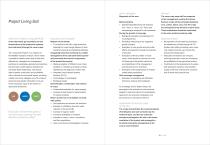
What is the Project Living Soil (PLS)? A tool that works par excellence for the bioactivation of the productive systems (soil and plant) through the cover crops. The “Living Soil Project” is an initiative of the WebBio Academy in Brazil, which makes it possible to identify select and at field level, alternatives, strategies and management practices of sustainable agricultural productions that promote a better balance between the soil-water-plant relationship. This should lead to greater productivity and profitability with a minimal environmental impact, providing a better and more intelligent...
Open the catalog to page 6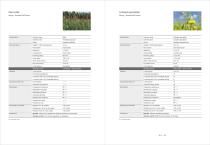
Crotalaria spectabillsSpring - Summer Soil Covers Identification
Open the catalog to page 7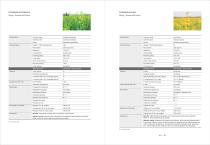
Cratalaria junceaSpring - Summer Soil Cavers Identification In mixtures with 4 to 6 crops 8 to 10 (kg /ha) Meloidogyne incognita Susceptible / Resistent mod. Pratylenchus coffeae - Attention points: Hostesses of Pratylenchus brachyurus, and some fungi. Biomass when incorporated, effects of tissue with glucosinolates are transformed into isothiocyanates and control nematodes (Pratylenchus, and others) and soilborne diseases trough “biofumigation”. These molecules are volatile and toxic to soil microorganisms and nematodes.
Open the catalog to page 8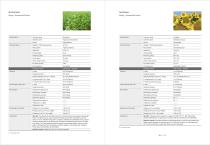
In mixtures with 4 to 6 crops 15 to 18 (kg/ha) SunflowerSpring - Summer Soil Covers Identification In mixtures with 4 to 6 crops 2 (kg /ha) Meloidogyne incognita Susceptible Meloidogyne javanica Susceptible Pratylenchus coffeae -
Open the catalog to page 9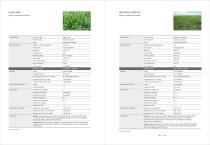
Brachiaria ruziziensisSpring - Summer Soil Covers Identification In mixtures with 4 to 6 crops 2 to 3 (kg/ ha) Pratylenchus coffeae - Recycling of nutrients Nitrogen (% in dry matter)2 0,75 to 2,01 Indications Benefits: Grows in soils with medium chemical fertility. Precocity and high biomass production. Can be intercropped with corn and other crops, ease of handling, high nutrients recycling and high C/ N ratio (around 40). Reduces Fusarium sp., Rhizoctonia sp. (white-mold). Attention points: Attempt for continuous use and every 2 years to perform nematode analysis (Pratylenchs brachiurus),...
Open the catalog to page 10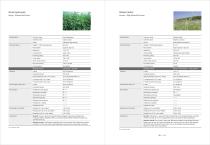
Oilseed radishAutumn - Early Winter Soil Covers Identification In mixtures with 4 to 6 crops 2 to 3 (kg/ha) Meloidogyne javanica Susceptible Heterodera glycines - Rotilenchulus reniformis - Pratylenchus coffeae - Attention points: Do not sow in areas with Sclerotinia problems. Intercropped with other species such as rye, oat, millet, buckwheat, etc., may be use 2 to 3 kg /ha, will decrease white mold and undermine the later crops. Can be successfully mixed with grasses, legume and other cover crop species.
Open the catalog to page 11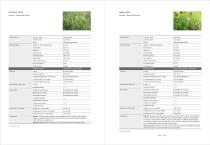
Hairy vetchAutumn - Winter Soil Covers Identification In mixtures with 4 to 6 crops 12 to 18 (kg/ha) Meloidogyne incognita Susceptible and hostess Meloidogyne javanica Susceptible and hostess Heterodera glycines - Rotilenchulus reniformis - Pratylenchus coffeae - Recycling of nutrients Nitrogen (% in dry matter)2 1,88 to 4,36 Indications Benefits: Rustic crop that fits well in soils with low content of pH, Al and P. Provide high N to the soil and next crops in temperate and subtropical regions. Trough mulching effects, soil structure, higher water retention, crop root development, soil biological...
Open the catalog to page 12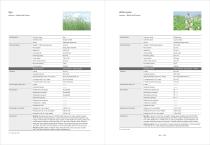
Autumn - Winter Sail Covers White lupine Autumn - Winter Soil Covers In mixtures with 4 to 6 crops 10 to 15 (kg/ ha) In mixtures with 4 to 6 crops 15 to 20 Intercropping with corn in lines broadcast sowing Rotilenchulus reniformis -- Pratylenchus coffeae -- Recycling of nutrients Nitrogen (% in dry matter)2 1,22 to 1,97 Indications Benefits: used as a cover crop, oil (seeds), forage (sweet varieties) and animal fodder. High fixing nitrogen and cycling phosphorus and other nutrients. Nitrogen fixing can vary from 100 to 200 kg N ha-1. P fixed by Fe, Al, and Ca phosphates can be released by root...
Open the catalog to page 13All Penergetic International AG catalogs and technical brochures
 SDS_Molasses_penergetic g
4 Pages
 Aquakat
2 Pages
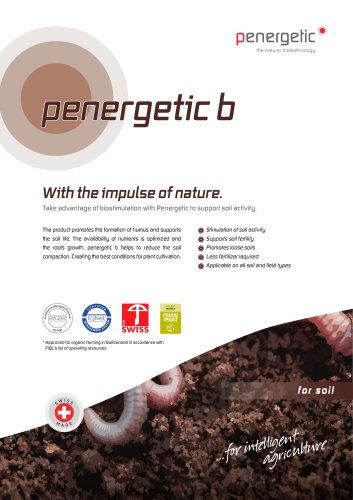 penergetic b
2 Pages
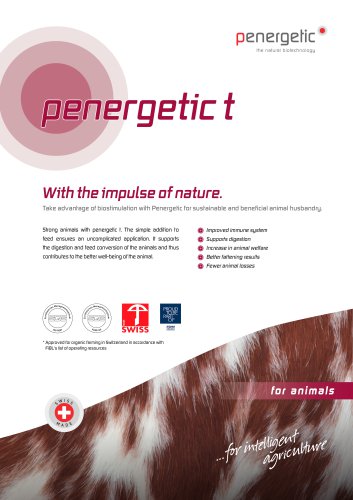 penergetic t
2 Pages
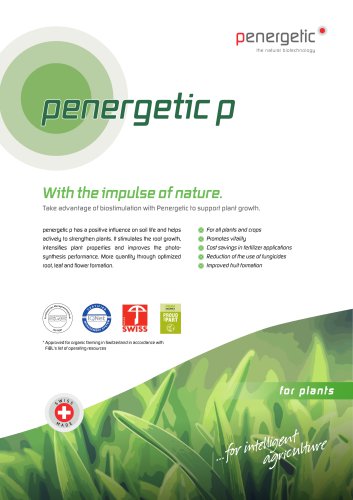 penergetic p
2 Pages
- Feed additive
- Dry feed additive
- Poultry feed additive
- Cattle feed additive
- Pig feed additive
- Biostimulant
- Treatment system
- Amendment
- Water treatment system
- Organic amendment
- Powder feed additive
- Biostimulant with trace elements
- Foliar application biostimulant
- Soil structure amendment
- Biological biostimulant
- Root amendment
- Soil fertility amendment
- Root biostimulant
- Growth enhancer feed additive
- Vegetable amendment