
- Catalogs
- Rite Way Mfg. Co. Ltd.
- CRUSH-RITE

CRUSH-RITE

CRUSH-RITE
The Crush-Rite Crimper Roller by Rite Way is designed to manage weeds and cover crops while protecting and replenishing soil. It aims to reduce or eliminate the reliance on chemical inputs in farming.
Product Features
The Crush-Rite incorporates features from Rite-Way landrollers, such as size, flexibility, weight, and the patented FORWARD™ unfolding system. It includes cutting blades to crush and crimp weeds and cover crops, converting them into nutrient-rich, soil-protecting field cover. The product is easy to transport, with multi-section units featuring the FORWARD™ unfolding system.
Specifications
The Crush-Rite is available in various models with different sizes and weights:
- CF1-20: 20’ (6.1 m), 9,700 lbs (4,400 kg)
- CF3-32: 32’ (9.8 m), 18,880 lbs (8,564 kg)
- CF3-36: 36’ (11 m), 20,880 lbs (9,471 kg)
- CF3-42: 42’ (13 m), 23,520 lbs (10,669 kg)
- CR12FH: 12’ (3.7 m), 3,682 lbs (1,670 kg)
- CR14FH: 14’ (4.3 m), 4,492 lbs (2,037 kg)
- CR16FH: 16’ (4.9 m), 5,302 lbs (2,405 kg)
- CR18FH: 18’ (5.5 m), 6,112 lbs (2,772 kg)
- CR20FH: 20’ (6.1 m), 6,922 lbs (3,140 kg)
Target Users
The Crush-Rite is ideal for:
- Organic farmers
- No-till farmers aiming to reduce crop inputs
- Farmers focused on preventing soil erosion
- Innovative farmers experimenting with new crops and cover crops
Benefits
Using the Crush-Rite offers several advantages:
- Cost savings on crop inputs
- Preservation of topsoil by leaving organic material on the surface
- Reduced environmental impact of crop protection products
- Return of important nutrients to the soil through cover crops
Cover Crops
Cover crops are typically planted in the fall and terminated in the spring before planting the main crop. They include grasses, cereal grains, legumes, or grass/legume mixtures. Benefits of cover crops include:
- Increased soil organic matter
- Decreased runoff and soil erosion
- Conserved soil moisture
- Reduced soil compaction
- Increased nutrients and reduced nitrate leaching
- Supply of nitrogen to the following crop
- Suppression of weeds, soil-borne diseases, and nematodes
- Attraction of beneficial insects
- Increased yields of the following year's crop
Catalog excerpts

CRUSH your weeds CRUSH your cover crop PROTECT and replenish your soil REDUCE or eliminate your reliance on chemicals
Open the catalog to page 1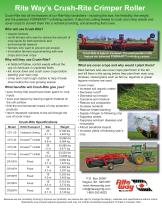
Crush-Rite has all the features of our Rite-Way landrollers - including the size, the flexibility, the weight, and the patented FORWARDTM unfolding system. It also has cutting blades to crush and crimp weeds and cover crops to convert them into a nutrient-providing, soil-protecting field cover. Who will use Crush-Rite? • organic farmers • no-till farmers who want to reduce the amount of crop inputs for both economic and environmental reasons • farmers who want to prevent soil erosion • innovative farmers experimenting with new crops and cover crops Why will they use Crush-Rite? • in fields left...
Open the catalog to page 2All Rite Way Mfg. Co. Ltd. catalogs and technical brochures
 HH8200
3 Pages
 ROCK REMOVAL SERIES
3 Pages
 LAND ROLLERS
3 Pages
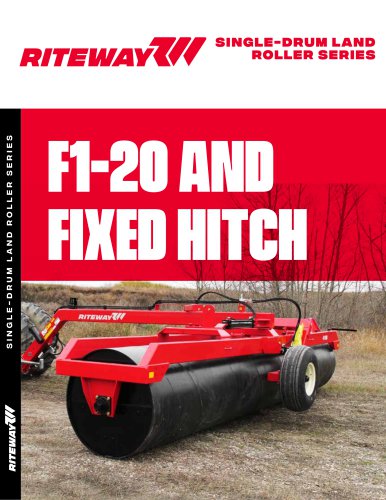 F1-20 And Fixed Hitch
3 Pages
 BALE CART & GRAPPLE
3 Pages
 ONE-TILL
3 Pages
 MAXI Rotary Harrows
3 Pages
 F-5 & F-7 LAND ROLLERS
3 Pages
 F-3 LAND ROLLER
3 Pages
 Fixed Hitch Land Roller
2 Pages
 Rock Pickers & Windrowers
3 Pages
 Jumbo heavy harrow
3 Pages