
- Catalogs
- Royal Eijkelkamp
- Calcimeter


Calcimeter
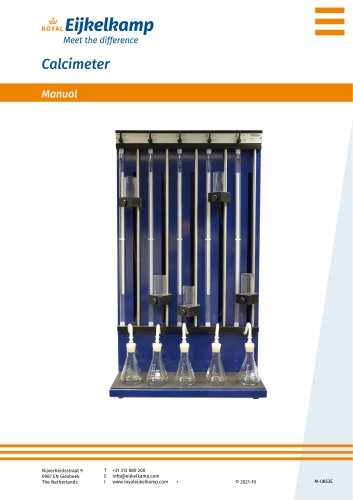
Calcimeter
The Eijkelkamp calcimeter is designed to measure soil carbonate content, indicating soil fertility, and complies with the NEN-ISO 10693 standard. It can analyze up to five samples simultaneously using the Scheibler method, which converts carbonates to CO2 with hydrochloric acid.
Device Information
The calcimeter includes two-way cocks for de-aeration and measurement, buffer vessels for water management, and a burette for CO2 measurement. Proper setup requires filling the burettes with water and ensuring no air bubbles.
Testing for Leakage
Leakage testing involves closing the burette and checking system stability over 60 minutes under constant temperature and pressure.
Required Substances
Necessary materials include air-dried soil samples, calcium carbonate powder, hydrochloric acid (4 mol/l), and high-quality water with specific conductivity standards.
Preparation
Soil samples are treated with hydrochloric acid to estimate carbonate content, determining the sample size for analysis.
Measurement Procedure
The procedure involves preparing reaction vessels with calcium carbonate and hydrochloric acid, allowing CO2 saturation, and conducting blank and calibration determinations in a temperature-controlled environment.
Notes
Volume changes during blank determinations should not exceed 1.0 ml. Additional water may be needed for soils with high organic content. Other gases can affect results and should be purified.
Calculation
Carbonate content is calculated using a formula considering CO2 volumes from the sample, standards, and blanks, along with the sample's water content.
Repeatability
Measurement repeatability should comply with specified standards for consistent results.
Carbonate Content Specifications
- For 0 to 50 g/kg, the acceptable difference is 3 g/kg.
- For 50 to 150 g/kg, the acceptable difference is 6% of the value.
- For 150 to 180 g/kg, the acceptable difference is 9 g/kg.
- For over 180 g/kg, the acceptable difference is 5% of the value.
Standards and Procedures
Further details on sample preparation, calculations, and repeatability are available in the ISO 10693 standard.
Reproduction and Liability
No part of this publication may be reproduced without prior written permission from Royal Eijkelkamp. Technical data may change without notice. Royal Eijkelkamp is not liable for personal damage due to improper use.
Feedback
Royal Eijkelkamp welcomes feedback and remarks about its products and instructions.
Catalog excerpts
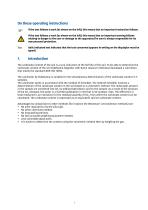
On these operating instructions If the text follows a mark (as shown on the left), this means that an important instruction follows. Italic indicated text indicates that the text concerned appears in writing on the display(or must be typed). If the text follows a mark (as shown on the left), this means that an important warning follows relating to danger to the user or damage to the apparatus.The user is always responsible for its own personal protection. The carbonate content of the soil is a sure indication of the fertility of the soil. To be able to determine the carbonate content of the soil...
Open the catalog to page 3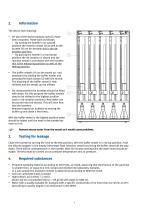
Information The device (see drawing) • On top of the device twoway cocks (4) have been mounted. These work as follows: - By turning the handle in an upward position the reaction vessel (3) as well as the burette (5) are de-aerated; this is the deaeration position. - By placing the handle in a horizontal position the de-aeration is closed and the reaction vessel is connected with the burette; this is the measuring position as well as the testing position. • The buffer vessels (1) can be moved up- and downward by holding the buffer holder and pressing the black button (2) with the thumb. The blocking...
Open the catalog to page 4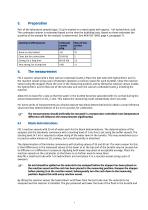
Part of the laboratory sample (appr. 2.5 g) is treated on a watch glass with approx. 1 ml hydrochloric acid. The carbonate content is estimated based on the time the bubbling lasts. Based on these estimates the quantity of the sample for the analysis is determined. See NEN-ISO 10693 page 4, paragraph 7.1. Fill a reaction vessel with a little calcium carbonate (CaCO3). Place the test tube with hydrochloric acid in the reaction vessel using a pair of tweezers (prepare a reaction vessel for each burette). Close the reaction vessel using the stopper. Place the cock in the measuring position and by...
Open the catalog to page 5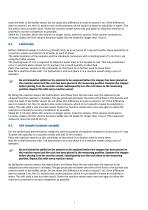
raise the level in the buffer vessel. Do not allow this difference in level to exceed 3 ml. If the difference were to exceed 3 ml, the CO2 would come under pressure, which would increase its solubility in water. This will yield a less accurate result. Shake the reaction vessel every now and again to allow the reaction to proceed to as near completion as possible. Shake for 5 minutes. When the volume no longer varies, note this volume. If the volume continues to increase, shake until the volume becomes stable (do not shake for longer than 1 hour). Before calibration weigh 0.2 and 0.4 g (dried)...
Open the catalog to page 6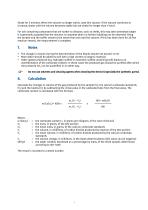
Shake for 5 minutes. When the volume no longer varies, note this volume. If the volume continues to increase, shake until the volume becomes stable (do not shake for longer than 1 hour). For soil containing carbonates that are harder to dissolve, such as shells, this may take somewhat longer. It is generally accepted that the reaction is complete when no further bubbling can be observed. Bring the burette and the buffer vessel to the same level and read the volume. If this has been done for all five reaction vessels, the measurement is complete. The change in volume during the determination...
Open the catalog to page 7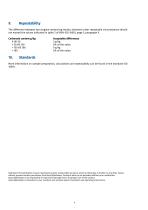
The difference between two singular measuring results, obtained under repeatable circumstances should not exceed the values indicated in table 2 of NEN-ISO 10693, page 5, paragraph 9. Carbonate content g/kg 0 till 50 > 50 till 150 > 150 till 180 > 180 Acceptable differences 3 g/kg 6% of the value 9 g/kg 5% of the value More information on sample preparation, calculations and repeatability can be found in the standard ISO 10693. Nothing in this publication may be reproduced and/or made public by means of print, photocopy, microfilm or any other means without previous written permission from Royal...
Open the catalog to page 8