- Company
- Products
- Catalogs
- News & Trends
- Exhibitions
SIS
SIS
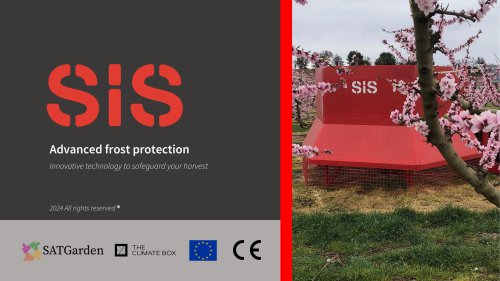
The document introduces the Selective Inverted Sump (SIS®), a cutting-edge frost protection system designed to safeguard agricultural crops from frost damage effectively and sustainably.
Frost is identified as a major threat to agriculture, causing significant crop losses, reduced yield and quality, and financial setbacks for farmers.
- Cold Air Detection: Identifies cold air accumulation near the ground during frost conditions.
- Selective Air Extraction: Extracts the coldest air from ground level to minimize risk to plants.
- Vertical Air Discharge: Propels the cold air upwards to mix with warmer air layers.
- Air Mixing at Height: Neutralizes the temperature of the cold air.
- Continuous Protection: Repeats the process throughout the night to ensure ongoing protection.
The SIS® system has been successfully implemented for over 25 years in vineyards, orchards, and other high-value crops across the USA, Europe, and Oceania, supported by advanced microclimatic studies and technology.
- Energy-efficient and environmentally friendly with low noise and minimal ecological impact.
- Cost-effective, offering high ROI through reduced losses and improved harvests.
Success stories include vineyards in California, France, Australia, and New Zealand, as well as protection for cherries, kiwifruit, blueberries, apples, citrus, and olives in various regions.
SIS® technology is also used for fog control, odor mitigation, and dust control in industrial settings.
- Constructed from durable SAE 1010 galvanized steel.
- Engineered for silent operation, suitable for agricultural environments.
- Energy flexibility with options for diesel, electric motors, and PTO drive.
- Precision deployment guided by microclimatic studies and GPS technology.
Farmers are encouraged to request a microclimatic study and consultation to tailor the SIS® solution to their specific needs, joining a network of successful farms.
Catalog excerpts
Innovative technology to safeguard your harvest
Open the catalog to page 1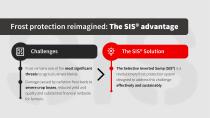
Frost protection reimagined: The SIS® advantage Challenges Frost remains one of the most significant threats to agriculture worldwide. Damage caused by radiation frost leads to severe crop losses, reduced yield and quality and substantial financial setbacks for farmers. The SIS® Solution The Selective Inverted Sump (SIS®) is a revolutionary frost protection system designed to address this challenge effectively and sustainably.
Open the catalog to page 2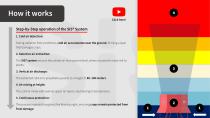
How it works Step-by-Step operation of the SIS® System1. Cold air detection: During radiation frost conditions, cold air accumulates near the ground, forming a layer that damages crops. The SIS® system extracts the coldest air from ground level, where it poses the most risk to plants. The extracted cold air is propelled upwards to a height of 80-100 meters. The cold air mixes with warmer upper air layers, neutralizing its temperature. The process repeats throughout the freezing night, ensuring crops remain protected from frost damage.
Open the catalog to page 3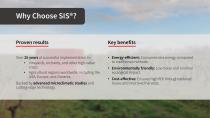
Proven results Key benefits Over 25 years of successful implementation in: • Vineyards, orchards, and other high-value crops. • Agricultural regions worldwide, including the USA, Europe, and Oceania. Backed by advanced microclimatic studies and cutting-edge technology. • Energy-efficient: Consumes less energy compared to traditional methods. • Environmentally friendly: Low noise and minimal ecological impact. • Cost-effective: Ensures high ROI through reduced losses and improved harvests.
Open the catalog to page 4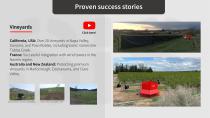
Proven success stories Vineyards Click here! California, USA: Over 20 vineyards in Napa Valley, Sonoma, and Paso Robles, including iconic names like Tablas Creek. France: Successful integration with wind towers in the Nantes región. Australia and New Zealand: Protecting premium vineyards in Marlborough, Coonawarra, and Clare Valley.
Open the catalog to page 5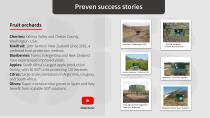
Proven success stories Fruit orchards Cherries: Yakima Valley and Chelan County, Washington, USA. Kiwifruit: 100+ farms in New Zealand since 2001, a preferred frost protection method. Blueberries: Farms in Argentina and New Zealand have experienced improved yields. Apples: South Africa’s largest apple production facility, with 30 SIS® units protecting 110 hectares. Citrus: Large-scale plantations in Argentina, Uruguay, and South Africa. Olives: Super-intensive olive groves in Spain and Italy benefit from scalable SIS® solutions. Click here
Open the catalog to page 6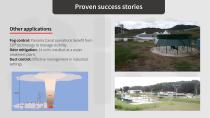
Proven success stories Other applications Fog control: Panama Canal operations benefit from SIS® technology to manage visibility. Odor mitigation: 14 units installed at a water treatment plant. Dust control: Effective management in industrial settings.
Open the catalog to page 7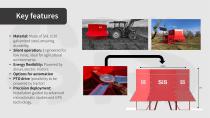
• Material: Made of SAE 1010 galvanized steel, ensuring durability. • Silent operation: Engineered for low noise, ideal for agricultural environments. • Energy flexibility: Powered by diesel, electric motors. • PTO drive (possibility to be powered by tractor) • Precision deployment: Installation guided by advanced microclimatic studies and GPS technology.
Open the catalog to page 8
Act now to safeguard your harvest! • Request your microclimatic study and discover how SIS® can transform your farm’s frost protection strategy. • Your consultation is personalized. Let us design a solution that meets your unique needs. • Join our growing network of successful farms and secure your crops and maximize your harvests. Contact us now and take the first step towards a safer, more productive future for your farm! Email: [email protected] Phone: +34 935122686 Website: www.satgard
Open the catalog to page 9All SATGARDEN catalogs and technical brochures
 Stargarden Presentation
16 Pages
 SiS® Description
11 Pages
 MONITOREO Y Y GESTION HORAS FRIO
30 Pages