- Company
- Products
- Catalogs
- News & Trends
- Exhibitions
SlagSil presentation H2S
1 /14Pages
SlagSil presentation H2S
1 /14Pages
Catalog excerpts
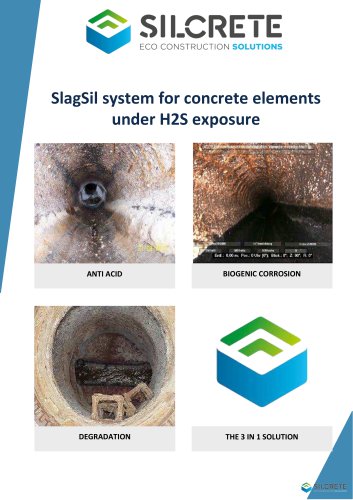
SlagSil system for concrete elements under H2S exposure ANTI ACID BIOGENIC CORROSION
Open the catalog to page 1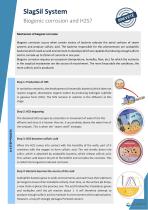
SlagSil System Biogenic corrosion and H2S? Mechanism of biogenic corrosion Biogenic corrosion occurs when certain strains of bacteria colonize the aerial surfaces of sewer systems and produce sulfuric acid. The bacteria responsible for this phenomenon are acidophilic bacteria (which need an acid environment to develop) which are capable of producing enough sulfuric acid to corrode up to 25mm of concrete in one year. Biogenic corrosion requires an ecosystem (temperature, humidity, flow, etc.) for which the nutrients in the sceptical wastewater are the source of nourishment. The more favourable...
Open the catalog to page 2
SlagSil System Protect the concrete from inside Immunize concrete against acid attacks - Technology for durable concrete. Cementitious materials such as concrete produce after drying hydrated calcium silicate (CSH) and Ca(OH)2 (portlandite). Although portlandite performs important functions in the protection against corrosion of reinforced concrete, it is also responsible for the undesirable corrosion of concrete. The acids will dissolve the Portlandite (Ca(OH)2 – Calcium), decalcify the other hydrates and lead to the crumbling of the concrete. The most effective protection of materials is therefore...
Open the catalog to page 3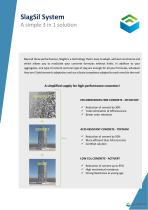
SlagSil System Beyond these performances, SlagSil is a technology that is easy to adapt, without constraints and which allows you to modulate your concrete formulas without limits. In addition to your aggregates, one type of cement and one type of slag are enough for all your formulas, whatever they are! Stoichiometric adaptation and our silicate complexes adapted to each need do the rest! A simplified supply for high-performance concretes! EFFLORESCENCES FREE CONCRETE - EFFLOSTOP Reduction of cement by 30% Total elimination of efflorescence Better color retention ACID RESISTANT CONCRETE...
Open the catalog to page 4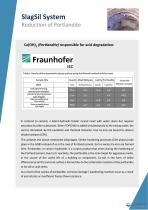
SlagSil SystemReduction of Portlandite Ca(OH)2(Portlandite) responsible for acid degradation: Table 2: Results of the quantitative phase analysis using the Rietveld method (in% by mass) In contrast to cement, a latent-hydraulic binder cannot react with water alone but requires activation by other substances. When TOPCHIM is added simultaneously to the mixing water, the sand is stimulated. By this excitation and chemical character, free Ca-ions are bound to calcium silicate hydrates (CSH). This achieves the above-mentioned advantages. Similar hardening processes (CSH phases) take place in the...
Open the catalog to page 5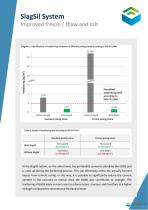
SlagSil SystemImproved freeze / thaw and salt Permitted weathering limit according to DIN EN 1340 Without SlagSil With SlagSil Porous paving stone Table 2: Results of weathering test according to DIN EN 1340 In the SlagSil system, on the other hand, the portlandite serves to stimulate the GGBS and is used up during the hardening process. This can effectively utilize the actually harmful excess from cement curing. In this way, it is possible to significantly reduce the cement content in the concrete or mortar since the GGBS also contributes to strength. The hardening of GGBS leads in most cases...
Open the catalog to page 6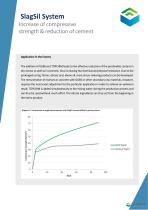
SlagSil SystemIncrease of compressive strength & reduction of cement The addition of GGBS and TOPCHIM leads to the effective reduction of the portlandite content in dry mortar as well as in concrete, thus increasing the chemical and physical resistance. Due to the prolonged curing, firmer, denser and, above all, more stress-relieving products can be developed. The remuneration of mortars or concrete with GGBS or other secondary raw materials, however, requires the most exact adjustment to the particular application in order to achieve an optimum result. TOPCHIM is added simultaneously to the...
Open the catalog to page 7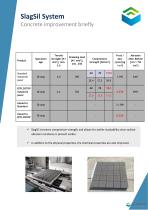
SlagSil SystemConcrete improvement briefly Product
Open the catalog to page 8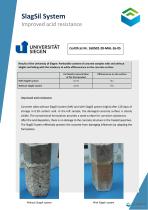
SlagSil System Improved acid resistance UNIVERSITATSIEGEN Results of the University of Siegen: Portlandite content of concrete samples with and without SlagSil and linking with the tendency to white efflorescence on the concrete surface Improved acid resistance Concrete slabs without SlagSil system (left) and with SlagSil system (right) after 120 days of storage in 0.5% sulfuric acid. In the left sample, the damaged concrete surface is clearly visible. The conventional formulation provides a weak surface for corrosive substances. After the acid deposition, there is no damage to the concrete structure...
Open the catalog to page 9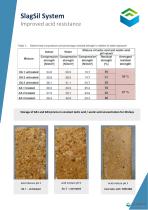
SlagSil SystemImproved acid resistance Table 1: Determined compressive and percentage residual strength in relation to water exposure Storage of XA1 and XA3 prisms in constant lactic acid / acetic acid concentration for 28 days Concrete with TOPCHIM
Open the catalog to page 10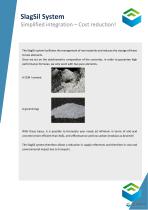
SlagSil System Simplified integration – Cost reduction! The SlagSil system facilitates the management of raw materials and reduces the storage of these to two elements. Since we act on the stoichiometric composition of the concretes, in order to guarantee high performance formulas, we only work with two pure elements. With these bases, it is possible to formulate your needs ad infinitum in terms of anti-acid concrete (more efficient than XA3), anti-efflorescence and low carbon (modular as desired)! The SlagSil system therefore allows a reduction in supply references and therefore in cost and...
Open the catalog to page 11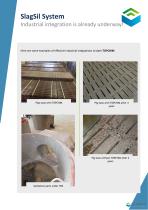
SlagSil System Industrial integration is already underway! Here are some examples of effective industrial integrations to date:TOPCHIM Pigs slats with TOPCHIM Pig slats with TOPCHIM after 4 years Pig slats without TOPCHIM after 4 years Sanitation parts under H2S
Open the catalog to page 12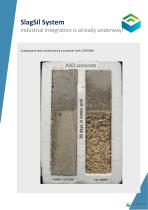
SlagSil System Industrial integration is already underway! Comparative tests carried out by a customer with: TOPCHIM
Open the catalog to page 13
Brand of Revoxia compagny 38 rue Uhrwiller F-67110 Gumbrechtshoffen (France) Tel : +33 6.83.02.45.65 Mail : [email protected] Web : www.silcrete.fr
Open the catalog to page 14All Silcrete catalogs and technical brochures
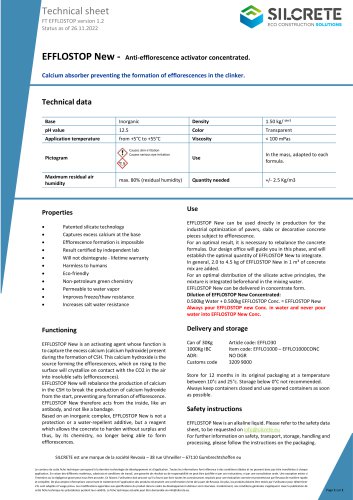 TDS EFFLOSTOP ENG
1 Page
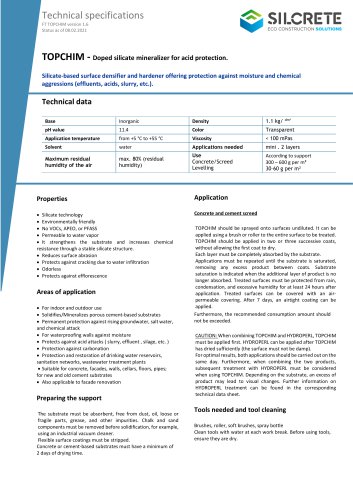 TDS TOPCHIM ENG
2 Pages