


TEAMTRACK™
TEAMTRACK™
Catalog excerpts
TEAMTRACK™ Asymmetric Backtracking. Tracker Position Control. +0.23%TeamTrack Gain against Middle Sensor Backtracking systems TeamTrack™ is part of comprehensive Soltec tracker position control that avoids inter-row shading in the early and late-day hours due to uneven terrain influences. TeamTrack achieves up to 6.2% yield-gain over standard tracking. • Tracker Control with no blind spots • Project Cost Control YIELD-GAIN 3D MODELLING +0.62%TeamTrack Gain against Dual-row tracking systems The TeamTrack 3D algorithm uses NREL sun-position data versus programmed constants of local irregularities to execute energy optimized backtracking position control, avoiding inter-row shading and achieving yield-gain. Tracker control is simply configured with irregularity parameters that do not change with time or external influences in normal operation. PROJECT COST CONTROL TeamTrack stands out from existing solutions that add equipment and feedback response mechanisms, that add cost and vulnerability. TeamTrack enables cost reduction in earth-grading on contours and steps. TeamTrack system is zero maintenance and provides for hardware independent software update. +1.13%TeamTrack Gain against Linked-row tracking systems TRACKER POSITION CONTROL TeamTrack is part of Soltec’s comprehensive tracker positioning control including sensors and response to cloud-cover, snow-cover, flood level, and wind regime. TeamTrack firstly assures secure tracker plant operation independent of external communications, and provides secure remote data communications. •Soltec’s TeamTrack™ Algorithms were validated byTUV Rheinland” Contents subject to change without prior notice © Soltec Energias Renewables * TeamTrackw.210iG5,V4 This document is of a commercial nature and the characteristics reflected are not binding for specific projects. The characteristics of the product will be specified in the final documentation of each project.
Open the catalog to page 1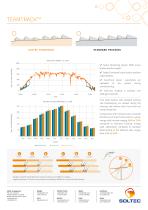
SOLTEC TEAMTRACK STANDARD TRACKING SPECIFIC AC POWER - 21 JUNE Spec. AC Power [kW/kWp] Tacker Monitoring System (TMS) active tracker position angles. Target Command issues tracker position angle updates. TeamTrack layout uploaded to the commissioning. parameters are system during Inter-row shading is avoided, and yield-gain achieved. Even while trackers with standard tracking and backtracking are shaded during the morning, the trackers with TeamTrack are mainly shade free. SPECIFIC AC YIELD [kWh/kWp] - 21 JUNE 250 Spec. AC Yield [kWh/kWp] Comparisons with 9 project cases conclude that...
Open the catalog to page 2All SOLTEC catalogs and technical brochures
 DIFFUSE BOOSTER
2 Pages