
- Catalogs
- STIHL AG & Co.
- STIHL SPA 65


- Products
- Catalogs
- News & Trends
- Exhibitions
STIHL SPA 65

STIHL SPA 65
This manual provides comprehensive instructions for the STIHL SPA 65, a specialized harvester for collecting olives, nuts, and other fruits. It emphasizes the importance of understanding all safety instructions before use.
The STIHL SPA 65 operates with STIHL AP or AR batteries. Key components include the control handle, carrying loop, grip hose, shaft, and rake fingers. The manual explains the function of each part and the symbols used on the device.
Safety is paramount, with warnings about potential hazards that could lead to serious injury or death. Users are advised to use only STIHL-approved batteries to prevent risks of fire or explosion. Proper use of the harvester and battery is emphasized to avoid accidents.
Users must be well-rested and physically, sensorily, and mentally capable of operating the harvester. Proper training is stressed to recognize and mitigate potential dangers.
Instructions cover assembly, battery charging, and operation of the harvester. Guidelines for adjusting the device for user comfort, inserting and removing the battery, and switching the harvester on and off are included. Maintenance procedures such as cleaning, storage, and troubleshooting are detailed.
The manual provides technical specifications, including sound and vibration levels, and compliance with EU regulations. Information on spare parts, accessories, and disposal instructions is also included.
The STIHL SPA 65 manual is a critical resource for ensuring safe and effective use of the harvester. It combines detailed operational guidance with stringent safety protocols to protect users and optimize performance.
- Users must be physically, sensorily, and mentally capable of operating the device and should wear work gloves and maintain a safe distance.
- The battery should be removed during breaks, transport, storage, maintenance, or repair and protected from heat, fire, and liquids.
- Read, understand, and keep the instruction manual.
- Secure long hair to prevent entanglement in the device.
- Wear long-sleeved, tight-fitting tops and dust masks to protect against flying debris and dust.
- Wear sturdy, closed footwear with a good grip.
- Keep bystanders, children, and animals away from the work area.
- Avoid working in flammable or explosive environments.
- Keep the battery away from metal objects, pressure, microwaves, chemicals, and salts.
- Do not transport or use a damaged battery.
- Ensure the device and battery are undamaged, clean, and functioning properly.
- Use only original STIHL accessories and follow the manual for installation.
- Work calmly and deliberately, avoiding poor visibility conditions.
- Hold the device with both hands and avoid touching moving parts.
- Stop work if the device behaves unusually and consult a STIHL dealer.
- Secure the device and battery during transport to prevent movement.
- Store the device and battery out of children's reach and in a dry, clean environment.
- Remove the battery before cleaning, maintenance, or repair to prevent accidental activation.
- Consult a STIHL dealer for maintenance and repair.
- Check the device, rake, and battery for safety compliance before use.
- Fully charge the battery as per the STIHL charger manual.
- Charge the battery according to the manual and check LED indicators for charge status or faults.
- Follow the manual for attaching and detaching components like fingers and stands.
- Special Harvester: Secure with lashing straps or a net to prevent movement during transport. Store out of children's reach and in a dry condition to prevent corrosion.
- Battery: Store in non-conductive packaging, away from children, and at temperatures between -10°C and +50°C. Ensure it is clean and dry.
- Remove the battery before cleaning or maintenance to prevent accidental start-up.
- Avoid using aggressive cleaning agents. Clean with a damp cloth or STIHL resin solvent.
- Contact a STIHL dealer for servicing or repairs.
- Ensure all components are in safe condition and the battery is fully charged.
- Fit and adjust the carrying system and check controls.
- Charge the battery fully using STIHL chargers. The LEDs indicate the state of charge and any malfunctions.
- Fit and remove tines using a 16 mm ring wrench. Adjust the carrying system for user comfort.
- Hold the harvester correctly and adjust rake speed as needed. Follow specific harvesting techniques for efficiency.
- LED indicators provide information on battery charge and malfunctions. Follow specific steps for troubleshooting issues.
The document provides detailed specifications for the STIHL SPA 65 Special Harvester and STIHL AP battery. The harvester is compatible with STIHL AP and AR batteries, weighs 3.3 kg without the battery, and measures 2.26 m in length. The STIHL AP battery uses lithium-ion technology, operates at 36 V, and its capacity and energy content can be found on the rating label. It operates within a temperature range of -10°C to +50°C.
The document specifies sound and vibration levels, recommending hearing protection. Sound pressure and power levels are measured at 84 dB(A) and 95 dB(A) respectively, with a vibration level of 2.5 m/s² for both control and loop handles.
The document mentions compliance with the REACH regulation and various EU directives, ensuring the product meets safety and environmental standards. It also includes an EC Declaration of Conformity, confirming adherence to specific directives and standards.
STIHL recommends using original replacement parts and accessories, available from authorized dealers.
Instructions for disposing of the harvester, battery, and accessories in accordance with local regulations are provided.
The document outlines comprehensive safety precautions for using power tools, including electrical safety, personal safety, and proper tool use and maintenance. It emphasizes the importance of using the correct tools, maintaining them properly, and following safety guidelines to prevent accidents.
Guidelines for battery care include using the specified charger, avoiding short circuits, and not exposing batteries to extreme temperatures or fire. It also advises against using damaged or modified batteries.
Power tools should be serviced by qualified personnel using identical replacement parts to maintain safety standards.
- Sparks and Explosions: Sparks can cause fires or explosions, leading to severe injuries or fatalities. Avoid working in explosive environments or near flammable materials.
- Battery Safety: Ensure that bystanders, children, and animals are kept away from the battery. The battery should not be exposed to environmental influences that could cause it to catch fire or explode. Keep it away from metal objects, pressure, microwaves, chemicals, and salts.
- Olive Harvester: Must be undamaged, clean, and have functioning controls. Only use original STIHL accessories.
- Combs: Ensure combs and fingers are undamaged and correctly mounted. Use only original STIHL accessories.
- Battery: Must be undamaged, clean, dry, and unmodified. Do not recharge damaged batteries.
- Work calmly and attentively. Avoid working in poor lighting or visibility conditions. Do not work above shoulder height and be cautious of obstacles.
- Hold the olive harvester firmly with both hands to prevent loss of control.
- If unusual behavior is observed, stop work and consult a STIHL specialist.
- Transport: Secure the olive harvester and battery to prevent movement or damage during transport.
- Storage: Keep the olive harvester and battery out of reach of children, in a clean, dry, and secure environment.
- Remove the battery before cleaning, maintenance, or repair to prevent accidental activation.
- Do not use aggressive detergents or sharp objects for cleaning. Consult a STIHL specialist for maintenance or repair needs.
- Ensure all components are in good condition. Fully charge the battery and clean the olive harvester before use.
- Check the control elements and consult a STIHL specialist if any issues are detected.
- Charge the battery according to the STIHL charger manual. LED indicators show the charge level and any disturbances.
- Follow the manual for assembling and disassembling the fingers and support foot of the olive harvester.
The document outlines the conditions for ensuring the safe state of a special harvester, rakes, and accumulator. The harvester must be undamaged, clean, and equipped with original STIHL accessories. Rakes should have all tines correctly mounted, and the accumulator must be intact, clean, and unmodified.
Operating in an unsafe state can lead to malfunction and severe injuries. It is crucial to work with non-defective equipment, maintain cleanliness, and avoid modifications. Keep unauthorized persons, children, and animals away from the work area. Protect the accumulator from heat and fire, and avoid immersing it in liquids.
Users should work calmly and cautiously, avoiding poor lighting conditions and working above shoulder height. Maintain balance and take breaks if fatigued. If the harvester behaves unusually, stop work and consult a STIHL specialist.
Secure the harvester and accumulator during transport to prevent movement. Store them clean, dry, and out of children's reach. The accumulator should be stored separately in a non-conductive package.
Ensure the accumulator is removed during cleaning or maintenance to prevent accidental activation. Use specified cleaning methods to avoid damage. Maintenance and repairs should be conducted by STIHL specialists.
Before starting, ensure all components are in a safe state, check and fully charge the accumulator, and clean the harvester. Follow the manual for assembling parts and adjusting the carrying system.
Charge the accumulator as per the manual. LED indicators show the charge status and any malfunctions. Address any issues indicated by red LEDs.
Instructions are provided for mounting and dismounting tines and the support foot. Ensure all parts are securely fastened.
Instructions for connecting and disconnecting the harvester are detailed, emphasizing safety and proper handling to avoid accidents.
The document outlines the safety precautions and operational guidelines for using a special harvesting device and its battery. It emphasizes the importance of practicing the removal of the carrying system to prevent panic in dangerous situations. The document warns about potential injuries and material damage during transportation and storage of the device and battery.
The special harvesting device must be secured with straps or nets to prevent it from falling or shifting during transport. The battery should not be transported if damaged and must be packed in a non-conductive material to prevent movement.
The device and battery should be stored out of children's reach, in a clean and dry environment. The battery should be stored disconnected from the device and charger, in a non-conductive package, and within a temperature range of -10°C to +50°C.
The document advises against using aggressive cleaning agents or water jets, as they can damage the device and battery. Maintenance and repairs should be conducted by a STIHL dealer to ensure safety and functionality.
Before use, the device, rake, and battery should be checked for safety. The battery should be fully charged, and the device cleaned. If any issues are detected, such as red blinking LEDs, the device should not be used, and a STIHL dealer should be contacted.
The charging time varies based on temperature conditions. The LED indicators on the battery display the charge level and any malfunctions. Red LEDs indicate a malfunction that requires attention.
Instructions are provided for assembling the device, including attaching the rake teeth and foot. The carrying system should be adjusted for user comfort.
The document provides detailed instructions on how to hold and operate the device, including setting the rake speed for continuous use and the correct method for harvesting.
After use, the device and battery should be dried if wet, cleaned, and stored properly. Transportation guidelines are reiterated for safety.
The document includes a troubleshooting section for addressing issues with the device or battery, such as low charge or temperature-related problems.
Catalog excerpts

Gebrauchsanleitung Instruction Manual Notice d’emploi Manual de instrucciones Uputa za uporabu Istruzioni d’uso Instruções de serviço Manual de instruções de serviços Handleiding οδη
Open the catalog to page 1
D Gebrauchsanleitung 1 - 25 G Instruction Manual 26 - 47 F Notice d’emploi 48 - 72 E Manual de instrucciones 73 - 97 h Uputa za uporabu 98 - 121 I Istruzioni d’uso 122 - 144 P Instruções de serviço 145 - 168 b Manual de instruções de serviços 169 - 192 n Handleiding 193 - 216 g οδηγίες χ
Open the catalog to page 2
Gedruckt auf chlorfrei gebleichtem Papier. Druckfarben enthalten pflanzliche Öle, Papier ist recycelbar. Informationen zu dieser Gebrauchsanleitung . . . . . . Geltende Dokumente . . . . . . . . . . . . . . . . . . . . . . . . . . . . . . Kennzeichnung der Warnhinweise im Text. . . . . . . . . Symbole im Text . . . . . . . . . . . . . . . . . . . . . . . . . . . . . . . . . . Akku laden und LEDs . . . . . . . . . . . . . . . . . . . . . . . . . . . . . Akku laden . . . . . . . . . . . . . . . . . . . . . . . . . . . . . . . . . . . . . . . . Ladezustand anzeigen . . . . . . . . . . . . . . ....
Open the catalog to page 3
20 Ersatzteile und Zubehör . . . . . . . . . . . . . . . . . . . . . . . . . . . . 20 20.1 Ersatzteile und Zubehör . . . . . . . . . . . . . . . . . . . . . . . . . . . . 20 21 Entsorgen . . . . . . . . . . . . . . . . . . . . . . . . . . . . . . . . . . . . . . . . . . 21 21.1 Spezialernter und Akku entsorgen. . . . . . . . . . . . . . . . . . 21 22 EU-Konformitätserklärung . . . . . . . . . . . . . . . . . . . . . . . . . . 21 22.1 Spezialernter STIHL SPA 65 . . . . . . . . . . . . . . . . . . . . . . . 21 23 Anschriften . . . . . . . . . . . . . . . . . . . . . . . . . . . . . . . . . . ....
Open the catalog to page 4
3 Übersicht – Sicherheitsinformation für STIHL Akkus und Produkte mit eingebautem Akku: www.stihl.com/safety-datasheets Kennzeichnung der Warnhinweise im Text WARNUNG Der Hinweis weist auf Gefahren hin, die zu schweren Verletzungen oder zum Tod führen können. ► Die genannten Maßnahmen können schwere Verletzungen oder Tod vermeiden. 3 HINWEIS Der Hinweis weist auf Gefahren hin, die zu Sachschaden führen können. ► Die genannten Maßnahmen können Sachschaden vermeiden. Symbole im Text Dieses Symbol verweist auf ein Kapitel in dieser Gebrauchsanleitung. 1 Bedienungsgriff Der Bedienungsgriff dient...
Open the catalog to page 5
6 Finger Die Finger schütteln die Äste. 1 LED leuchtet rot. Der Akku ist zu warm oder zu kalt. 7 Schalthebel Der Schalthebel schaltet den Spezialernter ein und aus. 4 LEDs blinken rot. Im Akku besteht eine Störung. 8 Rasthebel Der Rasthebel entsperrt zusammen mit der Schalthebelsperre den Schalthebel. 9 Schalthebelsperre Die Schalthebelsperre entsperrt zusammen mit dem Rasthebel den Schalthebel. 10 Sperrhebel Der Sperrhebel hält den Akku im Akku-Schacht. Die Angabe neben dem Symbol weist auf den Energieinhalt des Akkus nach Spezifikation des Zellenherstellers hin. Der in der Anwendung zur Verfügung...
Open the catalog to page 6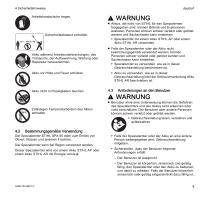
Arbeitshandschuhe tragen. Akku während Arbeitsunterbrechungen, des Transports, der Aufbewahrung, Wartung oder Reparatur herausnehmen. Akku vor Hitze und Feuer schützen. ■ Akkus, die nicht von STIHL für den Spezialernter freigegeben sind, können Brände und Explosionen auslösen. Personen können schwer verletzt oder getötet werden und Sachschaden kann entstehen. ► Spezialernter mit einem Akku STIHL AP oder einem Akku STIHL AR verwenden. ■ Falls der Spezialernter oder der Akku nicht bestimmungsgemäß verwendet werden, können Personen schwer verletzt oder getötet werden und Sachschaden kann entstehen....
Open the catalog to page 7
darf der Benutzer nur unter Aufsicht oder nach Anweisung durch eine verantwortliche Person damit arbeiten. – Der Benutzer kann die Gefahren des Spezialernters und des Akkus erkennen und einschätzen. ► Falls während der Arbeit Gegenstände herabfallen können: Einen Schutzhelm tragen. – Der Benutzer ist volljährig oder der Benutzer wird entsprechend nationaler Regelungen unter Aufsicht in einem Beruf ausgebildet. ■ Während der Arbeit kann Staub aufgewirbelt werden. Eingeatmeter Staub kann die Gesundheit schädigen und allergische Reaktionen auslösen. ► Eine Staubschutzmaske tragen. – Der Benutzer...
Open the catalog to page 8
4 Sicherheitshinweise ■ Elektrische Bauteiledes Spezialernters können Funken erzeugen. Funken können in leicht brennbarer oder explosiver Umgebung Brände und Explosionen auslösen. Personen können schwer verletzt oder getötet werden und Sachschaden kann entstehen. ► Nicht in einer leicht brennbaren und nicht in einer explosiven Umgebung arbeiten. 4.5.2 ■ Unbeteiligte Personen, Kinder und Tiere können die Gefahren des Akkus nicht erkennen und nicht einschätzen. Unbeteiligte Personen, Kinder und Tiere können schwer verletzt werden. ► Unbeteiligte Personen, Kinder und Tiere fernhalten. ► Akku nicht...
Open the catalog to page 9
deutsch ► Falls Unklarheiten bestehen: Einen STIHL Fachhändler aufsuchen. 4.6.2 Die Rechen ist im sicherheitsgerechten Zustand, falls folgende Bedingungen erfüllt sind: – Die Rechen und die Finger sind unbeschädigt. – Alle Finger sind angebaut. – Die Finger sind richtig angebaut. – Nur original STIHL Zubehör für diese Rechen ist angebaut. – Das Zubehör ist richtig angebaut. ■ In einem nicht sicherheitsgerechten Zustand können Bauteile nicht mehr richtig funktionieren und Sicherheitseinrichtungen außer Kraft gesetzt werden. Personen können schwer verletzt oder getötet werden. ► Mit unbeschädigten...
Open the catalog to page 10
■ Der Benutzer kann in bestimmten Situationen nicht mehr konzentriert arbeiten. Der Benutzer kann stolpern, fallen und schwer verletzt werden. ► Ruhig und überlegt arbeiten. ► Falls die Lichtverhältnisse und Sichtverhältnisse schlecht sind: Nicht mit dem Spezialernter arbeiten. ► Spezialernter alleine bedienen. ► Nicht über Schulterhöhe arbeiten. ► Auf Hindernisse achten. ► Auf dem Boden stehend arbeiten und das Gleichgewicht halten. Falls in der Höhe gearbeitet werden muss: Eine Hubarbeitsbühne oder ein sicheres Gerüst verwenden. ► Falls Ermüdungserscheinungen auftreten: Eine Arbeitspause einlegen....
Open the catalog to page 11All STIHL AG & Co. catalogs and technical brochures
 STIHL GHE 105
504 Pages
 STIHL HIGH-PRESSURE CLEANERS
4 Pages
 STIHL MSA 160 C, 200 C
596 Pages
 STIHL MSA 120 C, MSA 140 C
680 Pages
 STIHL HSA 25
144 Pages
 STIHL FSA 45
368 Pages
 STIHL MSA 160 T
2 Pages
 MS 193
4 Pages
 MS 201 C-M
8 Pages
 MS 241 C-M mit M-Tronic
6 Pages
 MS 261 C-M with M-Tronic
6 Pages
 MS 362 C-M
12 Pages
 HTA 85
13 Pages
 HS 82 R/T and HS 87 R
2 Pages
 HS 46, 46 C-E, 56 C-e
8 Pages
 STIHL cut-off saw TS 500i
12 Pages
 STIHL fuels and lubricants
7 Pages
 Axt Edition 1926
6 Pages
 VIKING 'Garden shredder
20 Pages
 VIKING 'Lawn care
20 Pages
 The new 7 series
4 Pages
 The high pressure cleaners
4 Pages
 Electric chain saws
8 Pages
 HSA 25 Flyer
2 Pages
 TSA 230 flyer
3 Pages
 BGA 100 flyer
32 Pages
 ASA 85 flyer
2 Pages
 cordless power system
32 Pages


- STIHL wood chipper
- STIHL lawn mower
- Groundcare sweeper
- Wood shredder with combustion engine
- Gasoline lawn mower
- Push lawn-mower
- Walk-behind tiller
- Backpack sprayer
- Small farm backpack sprayer
- Riding lawn mower
- Self-propelled lawn mower
- STIHL hedge trimmer
- STIHL brush cutter
- Pesticide backpack sprayer
- STIHL chainsaw
- Electric lawn mower
- Generator set
- Agricultural generator set
- Electric wood shredder
- Olive rake