
- Catalogs
- Sukup Mfg Co
- Fastir


Fastir

Fastir
The Fastir® system is designed to enhance grain drying efficiency by preventing overdrying, increasing airflow, and preserving grain quality. It utilizes stirring machines to mix grain layers, ensuring uniform moisture content and reducing static pressure.
Specifications and Features
- Stirring Mechanism: The system uses constant pitch augers to mix dry grain from the bottom with wetter grain at the top, achieving less than 1% moisture variation.
- Airflow Improvement: Stirring increases airflow by 33% when used with a powered spreader.
- Temperature and Humidity: For every 20°F temperature rise, relative humidity is halved, enhancing drying efficiency.
- Auger Design: Sukup augers are designed for even stirring, with heavy-duty gear motors and a patented mechanical reversing drive for reliability.
Performance and Cost Efficiency
- Drying Time and Costs: Stirring reduces drying time from 600 to 312 hours and cuts total drying costs significantly.
- Annual Savings: Using a stirring machine can save approximately $2813.89 annually.
Additional Features
- Auger Flexibility: Sukup offers kits for adding more augers to meet increased drying needs.
- Safety and Convenience: Includes a standard inside bin ladder and heavy-duty motors with thermal overload protection.
- Storage Capacity: Sukup track mounts allow for additional storage capacity in larger bins.
Recommendations
- Auger Recommendations: The number of augers varies based on bin diameter and drying system, with specific recommendations for natural air and plenum temperatures.
- Grain Types: Suitable for various grains including corn, beans, rice, and more.
Conclusion
The Fastir® system, with its innovative design and features, offers a comprehensive solution for efficient grain drying and storage, making it a valuable investment for both small and large-scale operations.
Catalog excerpts

Eliminate Overdried Grain. Increase Airflow. Preserve Grain Quality. While the most efficient way to dry grain is to add heat, you run the risk of overdrying the grain. A stirring machine is essential to prevent this. Stirring mixes the driest grain at the bottom of the bin with the wetter grain towards the top, resulting in more uniform moisture content. University tests show less than 1% variation from top to bottom in stirred grain. Stirring also loosens the grain, reducing static pressure and increasing airflow, so grain dries more quickly and efficiently. University tests show using a stirring...
Open the catalog to page 2
A one of a kind product leading the industry. With a patented mechanical reversing drive, the Sukup Fastir® makes other stirring machines with cable or chain drives obsolete. The Fastir® is the Ideal System for Large or Small Drying Operations. The patented, mechanical reversing drive on the Fastir® is the only one of its kind, making it the simplest and most dependable stirring machine on the market. This patented drive mechanism is operated by a single drive wheel. The movement of a lever by the reversing plates changes the angle of this drive wheel to move the carriage in and out on the crosstube....
Open the catalog to page 3
Fastir® Plus Stirs Along the Bin Wall The Sukup Fastir® Plus has all of the features of our standard Fastir®, like mechanical reversing and constant pitch down augers, plus we’ve added a stationary auger to stir along the bin wall. This stationary auger ensures complete stirring around the outside of the bin, where a large portion of the grain is located. Fastir Plus Down Auger Recommendations ® Drying, Storage, and Handling Solutions®: Our company has grown from the ground up to become the largest family- owned, full-line grain drying, storage and handling equipment manufacturer in the world....
Open the catalog to page 4All Sukup Mfg Co catalogs and technical brochures
 Spredway
2 Pages
 Material Handling AG SERIES
16 Pages
 Floors
4 Pages
 Fans and Heaters - Axial Fans
10 Pages
 Airways
2 Pages
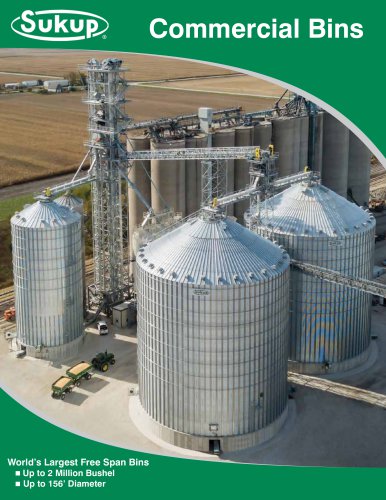 Commercial Bins
8 Pages
 Tower Dryers
6 Pages
 Mixed Flow GRAIN DRYER
6 Pages
 Grain Dryers
12 Pages
 Grain Bins
16 Pages
 SWEEPWAY
8 Pages
 Cyclone Pneumatic
1 Page
 Fans and Heaters
2 Pages
 Commercial Drag Conveyors
2 Pages
 QuadraTouch Pro Retrofit
2 Pages
 Cyclone Pneumatic System
4 Pages
 Commercial Sweep
2 Pages
 Chain Loop and Double-Run
4 Pages
 DriveOverHopper
4 Pages
 Tower Dryer
6 Pages
 Modular Tower Dryer
2 Pages
 Commercial Grain Bins
8 Pages
 Bucket Elevators
10 Pages
 Drive-Over Hopper
4 Pages


Archived catalogs
 Single To 3 Phase
1 Page
- Silo
- Grain conveyor
- Grain silo
- Metal silo
- Seed dryer
- Stationary dryer
- Screw conveyor
- Round silo
- Steel silo
- Bucket elevator
- Temperature monitoring system
- Real-time monitoring system
- Tower dryer
- Crop monitoring system
- Remote monitoring system
- Grain monitoring system
- Moisture monitoring system
- Agriculture monitoring system
- CO2 concentration monitoring system
- Air-assisted conveyor