
- Catálogos
- Hydro Fert
- Grow Quick


Grow Quick
1 /22Páginas
Grow Quick
1 /22Páginas
Excertos do catálogo

GROW QUICK Experimental Tests VEGETATIVE-REPRODUCTIVE BALANCE
Abrir o catálogo na página 1
CONCIME ORGANICO AZOTATO MISCELA Dl CONCIMI ORGANICI AZOTATIFLUIDA CONSENTITO IN AGRICOLTURA BIOLOGICA ORGANIC NITROGEN FERTILIZER FLUID MIX OF ORGANIC NITROGEN FERTILIZERS ALLOWED IN ORGANIC AGRICULTURE ENGRAIS ORGANIQUE AZOTE MELANGE FLUIDE D'ENGRAIS ORGANIQUES AZOTti ADMIS EN AGRICULTURE BIOLOGIQUE ABONO ORGANICO NITROGENADO „ MEZCLA FLUIDA DE ABONOS ORGANICOS NITRO Organic fertilizer based on amino acids, seaweeds (Ascophyllum nodosum), oligosaccharides, humic acids, betaines and enzymes. It can be applied on all crops in both foliar application and fertigation. - stronger root system and...
Abrir o catálogo na página 3
The importance of a good rooting Rooting is such an important topic not to be underestimated, whether it is concerned with a post-transplanting rooting of a horticultural crop or the vegetative regrowth of tree crops after winter break. A difficult root development leads to a general deterioration of plants, with a consequent occurrence of physiopathies not directly connected to nutritional deficiencies. Such phenomenon generally occurs on crops freshly transplanted and it’s classified as “post-transplanting stress”. In order to avoid the above-mentioned conditions, we should use some specific fertilizers...
Abrir o catálogo na página 4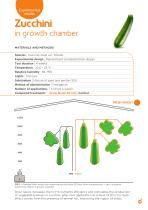
Species Cucumis melo var. Ortano Compared treatments Grow Quick 20 l/ha; Control FIG 1 - Average fresh weight per experimental plot after 30 days from transplanting, in two compared treatments. Plants in growth chamber. Grow Quick increases the N-P-K nutrients efficiency and stimulates the production of vegetable biomass in zucchini, after root application at a dose of 20 l/ ha. Such effect comes from the presence of animal AA, improving the vigour of crops.
Abrir o catálogo na página 5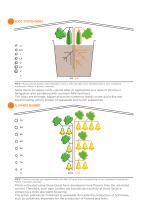
ROOT SYSTEM INDEX 0 0,5 1 1,5 2 2,5 3 n 2,6 2,9 FIG 2 - Root volume quality index between 1 and 4, after 30 days from transplanting in two compared treatments. Plants in growth chamber. Grow Quick increases roots volume after its application at a dose of 20 l/ha in fertigation, also combined with common NPK fertilizers. The roots are stronger, bigger and more numerous thanks to the auxin-like and biostimulating action, proper of seaweeds and humic substances. FLOWERS NUMBER FIG 3 - Flowers number per experimental plot after 30 days from transplanting in two compared treatments. Plants in growth...
Abrir o catálogo na página 6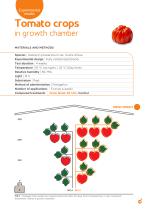
Experimental results Tomato crops in growth chamber MATERIALS AND METHODS Species Solanum lycopersicum var. Cuore di bue Experimental design Fully randomized blocks Test duration 4 weeks Temperature 19 °C (at night) / 23 °C (Day time) Relative humidity 65-75% Light 14 h Substratum Peat Method of administration Fertigation Number of applications Compared treatments 3 (once a week) Grow Quick 20 l/ha; Control FRESH WEIGHT FIG 1 - Average fresh weight per experimental plot after 30 days from transplanting, in two compared treatments. Plants in growth chamber. 05
Abrir o catálogo na página 7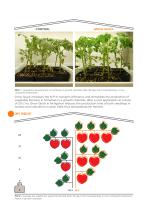
GROW QUICK IMG 1 - Vegetative development of tomatoes in growth chamber after 30 days from transplanting, in two compared treatments. Grow Quick increases the N-P-K nutrients efficiency and stimulates the production of vegetable biomass in tomatoes in a growth chamber, after a root application at a dose of 20 l/ ha. Grow Quick in fertigation reduces the production time of both seedlings in nursery and cultivation in open field, thus anticipating the harvest. DRY WEIGHT FIG 2 - Average dry weight per experimental plot after 30 days from transplanting, in two compared treatments. Plants in growth...
Abrir o catálogo na página 8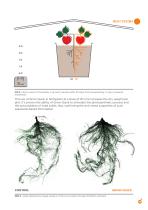
ROOT SYSTEM FIG 3 - Root volume of tomatoes in growth chamber after 30 days from transplanting, in two compared treatments. The use of Grow Quick in fertigation at a dose of 20 l/ha increases the dry weight per plot. It’s proven the ability of Grow Quick to stimulate the photosynthetic process and the accumulation of total solids, thus confirming the anti-stress properties of such seaweeds-based formulation. GROW QUICK IMG 2 - Data obtained by image analysis of the root system through WinRhizo software 0
Abrir o catálogo na página 9
Experimental results Tomato crops in open fields MATERIALS AND METHODS Species Solanum lycopersicum var. HEINZ 1538 Experimental design Fully randomized blocks Test duration 14 weeks (transplanting 13/05/2019 - Test conclusion 23/08/19) Temperature According to the climate trend in the countryside of Trinitapoli (Italy) Relative humidity According to the climate trend in the countryside of Trinitapoli (Italy) Light Typical of the trial period Substratum Sandy and loamy soil Method of administration Fertigation Number of applications Compared treatments 3 (flowering, fruit setting, fruit growth)...
Abrir o catálogo na página 10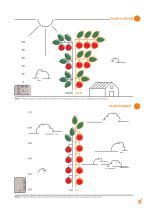
.PLANTS VIGOUR FIG 1 - Plants vigour index after 8 weeks from transplanting, in two compared treatments. PLANTS HEIGHT FIG 2 - Plants height after 8 weeks from transplanting, in two compared treatments.
Abrir o catálogo na página 11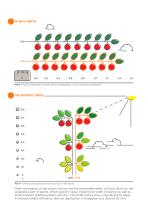
PLANTS WIDTH FIG 3 - Plants width after 8 weeks from transplanting, in two compared treatments. CHLOROPHYLL INDEX FIG 4 - SPAD index (photosynthetic activity of the plant) After the analysis of the results, we can see the remarkable effect of Grow Quick on the vegetative part of plants, affecting both vigour (height and width of plants) as well as biostimulation (photosynthetic activity). The SPAD values show a significant increase in photosynthetic efficiency, after an application in fertigation at a dose of 20 l/h
Abrir o catálogo na página 12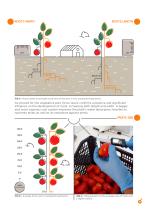
ROOTS WIDTH ROOTS LENGTH FIG 5 - Roots width and length at the end of the test, in two compared treatments. As proved for the vegetative part, Grow Quick confirms a positive and significant influence on the development of roots, increasing both length and width. A bigger and more vigorous root system improves the plant’s water absorption, besides its nutrients levels as well as its resistance against stress. FRUITS SIZE FIG 6 - Average fruits size in compared treatments. IMG 2 - Measurement of the average size of fruits with a digital calib
Abrir o catálogo na página 13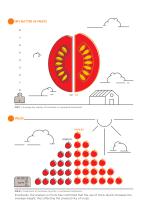
DRY MATTER OF FRUITS 8 7 6 5 4 3 2 1 0 7,2 7,5 g FIG 7 - Average dry matter of tomatoes in compared treatments. FIG 8 - Production of tomatoes (kg/ha) in compared treatments. Eventually, the analysis on fruits has confirmed that the use of Grow Quick increases the average weight, thus affecting the productivity of crops.
Abrir o catálogo na página 14Todos os catálogos e folhetos técnicos Hydro Fert
 Top Humic
1 Página
 Hydro Acid pH
1 Página
 Protev
1 Página
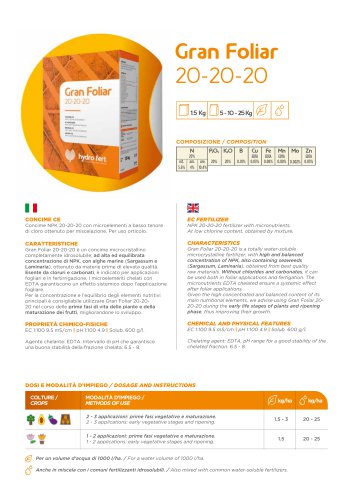 Gran-Foliar
1 Página
 ROOT GUARD
10 Páginas
 Vigor L
20 Páginas
 NEEM CARE FL
11 Páginas
 HYDRO HUMIC 16
14 Páginas
 Hydro Gold Veg
16 Páginas
 Hydro Gold Super
12 Páginas
 Hydroalga
12 Páginas
 Dynamic
16 Páginas
 Bialga15
10 Páginas
 Activeg
12 Páginas
 Hydrofert
120 Páginas
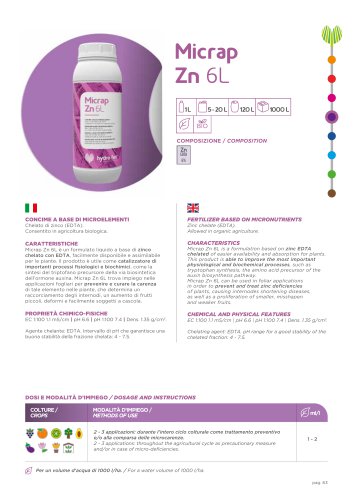 Micrap Zn 6L
1 Página
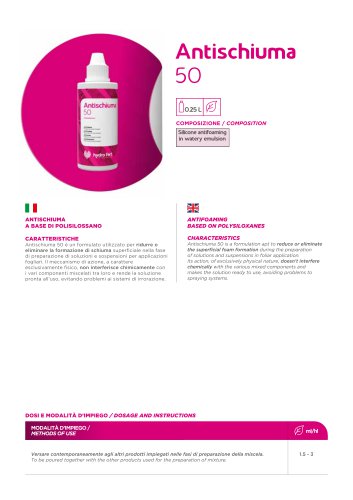 Antischiuma 50
1 Página
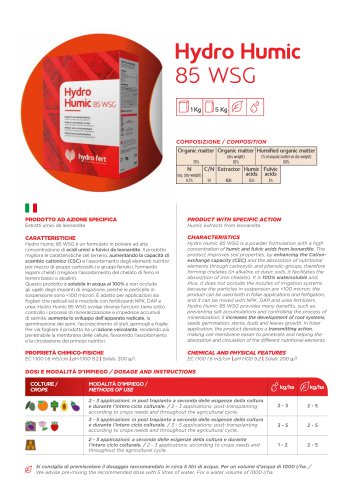 Hydro Humic 85 WSG
1 Página
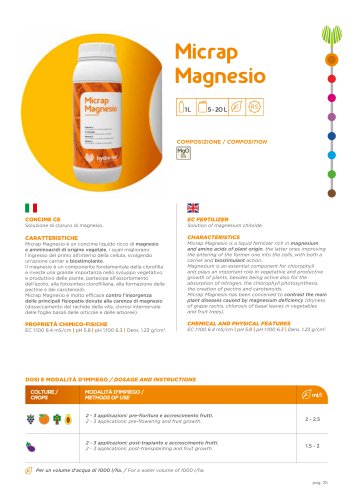 Micrap Magnesio
1 Página
- Fertilizante
- Fertilizante mineral
- Fertilizante granulado
- Fertilizante líquido
- Fertilizante com oligoelementos
- Fertilizante orgânico
- Fertilizante solúvel
- Fertilizante para fruta
- Fertilizante NPK
- Fertilizante para adubação foliar
- Fertilizante para fertirrigação
- Fertilizante para correção de deficiências nutricionais
- Bioestimulante
- Fertilizante nitrogenado
- Fertilizante potássico
- Bioestimulante líquido
- Fertilizante biológico
- Fertilizante rico em magnésio
- Fertilizante para raízes
- Fertilizante para gramado